

Introduction
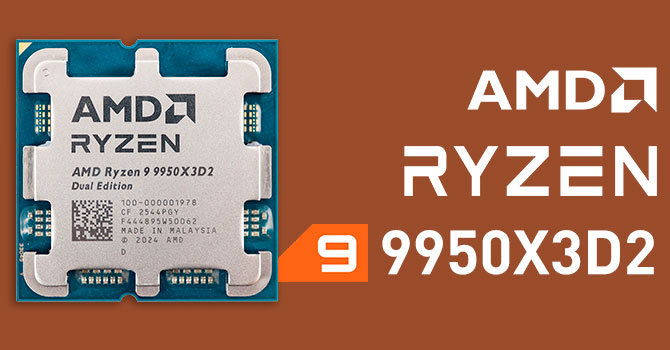
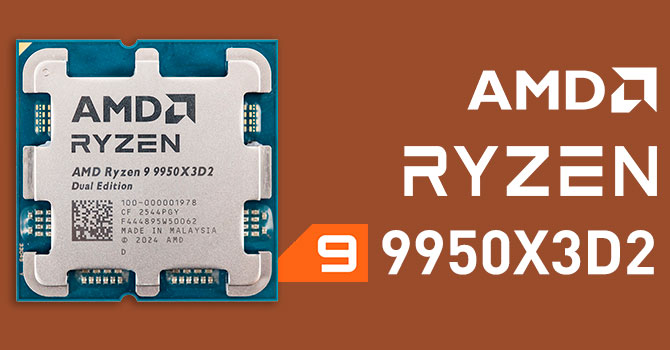
The AMD Ryzen 9 9950X3D2 Dual Edition is the company’s AM5 desktop processor, and the first X3D chip to feature 3D V-Cache on both CCDs. Where the original Ryzen 9 9950X3D and 7950X3D had cache on only one of their two chiplets, the 9950X3D2 removes that asymmetry, giving each CCD its own 96 MB L3 cache. This is a significant evolution that not only increases game performance across all cores, but also promises to eliminate the software-level programming complexity that has plagued dual-CCD X3D processors since the Ryzen 9 7950X3D. The “Dual Edition” brand indicates the dual configuration of the 3D V-Cache. 16-core/32-thread processor with 192 MB of L3 cache—96 MB per CCD (32 MB on-die + 64 MB stacked). The 9950X3D2 offers a base clock speed of 4.30 GHz with up to 5.60 GHz boost, and comes with a TDP of 200 W. The default socket power limit (PPT) is 270 W, up from 200 W on the 9950X3D, with high current limits to match 10 (EDC 50), A08 TDC 2). AMD recommends 360 mm of liquid cooling for this chip, compared to 240-280 mm for the 9950X3D.
The 9950X3D2 is based on the same Granite Ridge platform as the rest of the Ryzen 9000 series, with two 8-core Zen 5 chiplets on a 4 nm TSMC N4P die, paired with a 6 nm I/O die. The main difference is that both CCDs now have 3D V-Cache, so there is no more “fast CCD” and “slow CCD” to play. The AMD chipset driver still uses the Game Bar to park the CCD1 cores during gameplay, but does it really matter? We examine this specifically in this review.
3D V-Cache technology has been AMD’s most influential innovation in recent times, establishing the company as the maker of the fastest processors in the PC gaming world for several years running. The Ryzen 7 5800X3D matched the gaming performance of the Intel Core i9-12900K despite being based on an older Zen 3 architecture with slower DDR4 memory. The Ryzen 7 7800X3D dominated gaming over Intel’s 13th and 14th Gen Raptor Lake. The 9800X3D and 9850X3D extended that lead with Zen 5 and an inverted die stack that enabled overclocking on X3D processors for the first time. The original 9950X3D brought 3D V-Cache to the 16-core dual-CCD component, but only one CCD had additional cache, which required Game Bar integration for proper threading. Now, the 9950X3D2 takes the concept to its logical conclusion: high cores, high cache, no compromise.
With Zen 5, AMD has changed the way the CCD and 3D V-Cache die (L3D) are stacked. In older X3D processors, the L3D was overlaid on top of the CCD, with structural silicon conducting heat from the CPU cores through the stack. With the Zen 5, the CCD sits on top, with the L3D below it, connected via silicon vias (TSVs). This means that the CPU cores dissipate heat directly from the cooling solution over STIM, without structural silicon in the way, allowing the same thermal and overclocking characteristics as non-X3D models. Previously, dual 3D V-Cache was exclusive to AMD’s server-grade EPYC processors. The 9950X3D2 brings this technology to the consumer desktop for the first time.
The AMD Zen 5 microarchitecture features a complete reworking of almost all key components compared to Zen 4, with a special focus on the ability to compute numbers. Core comes with a true 512-bit floating-point data path to efficiently run 512-bit SIMD workloads using instruction sets such as AVX-512, VNNI, etc.; compared to Zen 4, which uses a double-pumped 256-bit data path to implement these rulesets.
AMD is pricing the Ryzen 9 9950X3D2 Dual Edition at $900, making it the best consumer desktop processor on the market. In return, you get the fastest application performance, combined with best-in-class game performance across all cores without compromising programming. The 9950X3D2 is compatible with all Socket AM5 motherboards; Support on AMD 600-series chipset motherboards requires a BIOS update, while AMD 800-series chipset motherboards are compatible with the latest BIOS.
| Price | cores / Threads |
The foundation A clock |
Size. Improve |
L3 A repository |
TDP | Buildings | The process | A socket | |
|---|---|---|---|---|---|---|---|---|---|
| Intel Core i5 | |||||||||
| Core i5-12400F | $110 | 6/12 | 2.5 GHz | 4.4 GHz | 18 MB | 65 w | Alder Lake | 10 nm | LGA 1700 |
| Core i5-13400F | $170 | 6+4/16 | 2.5/1.8 GHz | 4.6/3.3 GHz | 20 MB | 65 w | Raptor Lake | 10 nm | LGA 1700 |
| Core i5-12600K | $170 | 6+4/16 | 3.7/2.8 GHz | 4.9/3.6 GHz | 20 MB | 125W | Alder Lake | 10 nm | LGA 1700 |
| Core i5-13600K | $225 | 6+8/20 | 3.5/2.6 GHz | 5.1/3.9 GHz | 24 MB | 125W | Raptor Lake | 10 nm | LGA 1700 |
| Core i5-14600K | $260 | 6+8/20 | 3.5/2.6 GHz | 5.3/4.0 GHz | 24 MB | 125W | Raptor Lake | 10 nm | LGA 1700 |
| Intel Core Ultra 5 | |||||||||
| Core Ultra 5 245K | $310 | 6+8/14 | 4.2/3.6 GHz | 5.2/4.6 GHz | 24 MB | 159 W | Arrow Lake | 3 nm | LGA 1851 |
| AMD Ryzen 5 | |||||||||
| Ryzen 5 8500G | $150 | 6/12 | 3.5 GHz | 5.0 GHz | 16 MB | 65 w | Phoenix 2 | 4 nm | AM5 |
| Ryzen 5 5600X | $135 | 6/12 | 3.7 GHz | 4.6 GHz | 32 MB | 65 w | Zen 3 | 7 nm | AM4 |
| Ryzen 5 7600 | $185 | 6/12 | 3.8 GHz | 5.1 GHz | 32 MB | 65 w | Zen 4 | 5 nm | AM5 |
| Ryzen 5 7600X | $210 | 6/12 | 4.7 GHz | 5.3 GHz | 32 MB | 105 W | Zen 4 | 5 nm | AM5 |
| Ryzen 5 9600X | $185 | 6/12 | 3.9 GHz | 5.4 GHz | 32 MB | 65 w | Zen 5 | 4 nm | AM5 |
| Intel Core i7 | |||||||||
| Core i7-12700K | $210 | 8+4/20 | 3.6/2.7 GHz | 5.0/3.8 GHz | 25 MB | 125W | Alder Lake | 10 nm | LGA 1700 |
| Core i7-13700K | $280 | 8+8/24 | 3.4/2.5 GHz | 5.4/4.2 GHz | 30 MB | 125W | Raptor Lake | 10 nm | LGA 1700 |
| Core i7-14700K | $355 | 8+12/28 | 3.4/2.5 GHz | 5.6/4.3 GHz | 33 MB | 125W | Raptor Lake | 10 nm | LGA 1700 |
| Intel Core Ultra 7 | |||||||||
| Core Ultra 7 265K | $290 | 8+12/20 | 3.9/3.3 GHz | 5.5/4.6 GHz | 30 MB | 250 W | Arrow Lake | 3 nm | LGA 1851 |
| Core Ultra 7 270K Plus | $300 | 8+16/24 | 3.7/3.2 GHz | 5.5/4.7 GHz | 36 MB | 250 W | Arrow Lake Plus | 3 nm | LGA 1851 |
| AMD Ryzen 7 | |||||||||
| Ryzen 7 5700G | $165 | 8/16 | 3.8 GHz | 4.6 GHz | 16 MB | 65 w | Zen 3 + Vega | 7 nm | AM4 |
| Ryzen 7 5700X | $160 | 8/16 | 3.4 GHz | 4.6 GHz | 32 MB | 65 w | Zen 3 | 7 nm | AM4 |
| Ryzen 7 7700 | $280 | 8/16 | 3.8 GHz | 5.3 GHz | 32 MB | 65 w | Zen 4 | 5 nm | AM5 |
| Ryzen 7 7700X | $275 | 8/16 | 4.5 GHz | 5.4 GHz | 32 MB | 105 W | Zen 4 | 5 nm | AM5 |
| Ryzen 7 9700X | $305 | 8/16 | 3.8 GHz | 5.5 GHz | 32 MB | 65 w | Zen 5 | 4 nm | AM5 |
| Ryzen 7 5800X | $165 | 8/16 | 3.8 GHz | 4.7 GHz | 32 MB | 105 W | Zen 3 | 7 nm | AM4 |
| Ryzen 7 5800X3D | $340 | 8/16 | 3.4 GHz | 4.5 GHz | 96MB | 105 W | Zen 3 | 7 nm | AM4 |
| Ryzen 7 7800X3D | $375 | 8/16 | 4.2 GHz | 5.0 GHz | 96MB | 120 W | Zen 4 | 5 nm | AM5 |
| Ryzen 7 9800X3D | $450 | 8/16 | 4.7 GHz | 5.2 GHz | 96MB | 120 W | Zen 5 | 4 nm | AM5 |
| Ryzen 7 9850X3D | $500 | 8/16 | 4.7 GHz | 5.6 GHz | 96MB | 120 W | Zen 5 | 4 nm | AM5 |
| Intel Core i9 | |||||||||
| Core i9-12900K | $280 | 8+8/24 | 3.2/2.4 GHz | 5.2/3.9 GHz | 30 MB | 125W | Alder Lake | 10 nm | LGA 1700 |
| Core i9-13900K | $415 | 8+16/32 | 3.0/2.2 GHz | 5.8/4.3 GHz | 36 MB | 125W | Raptor Lake | 10 nm | LGA 1700 |
| Core i9-14900K | $460 | 8+16/32 | 3.2/2.4 GHz | 6.0/4.4 GHz | 36 MB | 125W | Raptor Lake | 10 nm | LGA 1700 |
| Intel Core Ultra 9 | |||||||||
| Core Ultra 9 285K | $570 | 8+16/24 | 3.7/3.2 GHz | 5.7/4.6 GHz | 36 MB | 250 W | Arrow Lake | 3 nm | LGA 1851 |
| AMD Ryzen 9 | |||||||||
| Ryzen 9 5900X | $265 | 12/24 | 3.7 GHz | 4.8 GHz | 64 MB | 105 W | Zen 3 | 7 nm | AM4 |
| Ryzen 9 7900 | $370 | 12/24 | 3.7 GHz | 5.4 GHz | 64 MB | 65 w | Zen 4 | 5 nm | AM5 |
| Ryzen 9 7900X | $400 | 12/24 | 4.7 GHz | 5.6 GHz | 64 MB | 170 W | Zen 4 | 5 nm | AM5 |
| Ryzen 9 7900X3D | $580 | 12/24 | 4.4 GHz | 5.6 GHz | 128 MB | 120 W | Zen 4 | 5 nm | AM5 |
| Ryzen 9 9900X | $430 | 12/24 | 4.4 GHz | 5.6 GHz | 64 MB | 120 W | Zen 5 | 4 nm | AM5 |
| Ryzen 9 5950X | $345 | 16/32 | 3.4 GHz | 4.9 GHz | 64 MB | 105 W | Zen 3 | 7 nm | AM4 |
| Ryzen 9 7950X | $660 | 16/32 | 4.5 GHz | 5.7 GHz | 64 MB | 170 W | Zen 4 | 5 nm | AM5 |
| Ryzen 9 7950X3D | $550 | 16/32 | 4.2 GHz | 5.7 GHz | 128 MB | 120 W | Zen 4 | 5 nm | AM5 |
| Ryzen 9 9950X | $490 | 16/32 | 4.3 GHz | 5.7 GHz | 64 MB | 170 W | Zen 5 | 4 nm | AM5 |
| Ryzen 9 9950X3D | $645 | 16/32 | 4.3 GHz | 5.7 GHz | 128 MB | 170 W | Zen 5 | 4 nm | AM5 |
| Ryzen 9 9950X3D2 | $900 | 16/32 | 4.3 GHz | 5.6 GHz | 192 MB | 200 W | Zen 5 | 4 nm | AM5 |