

I remember when ZERO 1 was first launched, Avantgarde President Holger Fromme and Overseas Sales Representative David Browne, who had not visited Taiwan in many years, came to Taiwan in March for a two-day launch event to show their commitment to the product. After the launch event, I had the opportunity to chat with Holger. He pointed out that ZERO 1 is the flagship and innovative product of Avantgarde.
Since its release, it has received a remarkable response from the market and its sales have been incredibly strong, proving that the market desires products like the ZERO 1: simple, modern, simple, and capable of delivering excellent sound.
The ZERO 1 is currently available in black and white. The reason it cannot offer the same level of custom color options as other Avantgarde models is that the cabinet material is a completely new development, made of special Polyurethane. The version that arrived in the HiFiReport listening room is the white one.

The ZERO 1 has built-in amplifiers and DACs, so everything you need to prepare a digital source. Because it has integrated amplification, it is an active speaker design, requiring a power cord for each speaker. If this is planned during the interior design, the power cables can be completely hidden (the test listening room did not pre-plan the power outlets at the ground level, so the power cables are visible).

In addition, the ZERO 1 uses wireless transmission between the left and right speakers, eliminating the need for speaker cables, which is very aesthetically pleasing. The ZERO 1 also has reserved wired network ports; if the wireless connection is subject to environmental interference, users can connect to the left and right channels through network cables.

The ZERO 1 is considered a mid-sized floor-standing speaker, featuring a large 300mm bass driver and horn-loaded mid- and high-range drivers.

Removing the grille from the bass driver makes the sound clearer, but has little effect on taste. In fact, the sound with the grille is already at a high level, and the impact is insignificant. Above the bottom logo is a power indicator light.

On the back panel, you can see the horn compression driver sticking out at the top, with the power and digital inputs located below.

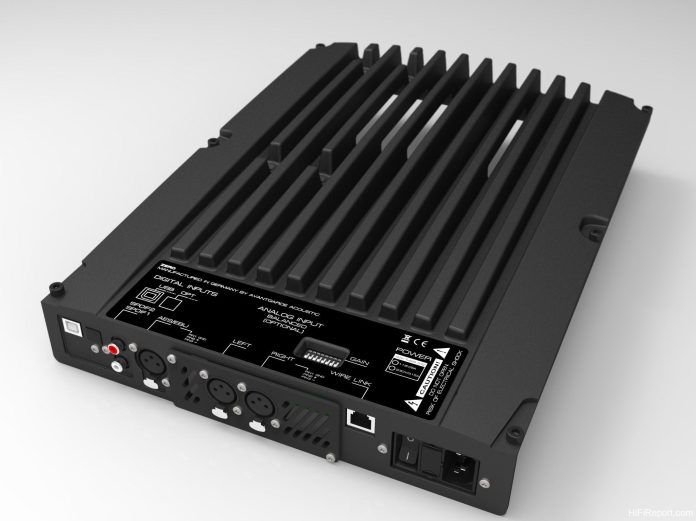
After removing the back panel, you can see the amplifier’s heat sink and signs for the digital input ports, including USB, optical, two coaxial inputs, and one AES/EBU.

Analog input is optional. There are also pins to adjust the bass gain of +/- 4dB. Note that the network port is not broadcast; as mentioned before, for connecting the left and right speakers if needed. Of course, using built-in wireless is still the most convenient and aesthetically pleasing option.

The remote control is a very familiar Avantgarde style, also used with XA amplifiers. However, for convenience, the ZERO 1 also comes with another remote control, pictures of which will be added later.

[Image: Exploded diagram of ZERO 1 PRO]

[Image: Internal amplifier module of ZERO 1 PRO]
Products that use antennas for speaker drivers are actually not that common. ZERO 1 PRO comes from Avantgarde, the use of horns is not surprising in nature. However, since it’s been a while since I last listened to Uno Fino, I was still inspired by the direct, high-quality, and very transparent aspects of the horns.
Currently, the low frequency setting is in the normal 0 position, and the overall frequency range already sounds balanced, it seems that it does not need to be adjusted. This may also be the first time a listening room has tested such a large pair of active speakers. Without the function of matching the amplifier, things become very simple.
Initially, I was using the MAC USB input on the ZERO 1 PRO. Now, I’ve switched to using the LUMIN digital output on the ZERO 1 PRO. The built-in amplifier is very powerful, and the control of the bass driver is excellent. After getting used to it over the past few days, I may have to start working on the correct toe angle. The overall sound has a very nice and natural dispersion.
What’s Different in the PRO Version?
There are two versions of ZERO 1: the PRO version reviewed here, and another version that can be called the standard version. Outside, there is no difference between the two. The difference is in the digital processing delay in the internal firmware. The standard version has a delay setting of about 30ms to synchronize the sound and pictures of the TV. The PRO version is set to 220ms.
Because the processing time is longer, the sound is also more accurate, but you may have lip sync problems when used with a TV. When you buy the PRO version, in addition to the basic black remote control, you also get a high-quality Avantgarde cylindrical metal remote control. If needed, you can have it set to the regular version for free in the future, but changing the regular version to the PRO version will incur a charge. This difference is also reflected in the purchase price of these two versions.
[Image: PRO version remote control]
Both the standard and PRO versions come with a basic remote control, which includes input source selection.
Playing “Diva Dance”, the Zero 1 Pro has a lot of power to release the sound pressure – which is really fun.
The Zero 1 Pro adopts a functional design with a powerful built-in amplifier. The mid-high speakers are driven by 50W each, and the 12-inch bass driver by 400W. Full dynamic range easily reaches 100dB without distortion, and control and speed remain excellent. If it were a passive speaker, one would have no idea how much power they would need in a power amplifier to achieve this level of performance. Listening to it is very satisfying.
Maybe because the dynamic volume was too high, while I was enjoying it, a neighbor came knocking on XD’s door. Moving on to the low-end vocal pieces, the Zero 1 Pro’s mid- and high-frequency horn drivers perform very well, with excellent clarity and detail. Because of this feature, even Avantgarde moving speakers often use fixed bass designs, making it easier to achieve a consistent speed across the frequency range.
Horn alignment is very sensitive to placement, so it is necessary to spend some time paying attention to the position and toe-in. If properly adjusted, it will have a more accurate image and sound stage than standard speakers. The free, transparent, and airy tone of the horns is also a characteristic that traditional dome tweeters struggle to match.
With full bandwidth and excellent control, playing a variety of music naturally produces consistent high-quality performance. The transition to the orchestral music, the scene and the rhythm are very structured and well planned. The extension and detail of the violins are naturally expressed, achieving not only sonic beauty but also musicality.
Next, listening to “” [Wheatfield Song]this is a recording of a lawyer made in a church. The voice of the choir naturally blends with the harmony of the church, creating a great sense of space. I think the size of the Zero 1 Pro is perfect for the HiFiReport listening room. The sense of space and scale of the church is correct, with excellent depth and layering. The Zero 1 Pro sound stage control is very precise, placed behind the speakers.
Another recently discovered high-quality audiophile jazz recording, recorded live at a well-known jazz bar. The texture of each instrument is excellent – piano, saxophone, bass – creating an independent but harmonious combination. Rich bar jazz music, along with cheers and applause from the live audience, adds to the lively stage atmosphere.
The Zero 1 Pro is also very capable, and all aspects are very balanced, without any unnecessary sounds appearing, which makes it very pleasant to listen to.
Thanks to the efficient and high-quality design, even at low volumes, it can easily present the necessary details and sound stage.
Let’s listen to Tsai Chin’s words. The necessary richness and charm are still there, and the fear that Tsai Chin’s mouth is getting too big is completely unfounded.
Even at low volumes, every detail and sound stage can be heard.
Full report (HiFiReport e-Magazine Issue 12)
* Details:
* Speaker type: Active, mid-range horn loaded, bass-reflex
* High/Mid Drivers: Horn, 50W amplification each
* Low Driver: 12-inch, 400W amplification
* Digital Inputs: USB, Optical, 2 x Coaxial, AES/EBU
* Analog Input: Optional
* Latency (Standard Version): 30ms
* Latency (PRO Version): 220ms
* Remotes: Basic (Standard and PRO), Advanced Metal (PRO only)