The Rise of Quantum Computing: Opportunities and Threats
Quantum physics has long been a staple of science fiction: That elusive, futuristic technology that allows for a kind of scientific magic that can do anything. Just think of the various Star Trek captains using quantum tunneling and entanglement to teleport to strange new worlds, or interstellar communications, and the theoretical underpinnings of faster-than-light warp drives.
Sure, in television, books and cinema, quantum computing has been portrayed as a mysteriously powerful technology, but by 2025, it’s at our doorstep. New developments, such as the UK’s most powerful supercomputer, Isambard-AI, are coming online, highlighting the speed at which technology is advancing.
As for the cosmic future we’ve seen on TV, it’s less than a decade away, perhaps not with warp drives (yet), but with real-world implications that might feel lifted from a Gene Roddenberry classic.
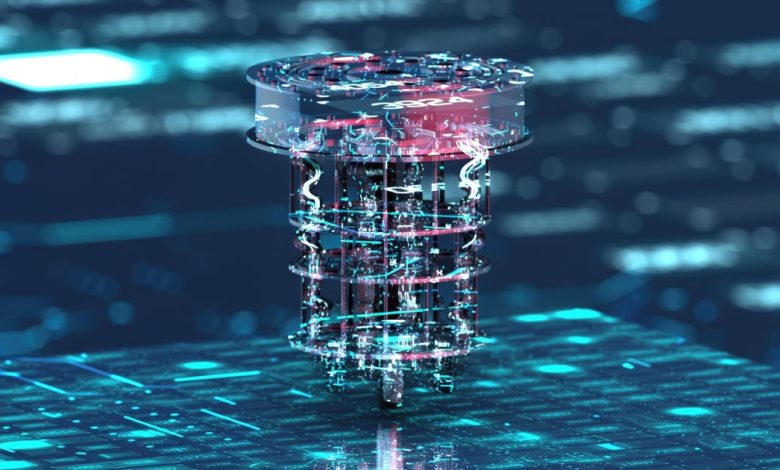
What exactly is quantum computing? It all comes down to bits, the smallest unit of data in a computer. A bit can have two values: Off (0) or On (1). In a classical computer, bits are processed sequentially. In quantum computing, simultaneous bits can be 0, 1, or both. This allows quantum computers to explore multiple possibilities simultaneously, thanks to superposition and entanglement. It’s like this: A classic computer is like reading every book in the library one at a time; quantum computing is like reading every book in the library at once.
It is estimated that quantum computers can solve some problems until 100 million times faster than old computers. For example, even back in 2019, Google Sycamore quantum processor solved a complex problem in 200 seconds that would have taken the world’s fastest supercomputer 10,000 years to complete.
Now that’s science fiction – but what it allows is absolutely fascinating.
The New Frontier of Cybersecurity
The applications of quantum computing are impressive, to say the least. They range from simulating molecules and chemical compounds with atomic precision, enabling faster and more efficient drug discovery, to discovering new battery chemistries for electric vehicles and renewable energy storage. Where a classical computer can use numbers to model a storm’s path, a quantum computer can create a virtual storm, down to the very atom.
This range of possibilities makes quantum computing a threat to the current cybersecurity landscape. For example, quantum algorithms can solve the types of problems described above in a short time, so if that power were converted to encryption, even the strongest security measures today could be cracked in hours or minutes. That is very dangerous Gartner predicts that, by 2026, 20% of organizations will plan to set and provide a fixed budget quantum related threats.
Brutal players are already preparing for its arrival, welcome “harvest now, harvest later” method: stealing encrypted data today that can be cracked in three, five or 10 years, when quantum machines become accessible.
Case in point: The UK’s National Cyber Security Center (NCSC) has released many warnings for organizations to prepare their systems against quantum-enabled attacks in 2035, as breakthroughs in supercomputers threaten to improve digital encryption. Every development brings us closer to a time when years – or decades – of secrets and confidential data can be decrypted, periodically, by malicious actors.
Quantum Countdown
This year, quantum computing has moved from the experimental stage to an early practical application. Major players such as IBM, Google and Microsoft have all published ambitious roadmaps for practical quantum computing. As it is, we are currently in the “pre-quantum era,” where commercial and affordable quantum computing does not yet exist or is limited to big players like IBM and Amazon, who are already hiring for quantum computing.
Each year from now on will bring important quantum measurements, but IBM suggests that it is 2033 when we will unlock the full potential of quantum computing at scale and enable mainstream applications in security, chemistry, machine learning, and optimization. In accordance with McKinseyInnovations using quantum computing could generate $97 billion in revenue worldwide by 2035.
So that’s where we are now, and although it’s hard to prove, the consensus is that bad actors and nation states are probably not too far from achieving quantum computing. In the meantime, while time is on our side, organizations should start looking at both AI and quantum technology trends, as the two are increasingly interconnected.
Preparing for the ‘Quantum Moment’
It is important to note that these timelines are subject to change at any time.
Advances in AI could bring practical quantum computing much faster than hyperscale expectations. Because quantum computers are incredibly sensitive to noise, unreliability, and hardware imperfections — all of which lead to error rates, that is, the chance that the operation of a qubit or gate gives the wrong result — introducing AI into the mix can quickly remove those errors, opening the floodgates to quantum computing.
That’s why businesses should prepare for the ‘Quantum Era’ now by establishing a Post-Quantum Cryptography (PQC) integration plan. Simply put, PQC is cryptographic cybersecurity that protects classical computers from attacks from quantum computers.
Wait a minute – what is a Quantum Moment, exactly? It’s a public event where a malicious actor uses a quantum computer for the first time to break encrypted data. It’s a time that will send the business landscape into chaos, and when every CEO will turn to their CISO and ask: How prepared are we? What do we have in place?
If you think the war for IT talent is tough now, imagine what it will be like when every company in the world is looking for a small pool of quantum experts. The Quantum Moment will be short – but the time it takes to implement the right PQC solution will be highly dependent on the company’s leverage and available capital.
Combating Quantum Threats
At the very least, a PQC plan should begin by estimating when your organization will need quantum-resistant encryption to protect critical data. Ask yourself: How long do your brand secrets need to stay secret? Then estimate when quantum cryptanalysis might work and subtract that from the lifetime of those secrets. The result gives you a deadline for quantum-resistant encryption.
Set up checkpoints at the board and C-suite level to ensure your business stays on track.
Your plan should include the preparation and implementation of that plan, including deployment to business areas, starting with those most critical to security. US Department of Commerce National Institute of Standards and Technology (NIST) provides practical guidance, including three publicly available encryption algorithms that indigenous organizations can adopt when quantum computers become a real threat.
IT teams must also consider ownership implications. Take digital signatures, for example: Most authentication and authorization protocols rely on encryption to sign assertions and tokens to prove authenticity. If compromised, this encryption can open the door to malicious attacks and unauthorized access. Identity practitioners need to assess potential worst-case scenarios to understand and prepare for these emerging attacks.
Although post-quantum cryptography may not be fully realized yet, the cryptography market is expected to grow at around 37-38% from 2025 to 2030. According to Grandview Research, the market could reach $7.82 billion in 2030, and in 2034, estimates suggest it could reach $30 billion.
That tells us all we need to know about the journey and why it doesn’t take a quantum leap to understand that the time to prepare is now.