Fosi Audio V3 Review – HiFiReport
Overview
The Fosi Audio V3 is a budget-friendly 2-channel stereo power amplifier that became one of the most talked-about audio products in the enthusiast community the year it launched — and the excitement was earned. In a category full of amplifiers that make inflated promises and deliver mediocre results, the V3 arrived with independently verified measurements that placed it ahead of competitors costing two, three, and four times as much. With a SINAD of 88 dB and SNR of at least 110 dB, a distortion figure of ≤ 0.003%, audiophile-grade internal components, and a chassis design that manages heat without a fan, the V3 made a compelling argument that serious hi-fi performance no longer requires serious expenditure.
The compact amplifier segment had been slowly maturing for several years before the V3 arrived, with Texas Instruments’ TPA3255 chip enabling performance levels that were previously unreachable from devices this small. What Fosi did differently with the V3 was not the chip choice — several competitors use the same TPA3255 — but the circuit implementation around it. By pairing the chip with a carefully curated collection of premium-grade Japanese and German passive components, using a full-body heatsink that turns the entire chassis into a cooling surface, and tuning the gain structure to optimize measured performance rather than maximizing raw power output, the V3 achieved a SINAD score that specialists at Audio Science Review described as genuinely impressive for this price tier.
With over 5,700 verified customer ratings and a 4.4 out of 5 average on Amazon, the V3 has sustained its community reputation across multiple years and thousands of real-world listening setups. It has been reviewed by specialists in multiple countries, compared against everything from vintage receivers to much more expensive Class A/B designs, and consistently praised as a product that delivers sound quality well above what its appearance and price tag suggest. That consistency of positive reception, across reviewers with very different reference systems and listening preferences, is one of the strongest endorsements an amplifier can receive.
This review covers the V3’s key technology in plain language, explains the important distinction between its maximum power claims and its real-world performance, addresses both its sonic strengths and its honest limitations, and helps you decide whether it belongs in your system.
Key Features & Tech Specs Explained
TPA3255 + Premium Components: When the Chip Is Just the Starting Point
The Texas Instruments TPA3255 is the same Class D amplifier chip used in several well-regarded compact amplifiers in this price segment. Class D amplification works like a very fast on/off switch — instead of continuously pushing electrical current through circuits the way older Class A or AB designs do, it pulses power hundreds of thousands of times per second and delivers energy only when the waveform requires it. This approach typically converts over 90% of input power into audio output rather than heat, which is why Class D amplifiers can be so compact without requiring massive heatsinks or cooling fans.
But the chip alone does not determine the final sound quality — how the surrounding circuit is built matters just as much. The V3’s internal design pairs the TPA3255 with Japanese NCC and ELNA electrolytic capacitors (well-regarded in the audio community for their low leakage and stable characteristics), German WIMA film output capacitors (valued for their precision and low self-resonance), and Japanese Sumida professional audio inductors that have lower impedance and can handle larger current swings than generic alternatives. Each of these component choices was deliberate. The inductors in particular matter for Class D amplifiers because they form part of the output filter that converts the high-speed switching pulses into a clean audio waveform — a cheaper inductor introduces its own distortion here, while a Sumida-grade component does not. The combination of a well-implemented TPA3255 and these premium passives explains why the V3 measures significantly better than competitors using the same chip with lower-grade components.
SINAD 88 dB: Putting the Measurement in Context
SINAD — Signal-to-Noise and Distortion — is a combined measurement that captures how cleanly an amplifier passes audio relative to all forms of noise and distortion together. At 88 dB, the V3 means the music signal is about 25,000 times louder than the sum of all unwanted noise and distortion products. This is a meaningful figure for several reasons. First, the threshold for human perception of distortion is typically around 60–65 dB SINAD; everything above that is below the level of audibility. The V3’s 88 dB rating sits 20+ dB above human hearing limits — a substantial margin of safety. Second, when independent reviewers measured competing amplifiers in this price range, many scored between 70 and 80 dB SINAD. The V3’s 88 dB score represented a genuine step forward. Third, the amplifier’s SNR of ≥ 110 dB means background noise at idle is inaudible — users who have pressed their ear against a connected tweeter at full volume report hearing nothing.
The related THD figure of ≤ 0.003% means total harmonic distortion is 100 times lower than the 0.3% commonly seen in similarly priced competitors. Harmonic distortion at these levels is mathematically immeasurable to the human auditory system, which means the V3 is effectively distortion-free under any realistic listening condition.
Understanding the Real Power Output: Marketing vs. Reality
The V3’s advertised 300 W × 2 maximum power rating requires some explanation, because it is a figure measured at the absolute limits of the hardware and is not representative of what most users will actually experience. Independent testing established that with the included 32V/5A power supply, the V3 delivers approximately 38 W per channel into 8-ohm speakers — which is the impedance rating of many common bookshelf speakers. Into 4-ohm speakers, that figure rises to approximately 60–80 W with the same supply. With an upgraded 48V/5A power supply, real-world output climbs into the 60–100 W per channel range at 8 ohms. The 300 W figure is measured at 4 ohms with a 48V/10A supply at distortion levels that are not suitable for music listening.
This is important context — but it is not a reason to avoid the V3. For the vast majority of use cases, 40–80 W of clean Class D power is more than sufficient. Desktop listening rooms, bedrooms, and small-to-medium living spaces will never need the amplifier to work hard. Even moderately sensitive bookshelf speakers — 85–88 dB/W/m sensitivity — will play at reference listening levels in a typical room using 10–20 W. The V3’s power is genuinely adequate for most users. The critical caveat is for listeners with large rooms, low-sensitivity speakers (below 84 dB/W/m), or a preference for very high listening volumes: those users should pair the V3 with a 48V power supply at minimum, or consider the V3 Mono monoblock pair (which adds PFFB technology, XLR inputs, and higher real-world output) as the more appropriate solution.
Op-Amp Rolling: Personalizing the Sound Character
The V3 uses two NE5532 op-amps in DIP8 sockets — meaning they are not soldered to the circuit board but simply press-fit into removable holders. Swapping them out requires no soldering, no tools beyond a flat implement to lever them free, and no technical expertise beyond basic care. This is called op-amp rolling, and it is the V3’s most enthusiast-friendly feature. The NE5532 is a respectable industry-standard choice with solid performance, and the V3 sounds good with stock op-amps. But the ability to replace them opens a documented upgrade path for curious users.
Popular alternatives include the LME49720 (slightly warmer and more musical), the OPA2134PA (smoother highs, often preferred for vocals), the OPA2604 (more spacious presentation), and premium options from Sparkos (SS3602), Burson (V5i, V6), and Muses (02). Dozens of forum threads document users’ experiences with each combination. This customizability gives the V3 a degree of long-term flexibility unusual for an amplifier at this price — you can tune the sound character to better match your speakers and personal taste without buying a new amplifier.
Whole-Body Heatsink: Engineering the Chassis as a Cooling System
The V3’s thermal design is one of its most distinctive engineering choices. Rather than attaching a separate metal heatsink block to the amplifier chip, Fosi integrated the TPA3255 directly into the chassis floor, making physical contact with the aluminum bottom panel. This means the entire case acts as one large, passive heat spreader. Vents on both the top and bottom panels encourage convective airflow across the chassis. The result is an amplifier that runs warm but not hot during typical listening sessions, and that continues delivering stable, clean output during extended use without throttling or thermal shutdown. Multiple reviewers tested the V3 at sustained high-volume levels for several hours and reported normal, controlled operating temperatures throughout.
This design also eliminates the need for a noisy cooling fan — the V3 operates in complete acoustic silence except for the music it plays.
Build Quality & Design
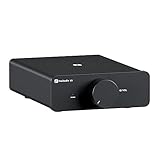
The V3 represents a design departure for Fosi. Previous compact amplifiers from the brand used utilitarian black boxes with minimal visual interest. The V3 introduced a new chassis with a distinctive pattern of ventilation holes across the top panel — arranged in a geometric flower shape centered on the Fosi logo — that serves both a thermal function and a genuinely attractive aesthetic purpose. The amplifier is small enough to sit beside a monitor or under a shelf without dominating the space, measuring 6.5 × 4.1 × 1.4 inches. At this size, it is smaller than most books.
The front panel carries a single volume control knob — the only control the V3 has — and the rear panel is equally minimal: one pair of RCA inputs, two pairs of speaker binding posts (accepting banana plugs and bare wire), and a 3.5mm auxiliary jack. The volume knob uses a logarithmic (A-taper) potentiometer, which is an important detail: logarithmic taper means the first half of the knob’s rotation covers a large volume range smoothly, while the second half provides increasingly fine control at higher levels. This matches how human hearing perceives loudness and makes volume adjustment feel more natural and precise than the linear-taper pots found in many competing products. Fosi includes both a black volume knob (installed by default) and an orange alternative in the box, making the color swap a matter of personal style.
Build quality is consistently praised across dozens of reviews. The chassis is all aluminum, there is no flex or rattle anywhere, and the component quality inside visibly exceeds what the exterior price tag would lead you to expect. Users who have compared the V3 side-by-side with amplifiers priced many times higher consistently note that the construction feels competitive. The included power supply is a laptop-style brick — practical and UL-certified for safety, though not upgradeable to standard audiophile power cable options.
One feature that requires specific clarification for new buyers is the 3.5mm auxiliary jack. Fosi labels it “Pre-out,” but its behavior is not what most audiophiles would expect from a pre-amplifier output. This jack outputs a fixed-level signal that is not controlled by the volume knob — it reflects the raw input signal regardless of where the volume knob is set. This design means it can be useful for daisy-chaining two V3 units in a bi-amping configuration, but it cannot be used as a conventional subwoofer pre-out (where you need the level to follow the volume control). Users who want a true pre-out for a subwoofer should connect the subwoofer to the speaker terminals or choose an amplifier that explicitly supports subwoofer pre-out.
Sound / Performance
The V3’s sonic character sits on the neutral-to-analytical side of the spectrum — an amplifier that aims for faithful accuracy rather than adding its own coloration or warmth. Independent reviewers across multiple platforms consistently describe it as clean, transparent, and quiet, with a presentation that reveals what the upstream components and speakers sound like rather than imposing a character of its own. One experienced reviewer who owns vintage receivers from multiple classic manufacturers — including a reference MacIntosh 1900 — described the V3 as occupying a similar role within the compact amplifier world to what the Mac occupies in vintage audio: a component that makes everything sound consistently good without the wow-factor peaks or valleys of more “voiced” designs.
Bass performance is tight and well-controlled — the V3 does not add warmth or bloom to the low end, which is a positive attribute with neutral or warm-sounding speakers but can make the overall presentation feel lean when paired with already-analytical speaker designs. Mid-range clarity is a genuine strength: voices and instruments are accurately placed in the stereo field with good definition, and there is no mudding or congestion even on complex passages with many instruments playing simultaneously. High frequencies are extended and detailed, with a slight lean toward analytical precision rather than warmth — experienced reviewers describe the treble as revealing and technically accomplished without harshness, though they note the presentation is smoother and more forgiving with warm-sounding sources.
The amplifier’s very low noise floor is a daily-listening advantage that is easy to underestimate. Users who previously owned amplifiers with audible hiss — tube designs and some older solid-state units — report a consistent reaction of surprise when they connect the V3 to high-sensitivity speakers and hear nothing but music. At idle, there is no hiss, no hum, no background noise of any kind. This kind of black-background presentation lets low-level musical detail come through clearly — the kind of fine detail that might be partially masked by the noise floor of a less quiet amplifier.
The V3 performed exceptionally well in an unusual speaker pairing documented by multiple reviewers: Martin Logan electrostatic speakers, which are notorious for dynamic impedance swings that can destabilize lesser amplifiers. The V3 drove them consistently and cleanly without strain or distortion at the impedance dips. This suggests the TPA3255 implementation has been tuned for stability across varying loads — an advantage for users with complex speaker impedance curves. Users pairing it with efficient speakers such as Klipsch Heritage designs report particularly satisfying results, noting that the combination of the V3’s low noise floor and the speakers’ high sensitivity reveals the full depth of well-recorded music.
Real-World Use Cases
The V3’s sweet spot is clear: it is a desktop-to-small-room 2-channel power amplifier for a listener who wants clean, neutral amplification without tone shaping features or wireless connectivity. The typical setup connects a DAC or other analog source via RCA, pairs with bookshelf speakers rated at 84–90 dB/W/m sensitivity, and uses the single volume knob for listening level control. This arrangement is deliberately and deliberately simple — there are no tone controls to adjust, no Bluetooth to configure, no remote to lose. The philosophy is get out of the way and let the music through.
For desktop near-field listening in a small room — roughly 10 × 12 feet or smaller — the V3 with the included 32V power supply is entirely adequate, even for extended high-volume sessions. Users working from home who want a real speaker-based listening system without desk clutter find the V3’s footprint ideal. For medium-sized rooms up to approximately 15 × 20 feet, pairing the V3 with an upgraded 48V power supply is strongly recommended to ensure sufficient headroom. The power supply upgrade costs a modest amount and delivers a meaningful improvement in bass weight and dynamic impact — it is widely documented as the single most worthwhile upgrade for V3 owners.
The V3 is also used extensively as a power amplifier block in multi-component systems — connected downstream of a dedicated preamplifier or DAC/preamp. In this configuration, the V3’s volume knob is turned to a consistent reference position and level control is managed entirely by the upstream preamp. Community users report using the V3 Mono’s elder sibling — the V3 stereo — paired with the ZP3 preamplifier reviewed separately, noting that the combination delivers impressive results. The same principle applies to any quality preamplifier with an RCA output. For users who want to expand into home theater, a pair of V3 stereo amplifiers (or multiples) can power center, surround, and Atmos height channels as power blocks in a larger system, where their compact size and passive cooling make them easy to co-locate near speaker positions.
What Real Users Are Saying
Across thousands of verified customer reviews and extensive forum discussion, three themes repeat most consistently. The first is the shock of the price-to-performance relationship — buyers who were skeptical about a product at this price tier routinely describe being surprised, and then further surprised, by how good the V3 sounds with well-matched speakers. Multiple users describe going back and forth between the V3 and amplifiers they own that cost five to ten times as much, finding it difficult to justify the price premium of the more expensive unit for everyday listening. One Amazon reviewer who tested the V3 against Martin Logan electrostatic speakers — a demanding and expensive speaker design — concluded that the amplifier’s stability and sound quality made it a genuinely no-brainer recommendation even for audiophiles with expensive equipment.
The second theme is the significance of the noise floor. Users who switch to the V3 from tube amplifiers or vintage solid-state equipment — both of which can carry audible background hiss — describe the experience as the audio equivalent of cleaning a dirty window: fine detail that was always present in the music becomes suddenly, clearly audible. Several users with high-efficiency speakers note this effect most dramatically, as those speaker designs are particularly revealing of amplifier noise. The combination of a clean, low-distortion Class D stage with high-sensitivity speakers is repeatedly described in glowing terms across forum communities.
The third theme is the community’s enthusiasm for op-amp rolling as a genuine and worthwhile customization. Forum threads documenting rolling experiments with different op-amp choices accumulate dozens of responses, with users sharing before-and-after impressions and building a shared knowledge base about which alternatives work well in which directions. This has created an enthusiastic subculture around the V3 that extends its useful life and gives owners an ongoing sense of engagement with their equipment. Users experimenting with Sparkos SS3602, Burson V5i, and OPA2134PA replacements consistently report tangible changes in presentation, with the consensus favoring warmer, more musical alternatives when the goal is to soften the V3’s analytical edge in brighter-sounding systems.
Users who report disappointment tend to fall into one category: those who connected the V3 with the stock 32V power supply to low-sensitivity or difficult-to-drive speakers in a medium or large room, found volume levels disappointing, and concluded the amplifier was underpowered. This experience is well-documented and entirely predictable — and is the clearest argument for the upgraded 48V power supply option for any listener with large rooms or demanding speakers. The amplifier itself is not at fault; the expectation mismatch is the product of the peak power marketing claims creating unrealistic expectations.
Pros & Cons
Pros
- Independently verified SINAD of 88 dB and THD ≤ 0.003% — both figures significantly above average for this price category, translating to completely inaudible distortion and a black-background noise floor at idle (based on third-party measurements)
- Premium passive component selection throughout: Japanese NCC/ELNA electrolytic capacitors, German WIMA film capacitors, and Sumida professional audio inductors — a parts quality level rarely seen at this price point, directly contributing to measured performance (based on spec analysis and third-party evaluation)
- Socketed DIP8 op-amps (NE5532 × 2) allow tool-free replacement with a wide range of alternatives to tune sound character — Sparkos, Burson, OPA2134, LME49720, and more are all well-documented by the community (based on spec analysis and user feedback)
- Whole-body heatsink design integrates the amplifier chip directly with the aluminum chassis, enabling passive cooling without a fan — the unit stays quiet during extended use at normal listening volumes (based on third-party evaluation and user feedback)
- Logarithmic volume taper provides smooth, natural-feeling fine control across the knob’s full range — an important usability detail often overlooked in competitor designs (based on spec analysis)
- Extremely compact chassis with attractive ventilation pattern design; stable, all-aluminum build quality that feels and looks premium relative to its price tier (based on third-party evaluation)
Cons
- Marketed maximum power output of 300W × 2 is a peak figure measured at distortion levels unsuitable for listening; real-world output with the included 32V power supply is approximately 38W at 8Ω — adequate for efficient speakers in small rooms, but insufficient for large rooms or low-sensitivity speakers without a 48V power supply upgrade (based on third-party measurements)
- No tone controls, no Bluetooth, no remote control, and no balanced XLR input — the V3 is intentionally bare-bones; users who need any of these features should consider other products in the Fosi range (based on spec analysis)
- The 3.5mm “Pre-out” jack outputs a fixed-level signal unaffected by the volume control; it cannot function as a conventional subwoofer pre-out and is frequently misunderstood by new buyers (based on third-party evaluation and user feedback)
- Audible click on power-up and power-down reported by a portion of users — not harmful to speakers, but noticeable particularly with high-efficiency speakers in quiet environments (based on user feedback)
Who Should Buy This?
The V3 is the right choice for a listener who wants the cleanest, most transparent stereo amplification they can get at an entry-level price, with no interest in features beyond volume control and RCA input. This describes a larger audience than it might seem: anyone building a focused 2-channel desktop or bedroom system around a quality DAC and bookshelf speakers, who uses streaming software or a separate device for source management, will find the V3 a nearly perfect power amplification solution. The same applies to the vinyl listener who already has a phono pre-amplifier and wants to add a clean, quiet power stage without paying for features they will never use. For these users, the V3 does exactly what a power amplifier should do and nothing more — and it does it with a measured performance that embarrasses competitors many times its price.
Enthusiasts who enjoy tinkering will find the V3 particularly rewarding. The op-amp rolling community around this amplifier is large, well-documented, and actively sharing results. Starting with stock NE5532 op-amps and progressively experimenting with upgrades is a low-cost way to personalize the sound character of the amplifier over time, and the process has a clear, tried-and-tested knowledge base to draw from. Users who bi-amp using two V3 units — one for woofers and one for tweeters — report impressive results with appropriately bi-wirable speakers.
Users who may want to consider alternatives include those who need tone controls, Bluetooth, or remote volume control: the BT30D Pro (for a 2.1 Bluetooth system) or the BT20A MAX (for a Bluetooth system with LDAC and a motorized remote-controlled volume) are better matches for those requirements. Users with large rooms, low-sensitivity speakers, or both should step up to the V3 Mono pair, which adds PFFB technology, XLR balanced inputs, and significantly higher clean power output — and pairs ideally with the ZP3 preamplifier for a complete high-performance balanced system. The AIYIMA A07 MAX and SMSL AO300 are the primary direct stereo-only competitors; the V3 generally measures better than the A07 MAX and offers more flexibility through op-amp rolling, while the SMSL offers additional connectivity at a higher price.
Verdict
Score: 8.9 / 10 — Sound: 50% | Build: 20% | Features: 20% | Value: 10%
The Fosi Audio V3 is the rare product that genuinely lives up to — and in some cases exceeds — its community reputation. Its independently verified measurements set a new bar for what this price tier was capable of at launch, its build quality surprises every reviewer who holds one, and its sonic character is clean, revealing, and deeply satisfying when paired with appropriate speakers and sources. The only honest caveats are the power output gap between marketing claims and real-world delivery, and the deliberate absence of features like tone controls, Bluetooth, and remote control that some listeners will need.
Strongly Recommended for anyone building a minimalist, focused 2-channel desktop or small-room audio system around a quality DAC and efficient bookshelf speakers. If transparency, low noise, and measured accuracy matter more to you than feature count, the V3 is one of the most competent amplifiers available at any price near this tier — and one of the most enduring value propositions in modern compact audio.
- Compact Yet Powerful: The V3 mini power amplifier combines a minimalist design with exceptional performance. With a power output of up to 600W, it can effortlessly drive 2-8Ω speakers, delivering impressive sound quality. Its compact size makes it suitable for various applications, from bookshelves and desktop setups to home theaters
- Audiophile-Grade Components: It features the TPA3255 high-end digital class D amp chip and utilizes premium Japanese NCC, ELNA, and German WIMA capacitors, and Japanese Sumida inductors for exceptional audio quality. With a SINAD rating of up to 88dB, an SNR of up to 110dB, and a low noise floor of only 140uV, it delivers exceptional clarity and low distortion
- Innovative Cooling: The V3 stands out with its groundbreaking heat dissipation design. Equipped with vents on the casing’s top and bottom, and a whole-body heatsink design, it efficiently dissipates heat, preventing damage to components and ensuring optimal performance