Fosi Audio IM4 Review – HiFiReport
Overview
The Fosi Audio IM4 is a single dynamic driver, open-back in-ear monitor — Fosi Audio’s first foray into the world of IEMs (In-Ear Monitors, the compact earphones used in studio monitoring, audiophile listening, and hi-fi portable audio). It is built around a 10mm beryllium-coated driver in a CNC-machined aluminium shell, features a genuinely open-back acoustic design, ships with two interchangeable tuning nozzles and nine ear tips across three tuning profiles, and was funded through a Kickstarter campaign that exceeded its goal by a substantial margin before professional reviews had even begun to circulate. For a brand built on desktop amplifiers and DACs, this is an ambitious and genuinely surprising product — and the critical reception from the IEM community has been equally surprising in how positive it has been.
Open-back in-ear monitors are unusual in a market dominated by sealed, closed-back designs. The open-back architecture — meaning the rear of each earpiece is acoustically vented to the outside rather than sealed — is common in over-ear headphones for critical listening, where it is valued for producing a more natural, airy, spacious presentation. Applying the same principle to IEMs is a more challenging design proposition: venting the rear of a tiny driver requires precise acoustic engineering to prevent the open design from simply bleeding energy out of the driver and leaving the sound thin and bass-light. Fosi’s IM4 uses a dual-chamber acoustic structure with a 9-port front chamber and a sealed rear chamber to manage this trade-off, and the result — according to reviewers across multiple platforms — is an IEM that genuinely delivers on the open-back promise of wider, more breathable sound without sacrificing the low-frequency body that makes music engaging.
The IM4 launched to a community reception that went from cautious interest to genuine enthusiasm as early units arrived and first impressions circulated on Head-Fi, IEMRanking, and dedicated review sites. A reviewer who heard the IM4 at the CanJam SoCal event described it as sounding ready for purchase on the spot. Multiple reviewers who received units for evaluation noted surprise at how mature the tuning felt for a brand attempting its first IEM. This review synthesises that body of feedback with full technical analysis to give you an honest and complete picture of what the IM4 is, what it does well, where its limits are, and exactly who it is right for.
Key Features & Tech Specs Explained
The 10mm Beryllium-Coated Driver: Why Diaphragm Material Matters
At the heart of each IM4 earbud is a 10mm dynamic driver with a PU-Beryllium (Be-PU) coated diaphragm. To understand why this material specification is worth paying attention to, it helps to know what a driver’s diaphragm actually does. The diaphragm is the moving membrane that converts electrical signal into physical air movement — it is the component that actually makes the sound. An ideal diaphragm would be simultaneously as stiff as possible (to move as a single unit without flexing), as light as possible (to respond quickly to fast transients), and as well-damped as possible (to stop moving precisely when the signal says stop, not ring or vibrate afterwards). These three properties are in tension with each other, and different materials make different trade-offs.
Beryllium is considered among the best diaphragm materials in audio because it is extraordinarily stiff for its weight — six times stiffer than titanium at one-third the density. Earphones and headphones using pure beryllium diaphragms are typically very expensive because pure beryllium is toxic to work with and requires specialised manufacturing. The Be-PU (Beryllium-coated Polyurethane) approach used in the IM4 applies a thin beryllium coating over a polymer base, which captures much of the acoustic stiffness benefit without the full cost and manufacturing complexity of a pure beryllium diaphragm. The result is a driver that can move quickly and accurately, with good control at both the frequency extremes, and that the Fosi design team has tuned specifically to work with the IM4’s dual-chamber acoustic structure.
The driver also uses an N52 dual-magnet motor system — N52 referring to the magnetic grade (the highest commercially available grade of neodymium magnet), and dual-magnet meaning two magnets are positioned on both sides of the voice coil rather than one. This dual-magnet arrangement produces a more uniform and powerful magnetic field throughout the voice coil’s range of motion, which translates to better control, lower distortion, and greater dynamic capability, particularly in the bass frequencies where the driver moves the most.
Open-Back Design: What It Gains and What It Trades Away
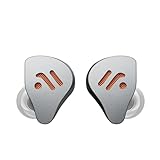
The IM4 is genuinely, functionally open-back — not “semi-open” in the marketing sense of having a small aesthetic vent that makes minimal acoustic difference, but a design where the rear of the aluminium shell has a large, transparent orange metal grille through which you can see the driver directly. Reviewers confirmed this with photographs showing light passing entirely through the unit from front grille to rear grille.
An open-back IEM design has one primary acoustic consequence and one primary practical consequence. The acoustic consequence is a more spacious, airy, and natural-sounding presentation: because the driver can breathe freely rather than pushing air into a sealed space, bass resonances are less exaggerated, the soundstage (the perceived width and depth of the audio image) feels less constricted, and the overall character is less “in your head” than closed-back IEMs at the same price. Multiple reviewers described the IM4’s soundstage as wider and more expansive than anything else they had heard at this price level in an IEM form factor. The practical consequence is the absence of noise isolation — the IM4 does not create a seal against outside noise, and some degree of your surroundings will always be audible during listening. By the same token, people near you can hear what you are playing, though at a moderate rather than distracting volume level.
This design makes the IM4 specifically suited to quiet listening environments: home listening, office use, a library, a café. It is not well-suited to commuting on public transport, exercise in noisy environments, or any situation where blocking outside sound is a priority. This is not a limitation of the IM4’s implementation — it is the inherent physics of open-back acoustic design, and the IM4 is honest about it in its marketing.
Dual-Chamber Acoustic Structure: The Engineering That Makes Open-Back Work
The IM4’s dual-chamber design manages a challenge that open-back IEMs must solve: how to deliver meaningful bass energy from a vented driver. A standard open-back design simply opens the rear of the driver, which can cause the front and rear acoustic waves to partially cancel each other at low frequencies, thinning out the bass. The IM4 addresses this with a 9-port front chamber — nine small acoustic ports between the driver and the nozzle that create a tuned resonance chamber in front of the driver — and a sealed rear chamber behind the driver before the open grille. This two-chamber architecture means the driver’s rear wave is managed and controlled before it exits through the grille, rather than interacting destructively with the front wave. The result, which reviewers across multiple platforms confirmed in listening tests, is bass that is present, textured, and extended rather than hollow or thin — a genuine achievement for an open-back design at this price.
Swappable Nozzles and Ear Tips: Building in Tuning Flexibility
The IM4 ships with two nozzle types — an aluminium nozzle (matte black, installed as default) and a brass nozzle (gold-coloured) — and nine ear tips across three tuning profiles (Balanced, Bass, and Deep Bass, each in three sizes). Swapping nozzles changes the acoustic path between the driver and your ear canal, and because brass is a denser material than aluminium, the two nozzles produce measurably different frequency responses. The aluminium nozzle produces a more full-range, all-rounder presentation: controlled bass, clear mids, and a treble that is present without becoming sharp. The brass nozzle shifts emphasis toward the upper midrange and lower treble, adding clarity and “bite” at the cost of some bass warmth and control.
Reviewers across multiple platforms converged on a consensus: the aluminium nozzle is the more coherent and musically satisfying default for most listeners and most genres. The brass nozzle is useful for listeners who specifically want more vocal presence or treble energy, but can venture into sibilance territory (an exaggerated, harsh quality on sibilant consonants like “s” and “sh” in vocals) with some music or tip combinations. The important practical implication is that the IM4 has a meaningful range of tuning flexibility built in, allowing listeners to adjust the character without software equalisation or cable changes. Between the two nozzles and three tip types, the number of sound signatures accessible from a single unit is genuinely broad.
Build Quality & Design
The IM4’s build quality is one of its most consistently praised attributes across all review sources, and for good reason. Each earpiece is machined from a single block of 6063 aluminium alloy — a precise, labour-intensive manufacturing process that produces a shell with no seams, no visible parting lines, and a surface finish quality typically associated with more expensive products. The sandblasted and anodised exterior has a smooth, matte feel that is hypoallergenic and pleasant against the skin during extended wear. The distinctive orange metal grille on each earpiece’s faceplate is a functional acoustic vent as well as a visual brand marker — recognisable as Fosi Audio’s design language without being garish.
At 7 grams per earpiece (38 grams including the cable), the IM4 is genuinely lightweight in use. Multiple reviewers who tested the IM4 for extended sessions of two hours or more described complete absence of discomfort or fatigue — the physical profile fits within the outer ear rather than pressuring the canal, and the absence of a canal seal that an open-back design implies means pressure equalisation during extended wear is not a concern. The earpieces are worn cable-up — the cable loops over the ear rather than hanging down — which is the preferred configuration for stable fit during listening at a desk and is specified in the IM4’s user manual.
The detachable cable is a 4-core, 392-strand, 5N OFC (Oxygen-Free Copper) silver-plated braid terminated in a 3.5mm gold-plated plug, with 2-Pin 0.78mm connectors at the IEM end — the most common standard for detachable IEM cables, meaning aftermarket cable upgrades or replacements are widely available. The cable does not tangle readily, does not produce significant microphonic noise (the crackling sound some cables create when they rub against clothing), and is an appropriate length for desktop listening. A 4.4mm balanced adapter is available separately, and the 2-pin connector standard means any compatible aftermarket balanced cable works directly.
In the box alongside the IM4s: both nozzles installed and spare, nine ear tips (three types × three sizes), a zippered faux-leather carrying case large enough to hold the IEMs, cable, and spare nozzles, and a user manual formatted as a proper booklet rather than a folded sheet — a detail multiple reviewers noted as a small but characterful quality gesture.
Sound / Performance
The IM4’s overall sound character, in its recommended stock configuration (aluminium nozzle, medium-sized balanced or bass tips), is warm, spacious, dynamic, and forgiving — tuned for enjoyable extended listening rather than clinical measurement-grade neutrality. The overall frequency response tendency is a mild V-shape: a slight emphasis in the bass and a slight emphasis in the upper midrange/lower treble relative to the midrange, with the open-back design softening what could be a fatiguing V-shaped character into something more relaxed and cohesive in practice.
Bass is the IM4’s most immediate and consistently praised quality. It is textured, defined, and extends meaningfully low without the one-note boominess that often plagues bass-emphasised budget IEMs. The dual-magnet motor gives the driver real control over low-frequency transients: bass notes start and stop cleanly, with the texture and decay of acoustic bass strings and kick drum hits resolved in a way that communicates the character of the instrument rather than just its frequency range. There is genuine weight here — enough to satisfy listeners who enjoy bass presence in their music — without the upper bass congestion that can make other bass-forward IEMs sound muddy or unclear.
Midrange is the most nuanced aspect of the IM4’s presentation, and the one where reviewer opinions diverge slightly based on listening preferences. Vocals and lead instruments are clear and present, and the open-back design gives them a sense of space that is unusual in IEMs at this price. The lower midrange can sound slightly recessed with certain tip combinations, giving some listeners the impression that body and warmth in male vocals is a step behind where they would prefer. The aluminium nozzle generally mitigates this tendency compared to the brass, though the degree of the effect varies with the specific ear tips in use. Switching to the bass tips adds low-end warmth that fills in this region effectively for many listeners. The IEMRanking community assessment described the midrange as offering “vivid vocals” with the black nozzle — clear, present, and slightly edgier than a neutral target but engaging rather than analytical.
Treble performance is competent and non-fatiguing in the default aluminium nozzle configuration. The top end is present and extended enough to convey cymbal shimmer, acoustic guitar picking transients, and the upper harmonics of strings and piano without drawing unpleasant attention to itself. The Headfonia reviewer, testing the IM4 with a broad range of challenging material, identified a slight sense of a potential breakup region above the comfort zone that can become apparent with very bright recordings or the gold brass nozzle, and recommended narrow-bore or deep bass tips for long sessions. With the aluminium nozzle and balanced or bass tips, this limitation is effectively managed and the vast majority of listeners will not encounter it in ordinary listening.
The standout technical achievement is the soundstage. Reviewers consistently describe the IM4 as delivering a width and sense of spatial openness far beyond any closed-back IEM at this price tier, and competitive with what open-back over-ear headphones substantially more expensive can achieve. Instrument placement is clear and well-differentiated — it is possible to follow individual instruments in dense arrangements without effort, which is the characteristic that makes the IM4 described as genuinely usable for critical and monitoring-oriented listening in addition to casual enjoyment.
Real-World Use Cases
The IM4’s open-back design naturally defines its optimal listening environments. Home desktop listening is the definitive sweet spot: seated at a desk, with the source device nearby, in a room where ambient noise is low. The combination of a detailed, spacious sound, lightweight extended-wear comfort, and the availability of both 3.5mm and 4.4mm cable options makes the IM4 a strong companion to a desktop DAC/amp stack — the IM4 connected to a Fosi ZD3 or DS1 via balanced 4.4mm cable is a setup several community members specifically describe as punching significantly above what the combined price might suggest.
Studio reference monitoring is a secondary use case where the IM4 shows relevant strengths: the open-back design and relatively accurate midrange make it useful for tasks like mixing decisions, vocal recording monitoring, and music production listening, where the more natural, less coloured character of an open-back design is preferred over the hyped bass of many closed-back consumer IEMs. However, the IM4’s V-shaped tuning lean means it is not a strictly neutral reference tool — experienced studio engineers who need measurement-grade flatness would look further up the IEM market.
For those who enjoy classical music, jazz, acoustic folk, or any genre where instrument separation and natural timbre matter most, the IM4 is particularly well matched. The open soundstage, coherent single-driver presentation, and controlled bass all serve acoustic music exceptionally well. Electronic music, pop, and hip-hop also play well — the IM4 is dynamic enough to make these genres engaging — though the deep bass tip option is recommended for maximum enjoyment of heavily bass-oriented tracks.
What Real Users Are Saying
The community response to the IM4 has been unusually enthusiastic for a debut IEM from a brand new to the category. The first cohesive theme across all platforms is the combination of build quality and value: reviewers repeatedly describe holding the IM4 for the first time and immediately feeling that the physical quality — the heft of the aluminium, the precision of the machining, the quality of the cable — represents a significantly higher tier than the price. Multiple reviewers specifically compared the IM4 shell quality to IEMs costing two to three times as much, finding the comparison favourable to the IM4.
The second consistent theme is the soundstage surprise. Users who had primarily experienced closed-back IEMs describe the switch to the IM4 as an immediate and striking change — not a subtle improvement but a clearly different type of listening experience where music feels less like it is happening inside the head and more like it is happening around the listener. Several users who tested the IM4 at CanJam SoCal described it as the most distinctive open-back IEM presentation they heard at the event, a meaningful comment given the range of products exhibited. A Head-Fi early adopter described it as potentially “the go-to under $100 — or maybe even under $300 — IEM,” which represents an ambitious framing that multiple subsequent reviews did not contradict.
The third theme is the genuine utility of the tuning system. Users who explored the full range of nozzle and tip combinations describe discovering meaningfully different sound signatures from a single unit — not just marginal tweaking but distinct enough differences that aluminium-nozzle listeners and brass-nozzle listeners effectively describe two different sound profiles. The ability to physically tune the IEM without software, and to replace the nozzles entirely if one becomes clogged or damaged, is cited as a durability and ownership benefit that extends the IM4’s practical value over time. Fosi’s customer service also receives specific praise from one Fosi-official-page user who reported a packaging defect and received a replacement case dispatched within hours of contacting support.
Pros & Cons
Pros
- Genuinely functional open-back architecture delivers soundstage width and spatial naturalness dramatically broader than closed-back IEMs in the same price bracket, confirmed across multiple independent review sources
- 10mm N52 dual-magnet beryllium-coated driver produces bass that is textured, controlled, and extended — strong for a single dynamic driver at this price tier, based on multiple reviewer listening assessments
- CNC-machined 6063 aluminium alloy shell at 7g per earpiece delivers build quality and physical precision well above the entry-level price tier standard, noted consistently across all review sources
- Two interchangeable tuning nozzles (aluminium and brass) plus nine ear tips across three tuning profiles (Balanced, Bass, Deep Bass) give the IM4 meaningful acoustic flexibility without software or external components, based on spec and reviewer testing
- Detachable 2-Pin 0.78mm cable uses the most common IEM aftermarket standard, enabling easy replacement and upgrade to 4.4mm balanced or other configurations, based on spec analysis
- Comprehensive accessories package — carrying case, nine tips, spare nozzle, quality cable — represents exceptional value-per-dollar in the IEM category, confirmed by reviewer consensus
Cons
- Open-back design provides minimal noise isolation — external sounds remain audible during listening, and music is slightly audible to nearby people; the IM4 is not suitable for commuting, exercise in noise, or any scenario where isolation is needed, based on fundamental open-back acoustic design and reviewer confirmation
- Lower midrange can sound slightly recessed with certain tip and nozzle combinations, giving male vocals and lower instruments reduced body; addressed by using bass tips or the aluminium nozzle, based on multiple reviewer reports
- Brass nozzle can venture toward sibilance on challenging high-frequency material or with wide-bore tips; requires careful pairing of nozzle and tip to manage, based on Headfonia and IEMRanking reviewer findings
- Ships with 3.5mm termination as standard; 4.4mm balanced cable requires a separate purchase or an aftermarket cable swap, based on product documentation
Who Should Buy This?
The IM4 is made for the listener who wants to experience what open-back audio sounds like in an IEM form factor — either because they have heard the description of the wider, more natural soundstage of open-back over-ear headphones and want to access that character in something compact, or because they are a desktop listener who wants an IEM that behaves more like a small speaker system than a typical sealed earphone. For home desktop listening, quiet office environments, and home studio casual reference listening, the IM4 delivers a distinctively spacious, comfortable, and dynamic experience that is genuinely unusual at its price point.
The IM4 is also the right choice for the listener who enjoys personalising their gear. The combination of two nozzle types and three tip tuning profiles, with clearly documented differences between them, turns the IM4 into a small sound-engineering project that rewards curiosity and patience with a tuning that feels specifically suited to your preferences and music library. Listeners who want to pair the IM4 with a quality DAC or DAC/amp for fully balanced listening will find the 2-pin standard enables this immediately with available aftermarket cables.
Buyers who should consider alternatives include anyone who needs isolation for commuting or exercise — a closed-back IEM is the only architecturally appropriate choice for those scenarios, and the Simgot EM6L, Kiwi Ears Cadenza, or similar sealed single-DD IEMs at comparable prices represent strong options. Critical studio monitoring engineers who need strictly neutral frequency response should look at established reference-tuned IEMs from Etymotic or similar brands. Listeners who specifically prefer a more neutral, less V-shaped tuning from an open-back design at this price point should compare directly against the Truthear Hexa or similar neutral-tuned competitors, as the IM4’s mild V-shape emphasis is consistent and intentional across all tip and nozzle configurations. For Fosi Audio fans specifically, the i5 over-ear planar magnetic headphone offers the open-back experience in a full-size form factor for those who want to take the next step.
Verdict
Score: 8.6 / 10 — Sound quality and character (50%): 8.5 | Build quality (20%): 9 | Features and tuning flexibility (20%): 9 | Value for money (10%): 9.5
The Fosi Audio IM4 is a genuinely impressive debut IEM from a brand that had no obligation to attempt this product category and did so with more engineering ambition and listener-oriented thinking than the price tag suggests. The open-back design is functional, not cosmetic. The dual-chamber acoustic architecture delivers real bass from a vented driver. The machined aluminium build quality competes convincingly with IEMs at meaningfully higher prices. The tuning system — two nozzles, three tip profiles — gives owners a real and audible range of sonic adjustment. And the soundstage, which is the IM4’s defining technical achievement, is broader and more naturally spacious than most closed-back IEMs at two or three times the price.
For the home listener, the desktop audiophile, and anyone curious about what open-back sound design feels like in an in-ear form factor, the IM4 is recommended with confidence. Its limitations — no isolation, a mildly V-shaped tuning, brass nozzle sibilance risk — are all either inherent to its design philosophy or easily managed through the included tuning options. What it offers in return is a genuinely distinctive, comfortable, and engaging listening experience that marks Fosi Audio’s arrival in personal audio as a serious new player, not a casual experiment.
- High-Fidelity Sound: The IM4 features a premium 10mm beryllium-coated diaphragm single dynamic driver for high resolution and natural three-band transition. The driver utilizes a dual-chamber structure and N52 dual-magnet circuit to deliver natural sound
- Spacious Soundstage: Featuring an open-back design, the IM4 delivers airy, wide-open playback for relaxed, fatigue-free listening. Instruments spread out nicely, and vocals don’t feel boxed in, making long sessions effortless
- Ergonomic & Lightweight: The IM4 is designed using a large ear-shape database to ensure it naturally conforms to your ear. With a smooth full-metal housing and weighing just 7g per bud, it delivers a comfortable, barely-there fit for all-day listening