Fosi Audio DS2 Review – HiFiReport
Overview
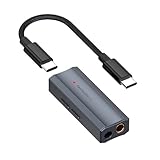
The Fosi Audio DS2 is a USB-C dongle DAC and headphone amplifier — a device smaller than a USB flash drive that plugs directly into your phone, laptop, or tablet and provides a dramatically better audio output than any built-in headphone jack or integrated audio circuit. It is built around dual Cirrus Logic CS43131 chips, ships with both 3.5mm single-ended and 4.4mm balanced headphone outputs, delivers enough power to drive planar magnetic and high-impedance dynamic headphones from a smartphone, and achieves measured performance figures that have drawn an “exceptional” designation from independent audio measurement testing. At an entry-level price for the capability it offers, the DS2 has become one of the most consistently recommended portable DAC dongles in the enthusiast community — cited repeatedly as the best value proposition in the dual-output dongle category, particularly for iPhone users transitioning away from the headphone jack.
Dongle DACs occupy a specific and increasingly important role in modern portable audio. As smartphones have progressively removed built-in headphone jacks — or retained them with minimal audio circuit quality — the gap between what good headphones and IEMs can deliver and what phones actually send to them has widened to a degree that is audibly significant. The DS2’s job is to bridge that gap: it takes the digital audio stream from the phone’s USB-C port, converts it to analogue signal with precision far beyond what any built-in audio chip produces, and amplifies it with enough current and voltage to properly drive headphones that built-in outputs cannot handle. The result is a direct and meaningful improvement in sound quality from devices most people carry daily — without adding weight, complexity, or the need for a separate battery.
The DS2 is Fosi Audio’s second dongle product, developed specifically to address feedback about the first-generation DS1 — which offered impressive power but in a physical form factor large enough to make true pocketability questionable. The DS2 is dramatically smaller and lighter: at 55mm long, 19mm wide, 12mm thick, and approximately 15 grams, it is genuinely pocketable and can remain plugged into a phone without making the phone unwieldy to hold. Fosi’s design team made this reduction in size without sacrificing the dual-output configuration or the power output capability — the 4.4mm balanced output in particular delivers more power than many larger competing dongles at comparable prices. Multiple independent reviewers confirmed in direct listening comparisons that the DS2 drives headphones like the planar magnetic Hifiman Sundara and the notoriously current-hungry Tin P1 with authority that competitors in the same size category cannot consistently match.
Key Features & Tech Specs Explained
Dual CS43131 Chips: Why Two and Why This One
The CS43131 is Cirrus Logic’s flagship compact DAC chip — a single-chip solution that combines a high-performance digital-to-analogue converter with a built-in headphone amplifier capable of delivering balanced output. “Flagship” in this context means it sits at the top of Cirrus Logic’s portfolio for this application, above the CS43198 and CS4398 used in mid-tier products. The DS2 uses two of these chips — one per stereo channel — rather than running a single chip in stereo mode. This dual-mono architecture matters for two reasons.
First, each channel has its own completely independent conversion and amplification path, which produces better channel separation — the ability of each ear to receive its signal without electrical crosstalk from the other side. Second, each chip contributes its amplifier output to the balanced (4.4mm) connection, which sums both chips’ outputs per channel to produce the higher power level of the balanced output. This is why the balanced output of the DS2 is substantially more powerful than the single-ended output — not just marginally higher, but significantly so, because it draws from both chips working together.
The specification result of this architecture is a THD (Total Harmonic Distortion) of 0.0001% and an SNR (Signal-to-Noise Ratio) of 130dB — figures that describe a conversion process adding essentially nothing audible to the original digital recording. The SINAD (Signal to Noise and Distortion ratio — a combined measurement of all signal errors) of 109dB has been independently confirmed by AudioScienceReview, whose measurements of the DS2 yielded an “exceptional” classification — a designation that places it in the top tier of tested devices regardless of price category. For a device the size of a USB drive, this measurement outcome is remarkable.
Power Output: What the Numbers Mean for Your Headphones
The DS2’s specified output is 130mW at 32 ohms from the 3.5mm single-ended output, and 170mW at 32 ohms from the 4.4mm balanced output. These are the Fosi-published figures. Independent reviewer measurements and user tests suggest the balanced output may deliver substantially more in practice — the Head-Fi reviewer measured the DS2 successfully driving the 50-ohm Hifiman Sundara at 90+ dB SPL with meaningful dynamic headroom to spare, and the MobileAudiophile reviewer noted that with 28-ohm IEMs at maximum volume, an Apple Mac was requiring only three of sixteen volume bars to reach comfortable levels. The IEMsandMusic reviewer specifically noted the DS2 managing the notoriously demanding Tin P1 planar on balanced output with satisfying bass presentation and adequate drive.
To translate these numbers into practical headphone compatibility: the DS2 comfortably drives essentially all IEMs (in-ear monitors), all standard consumer headphones up to around 150 ohms, and most audiophile-tier dynamic headphones up to 300 ohms with the balanced output. Planar magnetic headphones — typically 20–50 ohms but requiring substantial current — are driven with enough authority that the DS2 is one of the few dongle-tier products that can genuinely be called planar-capable rather than merely planar-functional. Very high-impedance headphones above 300 ohms (certain Beyerdynamic models, for instance) will play through the DS2 but may not reach their full volume potential without using the balanced output and accepting some loss of the very last decibels of available headroom.
The 60-step independent volume control — physical buttons on the side of the DS2 that adjust the device’s own volume independently of the phone or computer’s system volume — is both a usability and a sound quality feature. Controlling volume from the DS2’s own circuit rather than from the phone’s digital volume control avoids the bit-depth reduction that digital volume attenuation can cause at low system volume settings, preserving the full resolution of the audio signal through the conversion process.
Balanced 4.4mm Output: The Specification That Changes the Conversation
The inclusion of a 4.4mm balanced output on a dongle-tier device is itself a significant specification decision. Balanced audio — using a separate positive and negative signal conductor per channel rather than sharing a ground reference — has historically been the domain of desktop and rack-mounted audio equipment. Its advantages are: higher potential power output from the same chip architecture (as described above), theoretical immunity to common-mode noise (interference that affects both conductors equally and cancels in the balanced receiver), and better measured crosstalk between channels. At the DS2’s price point, a balanced output adds practical capability for listeners who already own headphones with 4.4mm cables or detachable 4.4mm cable options — and the power increase over the single-ended output is meaningfully audible with more demanding headphones, not just a specification exercise.
It is worth being clear that at normal listening volumes with sensitive IEMs and headphones up to 80 ohms, the difference between 3.5mm and 4.4mm outputs on the DS2 is subtle rather than dramatic. The meaningful benefit of the 4.4mm output emerges with harder-to-drive headphones at higher volume levels — exactly the scenario where the additional current delivery of the balanced configuration helps most.
High-Resolution Support: PCM 384kHz and DSD256
The DS2 supports digital audio input up to 32-bit/384kHz PCM and DSD256 — specifications that encompass every commercially available high-resolution audio format. For practical context: standard CD audio is 16-bit/44.1kHz. High-resolution download and streaming services typically offer 24-bit/96kHz or 24-bit/192kHz files. DSD256 is a specialist high-resolution format used by a subset of audiophile recordings. The DS2’s ceiling is therefore generous by any real-world measure — it will decode any audio format you are likely to encounter without truncation or downsampling. A colour-coded LED indicator communicates the active sample rate in real time, with different colours for standard and high-resolution audio.
Battery consumption is a practically important specification for a phone-powered device, and the DS2’s performance here is impressive. The Headphonesty reviewer measured 3% battery drain over 20 minutes of balanced-output playback with 32-ohm IEMs from a 4,500mAh phone battery — a rate that projects to approximately 11 hours of continuous use from a full charge before the phone’s battery reaches 50%. For most real-world portable listening sessions, battery impact is essentially negligible.
Build Quality & Design
At 55mm × 19mm × 12mm and approximately 15 grams, the DS2 is genuinely small — significantly more compact than the DS1 it succeeds, and small enough to keep plugged into a phone in a pocket without creating an awkward protrusion. The chassis is CNC-machined from aluminium alloy in a gunmetal grey finish — a single continuous piece of metal with no visible seams on the primary surfaces. The finish is matte and fine-grained, resistant to fingerprints, and pleasant to the touch. Multiple reviewers described it as one of the most attractive products in the dongle DAC category — the Headphonesty reviewer specifically called it “a looker,” and the MobileAudiophile reviewer noted a personal aesthetic preference for it over competing products.
The physical layout is well-considered: the USB-C port occupies one end, and the 3.5mm and 4.4mm headphone jacks sit side by side at the opposite end. The two volume control buttons are positioned on one long side, with an LED indicator on the top surface. No controls or connections are on the other long side or the underside, meaning the DS2 can lie flat without any connection being blocked. The volume buttons have positive mechanical feedback — a clear, definite click rather than a soft touch sensor — which makes adjustment by feel without looking at the device comfortable and accurate. Both headphone sockets grip firmly and do not wobble with a plugged-in cable.
In the box alongside the DS2: a USB-C to USB-C audio cable of good quality with a flexible, non-tangling construction, a USB-A to USB-C adapter for connecting to older computers and USB-A power banks, and a user manual and warranty card. The USB-A adapter is noted consistently across reviews as a thoughtful inclusion that extends compatibility to the large number of computers still using USB-A ports. What is not included is a Lightning adapter for older iPhones — a practical gap noted by the HomeStudioBasics reviewer as a missed opportunity given the iPhone user base that has not yet transitioned to USB-C devices. USB-C iPhone 15 and later models work directly; older Lightning iPhones require a separately purchased adapter.
Sound / Performance
The DS2’s sound character has been described with remarkable consistency across every independent review: neutral to very slightly bright, transparent, detailed, and controlled. Reviewers approaching it from different angles — a home studio professional, a portable audio specialist, a measurement-focused evaluator, an IEM enthusiast — all arrive at the same fundamental characterisation. The DS2 does not add warmth, does not add bass weight, does not add treble sparkle as a systematic signature. What it adds is a lower noise floor, more dynamic headroom, and more precise transient reproduction than the built-in audio output it replaces — and then gets out of the way of the headphones and the recording.
Bass reproduction is controlled and accurate rather than emphasised. Bass notes have definition and texture — the physical character of the instrument is communicated rather than just its pitch and rough weight. The MajorHiFi reviewer noted that pairing the DS2 with the ThieAudio Origin — an IEM known for bombastic, aggressive low end — resulted in the bass being better separated and more organised in the mix without losing its body, which is precisely what clean, low-distortion amplification does to a headphone with a strong intrinsic bass character: it disciplines rather than suppresses.
Midrange is the DS2’s strongest quality in the listening assessments of multiple reviewers. Vocals are described as clear, expressive, and three-dimensional — present in the mix without being shouted or recessed. Instruments in the midrange have natural timbre — the quality that makes a piano sound like a piano and a violin sound like a violin, rather than a processed approximation. The MobileAudiophile reviewer described the midrange as “pulling me into the performance” — a description of musical engagement that goes beyond measurement accuracy.
The MajorHiFi reviewer specifically noted increased soundstage depth compared to the headphones’ presentation without the DS2 — the front-to-back layering of the audio image felt more three-dimensional, which is consistent with the DS2’s measured performance characteristics: low distortion and a high noise floor allow subtle spatial cues in recordings to emerge rather than being masked. The IEMsandMusic reviewer, comparing the DS2 against the Questyle M15, described the DS2 as slightly more “energetic” — with a touch more presence in the bass and treble — while the M15 was marginally more strictly neutral. This is a very fine distinction in a field where all the competitors at this level are effectively transparent by any measurable or audible standard.
The Head-Fi measurement comparison — where the reviewer tested the DS2 alongside multiple competing dongles with a calibrated microphone and an ear canal simulator using the Hifiman Sundara — found all tested devices producing “the same result” at 90+ dB SPL. This is the measurement-level confirmation that at normal listening volumes with a moderately demanding headphone, the DS2 is genuinely transparent: it does not alter the headphone’s sound signature, it simply provides the electrical signal accurately. This is exactly what a properly engineered DAC and amplifier should do, and at this price level, it is not guaranteed — the DS2 achieves it reliably.
Real-World Use Cases
The DS2’s most immediate and universal use case is the iPhone USB-C user. When Apple transitioned to USB-C on the iPhone 15 series, it opened the door to a category of USB audio devices that Lightning-port owners had no clean way to access. The DS2 connects directly to a USB-C iPhone without adapters, presents itself as a USB audio device automatically recognised by iOS, and immediately provides the dual-output, high-power, high-resolution audio path that the iPhone’s built-in output cannot approach. The Head-Fi reviewer explicitly described the DS2 as their preferred dongle for iPhone users, specifically because of the combination of clean design, power output, dual outputs, and the absence of connection complexity that Lightning adapters introduce.
Android users are equally well served, with the additional option of using apps that provide fine-grained USB audio configuration if desired. The DS2 works in plug-and-play mode without configuration on stock Android, and its independent volume control allows adjustment without unlocking the phone or navigating to a volume slider. Laptop and desktop computer use — as a replacement for the built-in audio output — is a similarly clean experience: the DS2 is recognised immediately as a USB audio device on Windows, macOS, and Linux without driver installation, and its physical volume buttons provide convenient level adjustment without touching the keyboard.
For commuters, travellers, and daily portable listeners who use demanding IEMs or over-ear headphones on the go, the DS2’s combination of size, weight, and power output is the defining feature set. It fits without bulk in any pocket, adds negligible weight to any bag, and provides enough headroom to drive even planar-magnetic and high-impedance headphones at full dynamic potential from a phone. Multiple reviewers who tested the DS2 with the Hifiman Sundara — a well-regarded planar magnetic with a reputation for requiring real amplification — described the combination as genuinely satisfying rather than merely functional, which is a meaningful distinction for a phone-powered source.
What Real Users Are Saying
The DS2’s user feedback across Head-Fi, MobileAudiophile, Headphonesty, HomeStudioBasics, MajorHiFi, IEMsandMusic, and user-review aggregation on retail platforms is unusually cohesive. The dominant theme is the degree to which the DS2 exceeds expectations set by its physical size: buyers who plug it in for the first time and hear a demanding headphone responding with authority and clarity they associate with desktop equipment describe the experience consistently as surprising. The “dead silent background” noted by the MobileAudiophile reviewer — zero audible noise floor between tracks, even with sensitive IEMs — is specifically cited as the most immediately impactful first-listen quality, because it directly contrasts with the faint but persistent background noise that built-in phone audio and lower-quality DACs produce.
The 60-step volume control with volume memory — which remembers the last-used volume setting when disconnected and reconnected — earns specific appreciation from daily users who carry the DS2 through different listening environments. The ability to return to a known comfortable volume rather than having to readjust from maximum or minimum on every connection is a small but consistently valued quality-of-life feature. The volume buttons’ physical click feedback is also specifically praised as preferable to the soft-touch or capacitive controls on competing products, which can be difficult to use accurately by feel while the device is in a pocket.
The ASR “exceptional” measurement confirmation — cited by the Head-Fi reviewer and informing multiple subsequent reviews — has become an important part of the DS2’s community standing. In a category where specification claims are common and independent verification less so, having a well-regarded measurement authority confirm that the DS2 performs at the level its specifications describe provides a level of confidence that most competing products cannot reference. Community members who make purchasing decisions based on measured performance data point to this confirmation as a primary reason for their recommendation.
The one consistent criticism across review sources is the absence of a Lightning adapter for non-USB-C iPhone users, and the absence of a gain switch for fine-tuning output level with particularly sensitive IEMs. On the gain question: the DS2’s 60-step volume control provides granular enough adjustment that most users find the lowest steps accessible with all but the most extremely sensitive in-ear monitors, but a hardware gain switch — offering a lower power mode for IEMs that are too sensitive for comfortable adjustment in the lower volume steps — would extend the DS2’s range of comfortable use. The MobileAudiophile reviewer noted this as a quality improvement for a future revision.
Pros & Cons
Pros
- Dual Cirrus Logic CS43131 architecture achieves THD 0.0001%, SNR 130dB, and SINAD 109dB — confirmed by AudioScienceReview as “exceptional,” placing the DS2 in the top tier of measured DAC performance regardless of form factor or price, based on third-party independent measurements
- Balanced 4.4mm output with genuine dual-mono chip architecture drives demanding headphones including planars and high-impedance dynamics from a phone — a capability uncommon at this price tier, confirmed by multiple reviewer drive tests
- Genuinely pocketable at 55mm × 19mm × 12mm and 15g — significantly smaller than the DS1 it succeeds and most competing dual-output dongles, based on spec and reviewer dimensional analysis
- 60-step independent hardware volume control with volume memory provides granular adjustment and retains last-used setting across disconnection and reconnection, based on spec and user feedback
- Battery consumption of approximately 3% per 20 minutes of balanced playback from a standard-capacity smartphone is low enough to be effectively negligible in most daily use scenarios, confirmed by Headphonesty battery test
- Plug-and-play compatibility with iPhone 15+ (USB-C), Android, Windows, macOS, and Linux with no driver installation required, based on spec analysis and multi-platform reviewer testing
Cons
- No Lightning adapter included for pre-USB-C iPhone users — a separate purchase is required for older iPhone compatibility, noted by HomeStudioBasics and IEMsandMusic reviewers as a practical gap
- No hardware gain switch: very high-sensitivity IEMs (above approximately 115dB/mW) may have limited volume control range in the lowest steps; a low-gain mode would improve usability with the most sensitive earphones, based on MobileAudiophile and Head-Fi reviewer notes
- Single-ended 3.5mm output at 130mW is adequate for most headphones but substantially below the balanced output’s power level; listeners who do not own 4.4mm-terminated headphones or cables may not access the DS2’s full power capability, based on spec analysis
- Sound signature is neutral to very slightly bright, which is a strength for accuracy-oriented listening but may not appeal to listeners who prefer a warm, coloured, or bass-emphasised presentation, based on reviewer consensus across multiple independent sources
Who Should Buy This?
The DS2 is the natural choice for four clearly defined listener profiles. The first is the iPhone 15 or later user who has discovered that their headphones sound noticeably better from a laptop headphone jack than from the phone itself — or who bought quality headphones specifically to use with a phone and has been disappointed by the result. The DS2 plugs directly into the USB-C port, requires no configuration, costs far less than any upgrade to the headphones themselves, and delivers a meaningful, immediately audible improvement in clarity, noise floor, and dynamic headroom. The Head-Fi reviewer specifically recommended it as the best choice for iPhone users in direct comparison against competing dual-output dongles.
The second profile is the laptop or desktop user whose built-in audio output has a perceptible noise floor, produces interference from the computer’s internal electronics, or simply lacks the power to properly drive their headphones. Connecting the DS2 via USB-C or the included USB-A adapter moves all audio processing outside the computer’s electrically noisy chassis, and the combination of lower noise and higher power is consistently described by users in this scenario as the most dramatic audible improvement they have made to their listening setup without changing their headphones.
The third profile is the audiophile who carries demanding headphones — planars, high-impedance dynamics, or IEMs with complex crossovers — and wants a genuinely capable mobile source without carrying a dedicated portable amplifier with its own battery. The DS2’s measured performance and confirmed real-world drive capability with planar and high-impedance headphones makes it the dongle-tier upper boundary for this use case in its price range.
The fourth profile is the new entrant to the headphone hobby who wants to maximise the performance of their headphones without a large additional investment. The DS2’s combination of flagship-tier measured performance at an entry-level price means the gap between what the DS2 and a significantly more expensive desktop DAC offer is genuinely small in controlled listening comparisons — the Head-Fi measurement comparison found all tested devices essentially identical with a demanding planar at realistic listening volumes.
Buyers who would be better served by alternatives include those needing a Lightning adapter — the iFi Go Link comes bundled with a Lightning adapter and may be more immediately convenient for older-iPhone users despite slightly lower power output. Those who want a gain switch for sensitive IEM control should look at the Truthear SHIO or the FiiO KA15, both of which include hardware gain options. For desktop-primary listeners who want to leave the DAC on a desk rather than carry it, the Fosi ZD3 or the Topping E30 II provide a more complete desktop DAC feature set with displays, remote inputs, and preamp functions. Within the dongle tier, the iBasso DC-Macaron and FiiO KA15 are the most frequently cited direct comparisons — the Macaron is particularly recommended for Android users who want a companion app for fine-grained control, while the DS2 leads on power output in balanced mode.
Verdict
Score: 9.0 / 10 — Measured technical performance (50%): 9.5 | Build quality and design (20%): 8.5 | Features and compatibility (20%): 8.5 | Value for money (10%): 9.5
The Fosi Audio DS2 is the product that settles the question of whether a dongle-sized USB DAC can deliver genuinely serious audio performance, and it settles it conclusively in the affirmative. Its AudioScienceReview “exceptional” measurement rating, dual CS43131 architecture, 130dB SNR, and confirmed ability to drive planar magnetic headphones from a phone place it at a level of technical achievement that was previously unavailable in this form factor at this price. The measured performance leads not just the dongle category but stands comparison with desktop equipment at several times the price, in a device that weighs 15 grams and fits in any pocket.
The recommendation is unambiguous and enthusiastic: for any listener who wants to extract the full potential of their headphones from a phone, laptop, or computer — or who wants a portable DAC that does not require a separate battery, a separate bag pocket, or a separate charging habit — the DS2 is the reference choice in its price tier. It performs at the level its specifications claim, sounds exactly as transparent and capable as those specifications suggest, and does it in a package small enough to forget you are carrying it until you need it. Among dongle DACs available today, it represents the clearest proof yet that we are, as one reviewer aptly put it, in a golden age for pragmatically priced portable audio.
- Upgraded Version: A new generation USB-C portable headphone DAC and amplifier, supporting up to DSD256 and PCM 32bit/384kHz decoding for a high-resolution sound reproduction. It delivers a powerful drive of up to 170mW@32Ω each channel, effortlessly powering high or low-impedance headphones with 3.5mm single-ended or 4.4mm balanced connections, immersing you in the exquisite world of music
- Flagship Chips: Featuring two next-generation Cirrus Logic CS43131 DAC chips, the DS2 delivers superior system-level audio performance without draining your mobile source device’s battery life. With its ultra-low 1μV noise floor, minimal 0.0001% THD, high 130dB SNR, and excellent 109dB SINAD, it enables you to enjoy pure sound
- Easy to Use: Connect it to your audio source and enjoy high-quality music without any complicated settings. The device features independent 60-step volume control buttons, providing you with a seamless, stepless volume adjustment experience and supporting volume memory function