Fosi Audio GR70 Review – HiFiReport
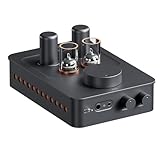
There are two kinds of tube amplifiers on the market. One kind uses tubes purely for aesthetics — a glowing vacuum tube perched above an otherwise solid-state circuit, providing the look of vintage audio without the substance. The other kind uses tubes throughout the actual amplification chain, letting the physics of those small glass cylinders shape every note that passes through the device. The Fosi Audio GR70 is firmly in the second camp. It is a genuinely all-tube headphone amplifier and preamplifier running a four-tube Class A circuit, and it delivers a listening experience that reviewers across multiple independent platforms describe with unusual consistency: warm, natural, open, and unexpectedly clean for a tube product in this price category.
The GR70 occupies a specific niche that was previously difficult to fill without spending considerably more money. If you wanted real tube amplification for headphones — not a hybrid design with a single decorative tube — your options at this price tier were limited, and they were often bulky, noisy, or unreliable. The GR70 changes the calculation. It measures 192mm long by 129mm wide and 46mm tall, weighing around 900 grams — substantial enough to feel serious on a desk, compact enough to coexist with other desktop gear without crowding everything out. It handles headphones from 16 to 300 ohms, serves double duty as a tube preamplifier for speaker systems, and includes bass and treble tone controls. For the category, it is a feature set that independent audio reviewers have described as genuinely punching above its weight.
The GR70’s market reception since its mid-2025 launch has been notably strong. On Head-Fi, the largest dedicated headphone community forum in the world, the GR70 has accumulated multiple detailed long-form reviews — an unusual distinction for a product this new and this affordable. The consensus portrait that emerges from those reviews is of a product that offers a genuine introduction to tube amplification without the usual noise floor compromise, housed in a build quality that holds its own against significantly more expensive competition.
Key Features & Tech Specs Explained
Pure Class A Quad-Tube Architecture: Why Four Tubes Instead of One
The GR70’s most fundamental design decision is its four-tube, two-stage amplification circuit operating in Class A. Understanding why this matters requires a brief look at how tubes work. A vacuum tube amplifies an audio signal by controlling the flow of electrons between a heated cathode (the electron source) and an anode (the collection point) through a grid that regulates current with great sensitivity. The character of the amplification — its harmonic signature, its tonal texture, the particular “sound” of the tube — emerges from this process and varies with the specific tube type, circuit topology, and operating conditions.
The GR70 uses two types of tubes in a deliberate division of labor. The two 5654W tubes, manufactured by General Electric and classified as NOS (new old stock — genuine vintage components from an earlier era of production), handle the voltage amplification stage. Think of this as the first stage of the signal journey: the 5654W receives the incoming audio signal from your source and amplifies its voltage, shaping the tonal character in the process. These tubes are known in the audio community for smooth, detailed, silky-midrange performance. The two 6AC7 tubes — also NOS, military-specification components originally produced for radar and communications equipment during World War II — handle the power amplification stage. Their job is to take the voltage-amplified signal and convert it into actual current output, providing the drive needed to push headphone drivers. The use of metal-can 6AC7s is genuinely unusual in headphone amplifiers: independent reviewers note they are difficult to find in any competitor product at any price, which is one reason the GR70’s sonic character is hard to replicate. Fosi Audio ships the tubes separately from the unit for protection during transit — you seat them into the sockets yourself during setup, an easy process documented in the manual.
Class A operation means both tube stages are always conducting current, regardless of whether a signal is present. This is the same principle that makes Class A amplification associated with low crossover distortion and smooth, natural signal handling: the amplification device never switches off, never has to recover from an off state, and never introduces the subtle switching artifact that Class AB designs trade for their greater efficiency. At headphone power levels, the modest heat generated by Class A operation is manageable within the GR70’s aluminum chassis.
The Impedance Interaction Effect: A Feature, Not a Bug
The GR70’s Hi/Lo impedance switch is not simply a gain control dressed up with a different label. It changes the amplifier’s output impedance — how much resistance the amplifier itself presents to the headphone load — and this has a measurable, audible consequence that experienced tube amp reviewers have documented carefully.
Some headphones, particularly older and audiophile-grade dynamic driver designs like the Sennheiser HD600 and HD650 series, have impedance curves that are not flat across the frequency spectrum. The HD600’s impedance, for example, rises dramatically around 100Hz — the bass region — reaching over 500 ohms at that frequency before settling back down. When paired with an amplifier that has non-trivial output impedance (as tube amplifiers naturally do, and as the GR70’s Hi-Z mode exemplifies), the physics of the headphone and amplifier interacting creates a real bass emphasis at the frequency where the headphone’s impedance peaks. This is sometimes called impedance coupling, and it’s an effect that digital EQ cannot replicate because it changes the actual electrical interaction between source and driver. Independent reviewers who measured the GR70 with multiple headphones documented approximately 1 to 3dB of additional bass weight in the midbass region on high-impedance headphones when using Hi-Z mode — a warm, full-bodied character that many listeners specifically seek from tube amplification. On headphones with flat impedance curves, the Hi/Lo switch has less pronounced but still audible effects. The Lo-Z mode, designed for 16 to 120 ohm headphones, presents lower output impedance and delivers a more controlled, tighter presentation appropriate for modern dynamic headphones and IEMs.
Power Output and Headphone Compatibility
The GR70 delivers a rated 90mW per channel into 32 ohms, with a peak maximum of 300mW at 32 ohms. These numbers require context to interpret correctly. The rated 90mW figure is conservative — it represents the power level at which the specified distortion rating applies — while 300mW is the maximum the circuit can deliver before distortion rises to the audible range. For listeners with sensitive headphones in the 90dB/mW sensitivity range or above, and impedance between 32 and 300 ohms, this power envelope is fully adequate for satisfying listening volume with meaningful dynamic headroom. Multiple independent reviewers confirmed the GR70 driving headphones from easy-load IEMs through to the Sennheiser HD650 (300 ohms) without strain at normal listening volumes.
Where the GR70’s power budget runs into practical limits is with planar magnetic headphones — a family of driver technology that typically requires significantly more current to reach appropriate listening levels than conventional dynamic drivers. Independent reviewers who tested the GR70 with planar headphones rated at 32 ohms and 90dB efficiency found adequate performance at moderate volumes, but noted that demanding bass-heavy tracks at high levels pushed the amplifier toward its limits. This is a well-understood characteristic of tube amplifiers at this power tier: they excel with dynamic driver headphones, particularly high-impedance designs, but are not the natural first choice for power-hungry planar magnetics.
The SNR rating of ≥97dB is a pleasingly high figure for a tube design — many budget tube amplifiers exhibit audible hiss that raises their effective noise floor. Multiple independent reviewers who tested the GR70 with sensitive IEMs specifically called out the unusually low noise floor as a positive surprise: the GR70 stays quiet even when the headphone is highly efficient. One documented caveat worth noting: the GR70 uses genuine vintage vacuum tubes in an exposed configuration, which makes it more susceptible to electromagnetic interference from nearby devices. Placing a WiFi router or mobile phone directly beside the unit can introduce audible noise through the tubes — a behavior Fosi Audio notes in the manual and advises users to mitigate by keeping EMI-generating devices at a distance.
Two-in-One Functionality: Preamp and Headphone Amp Simultaneously
The rear panel of the GR70 provides both RCA inputs and RCA outputs, and the preamp output remains active even when headphones are connected — both outputs operate simultaneously. This is a more system-friendly design than many headphone amplifiers that disable the preamp output when the headphone jack is occupied. In practice, it means the GR70 can anchor a desktop audio system as a tube preamp stage for a speaker amplifier, while also serving as the headphone amp for the same listener. Users in forum discussions have exploited this to build multi-zone listening configurations: the GR70 handles both the headphone circuit and the speaker circuit from a single source connection without requiring any switching.
Build Quality & Design
The GR70’s chassis is milled from CNC-machined aluminum alloy with a matte black anodized finish and ventilation cutouts on both sides to allow airflow around the tubes during extended operation. At 900 grams it has genuine desk presence — it doesn’t slide around when you operate the controls, and it feels substantially built in a way that users across multiple review platforms specifically noted exceeds expectations for its tier. The control layout is functional if slightly unusual: the large combined power-and-volume knob sits on the top surface, turned clockwise from its zero detent to power on and control volume simultaneously. This design is clean and minimalist, but it carries a minor inconvenience that independent reviewers noted — it is easy to accidentally power off the unit when trying to make a small volume adjustment if you turn the knob too far counterclockwise. Users who prefer to leave their amp set at a fixed listening volume and use their source’s volume control will sidestep this entirely.
On the front panel, three additional knobs handle bass, treble, and the Hi/Lo impedance switch, along with the dual headphone outputs (3.5mm and 6.35mm). The tone control knobs have a pleasingly weighted resistance that provides tactile feedback during adjustment, and centers on a detent that represents the neutral position. Fosi Audio acknowledges on their product page that the bass and treble knob labels are arranged in the reverse order from what many users expect coming from other hi-fi equipment (bass on the left, treble on the right is the more traditional convention) — a quirk that experienced reviewers mention but universally describe as a minor orientation adjustment rather than a usability problem.
The four tubes are fully exposed on the top surface — a deliberate aesthetic choice that showcases the warm amber-and-orange glow of the vacuum tubes during operation, particularly striking in a dim listening environment. Two of the front tubes (the 5654W) include acrylic protection covers in the box; the two rear 6AC7 tubes have their own metal housings, which is part of their military-specification design heritage and makes them inherently more physically robust than glass-bodied equivalents.
Sound / Performance
The GR70’s sonic character is best described as warm and natural without crossing into thick or syrupy territory — a distinction that multiple experienced tube amp reviewers made explicitly, often with some surprise. This is a genuine all-tube amplifier, and the expectation coming in is often that such a device will heavily color the sound in a romantically warm direction. What the GR70 delivers instead is a sound that adds tube character in a controlled and musical way: a subtle richness in the midrange, a sense of dimensional depth and spaciousness in the soundstage, and a natural decay on notes that makes instruments feel more like live sound rather than reproduced recordings. The bass is not loose or bloated — reviewers consistently describe it as controlled and well-textured, with the midbass warmth being pleasant rather than overwhelming.
The midrange is where the GR70’s tube character is most immediately apparent and most appreciated. Vocals take on a natural presence and intimacy that solid-state amps at this price rarely achieve — the kind of forward, three-dimensional quality that makes a singer feel close. Acoustic instruments, particularly piano and strings, have additional body and texture. The 5654W tubes’ documented reputation for smooth midrange performance appears to deliver in practice. Multiple reviewers who ran the GR70 alongside significantly more expensive solid-state amplifiers noted the midrange as the area of clear tube advantage.
The treble is smooth and well-extended without harshness. Independent reviewers who tested the GR70 specifically with headphones known for bright or fatiguing upper frequency responses — such as certain vintage Japanese dynamic headphones and various IEM designs — found that the GR70’s natural treble smoothing made previously difficult-to-listen-to headphones enjoyable without sacrificing detail. This effect is the GR70 doing one of the things tube amplification does best: taking off the edge of upper-frequency sharpness in a way that sounds organic rather than filtered.
The measured distortion figure for the headphone output — ≤0.5% THD — is worth contextualizing for readers who may approach it as a red flag. In tube amplifiers, distortion at this level is primarily even-order harmonic distortion, which is the same type of distortion that occurs in acoustic instruments and is perceived as musical and pleasant by human hearing. It is fundamentally different in character from the harsher odd-order distortion that typically accompanies solid-state amplifiers driven into clipping. An AVS Forum reviewer with a high-end solid-state reference amplifier (the Schiit Jotunheim 2) noted that the GR70 sounded more “in the room” and immersive on the Sennheiser HD6XX pairing, even while acknowledging the Jotunheim’s superior measurement performance.
Real-World Use Cases
The GR70’s ideal primary use case is the desktop headphone listening station anchored around dynamic driver headphones — particularly medium-to-high impedance designs in the 80 to 300 ohm range. Users with the Sennheiser HD600, HD650, HD6XX series, or similar high-impedance studio reference headphones repeatedly emerged in independent reviews as the best-matched pairing, largely because the GR70’s impedance interaction effect delivers a natural bass warmth that complements these headphones’ somewhat lean low-end character. The result is a sound that several reviewers described as approaching the combination of a high-quality vintage tube amplifier with these headphones — an effect that would previously have required spending substantially more money.
As a tube preamplifier in a speaker system, the GR70 integrates naturally between a source or DAC and a power amplifier. Users running JBL monitors, flat-response studio speakers, or passive bookshelf speakers paired with a separate power amplifier found the GR70’s tube warmth useful for adding analog character to speaker setups that reproduce music with clinical accuracy. The RCA output provides a 1.2V signal level sufficient to drive virtually any power amplifier or active speaker to full output. Tone control functionality is preserved through the preamp output, giving the GR70 the ability to add both tonal shaping and tube warmth to a desktop speaker chain in one device.
Setup requires inserting the tubes before first use — a simple process of aligning the pins and pressing each tube gently but firmly into its socket. After connecting a source via RCA and powering on, the GR70 requires approximately 20 seconds of warm-up time, indicated by an audible chime when the circuit is ready. No sound plays during warm-up, which can initially surprise users expecting immediate output. Fosi Audio’s manual specifically advises against plugging or unplugging cables while powered on, and recommends keeping EMI sources such as wireless routers and smartphones at a distance from the exposed tubes.
What Real Users Are Saying
Based on the concentrated body of independent reviews from experienced audio community members, the three aspects of the GR70 that most consistently generate enthusiastic feedback are: the build quality relative to price, the genuinely quiet noise floor (described as remarkable for an all-tube design), and the specific synergy with high-impedance Sennheiser headphones. Users with the HD600, HD650, and HD6XX series describe a particularly pleasing interaction between those headphones and the GR70 that multiple reviewers felt justified the amp as a dedicated pairing even if they owned more powerful solid-state alternatives. Several reviewers conducted direct comparisons against amplifiers costing three to five times more and described the GR70 as competitive or preferable in specific musical genres, particularly with acoustic and classical recordings.
The aspect of the GR70 that most consistently exceeded reviewer expectations was how uncharacteristically quiet and controlled the amplifier behaves for a product with fully exposed all-tube circuitry. Reviewers who tested it with sensitive IEMs in the low-impedance mode reported no audible hiss even during quiet passages — an outcome that led several to specifically contrast the GR70 with other budget tube amps they had owned that suffered from audible noise floors. The cleanliness of the noise floor also contributed to what reviewers described as a sense of black, dimensional soundstage: instruments and vocals felt clearly positioned and separated against a quiet background.
In community discussions, a recurring creative application is using the GR70 as both a headphone listening stage and a simultaneous tube preamp in the signal chain for desktop speakers — the simultaneous active output of both the headphone jack and the RCA preamp out enabling a persistent, always-on listening hub that doesn’t require cable swapping. Users have also rolled the stock tubes for sonic variety: the 5654W front tubes accept the commonly available 6AK5 and 403A tube families as substitutes, and several reviewers noted meaningful tonal changes from different variants. This tube-rolling potential adds a layer of long-term flexibility that extends the GR70’s useful life and allows owners to dial in their preferred sound signature over time.
Pros & Cons
Pros:
- Genuine all-tube Class A amplification using NOS (new old stock) General Electric 5654W and military-spec 6AC7 vacuum tubes provides authentic tube character that hybrid designs cannot fully replicate, based on independent technical evaluations and user feedback.
- Unusually low noise floor for an all-tube design — independently verified as quiet with sensitive IEMs in low-impedance mode — addresses the most common criticism of budget tube amplifiers, based on third-party listening evaluations.
- Hi/Lo impedance switch creates measurable, musically beneficial impedance interaction with high-impedance headphones like the Sennheiser HD6XX family, naturally adding bass body in a way digital EQ cannot replicate, confirmed by independent measurements.
- Headphone output and RCA preamp output function simultaneously, enabling persistent dual-use as both a headphone amplifier and tube preamplifier in a desktop speaker system, based on spec analysis and user feedback.
- CNC-machined aluminum chassis with substantial 900g build weight provides a premium physical presence that independent reviewers consistently rate above expectations for the price tier, based on user feedback.
- Compatible with tube rolling (5654W sockets accept common 6AK5 and 403A compatible tube variants), allowing owners to tune sonic character through tube selection over the product’s lifetime, based on user feedback.
Cons:
- Maximum 300mW output into 32 ohms is sufficient for dynamic driver headphones up to 300 ohms, but may not provide enough headroom for power-hungry planar magnetic headphones during demanding musical passages, based on third-party listening evaluations.
- Exposed tube design is susceptible to electromagnetic interference from nearby WiFi routers and mobile phones, which can introduce audible noise; requires mindful placement on the desktop, based on user feedback and manufacturer documentation.
- Combined power and volume knob can be accidentally turned off when making small volume adjustments; users who prefer leaving their amp at a fixed volume will find this less inconvenient, based on user feedback.
- No passive RCA signal passthrough when powered off — the signal path is fully interrupted when the unit is switched off, which limits flexibility in certain multi-component setups, based on spec analysis and user feedback.
- No balanced output (4.4mm or XLR); users who require balanced connectivity for their headphones will need to look at higher-tier options, based on spec analysis.
Who Should Buy This?
The GR70 is purpose-built for two overlapping buyer profiles. The first is the headphone enthusiast who wants to experience genuine tube amplification for the first time — not a one-tube hybrid, not a product using tubes as aesthetic decoration, but a full Class A tube circuit with the harmonic character, spatial dimensionality, and midrange richness that the format is genuinely known for. At this price, the GR70 is the most accessible all-tube headphone amplifier that independent reviewers have documented as performing its job authentically. Listeners who have been curious about tubes but unwilling to invest in a full-sized, expensive setup will find the GR70 a low-risk, high-reward entry point.
The second ideal buyer is someone who already owns high-impedance dynamic driver headphones — particularly the Sennheiser HD6XX, HD600, HD650, or similar 150 to 300 ohm designs — and wants an amplifier that will bring out the best in those specific headphones. The impedance interaction between the GR70 and this class of headphones is documented and measurable, delivering bass warmth and a sense of natural, in-room dimensionality that multiple reviewers preferred over solid-state alternatives at several times the price for acoustic and vocal music. If you own these headphones and have been listening through a solid-state amp, the GR70 offers a genuinely transformative pairing. Users who want to add tube warmth to a desktop speaker system simultaneously — using the GR70 as preamp while also using it for headphone listening — will find the simultaneous active outputs a practical convenience that few competing products in this category offer.
Users who might be better served elsewhere include those who primarily drive planar magnetic headphones and listen at high volumes, those who need balanced output connectivity, and those who find EMI management constraints incompatible with their specific desktop setup. For users who want a combined DAC and tube headphone amp in a single device, the Fosi Audio GR40 (a hybrid design with a built-in DAC and Bluetooth) serves that use case at a lower price with a more compact footprint, though with a less purely tube-driven sonic character. The xDuoo MT602, another tube option in the category, offers more output power at lower cost but with a brighter sound signature and less tonal flexibility.
Verdict
Overall Score: 8.5 / 10 — Sound Quality: 8.5/10 (50% weight), Build Quality: 9/10 (20% weight), Features: 8/10 (20% weight), Value for Money: 9/10 (10% weight).
The Fosi Audio GR70 is one of those rare budget audio products that delivers on its core promise without compromise. All-tube Class A amplification using genuine NOS American military-spec components, in a desktop chassis that weighs almost a kilogram and looks handsome doing it, producing a sound that experienced reviewers who own expensive reference-class equipment describe as competitive or preferable for certain headphone pairings and music genres — that is a genuinely unusual package for this tier of the market. The GR70 won’t win a distortion measurement contest, and it doesn’t aspire to. What it offers is a listening experience that measures differently from what pure specifications predict: spatial, warm, natural, and involving in the way that has made tube amplification a persistent preference in audiophile circles for seven decades.
Its limitations are honest and easy to plan around. Power-hungry planars need a different amp. EMI-sensitive environments need thoughtful placement. Users who need balanced outputs should look higher up the product ladder. But for the considerably larger group of listeners who want to experience what tubes actually do to the sound — who own dynamic driver headphones, want a desktop-ready two-in-one headphone amp and preamp, and value build quality and authentic components over raw specification numbers — the GR70 is an enthusiastic recommendation. It is the entry point to tube amplification that the format has always deserved to have at an accessible price, and it performs that role with more credibility than the competition.
- Pure Tube-Amplification: The GR70 headphone tube amp combines vintage charm with modern tech, delivering authentic tube essence. Perfect for headphone enthusiasts, it pairs excellently with over-ear and in-ear headphones for superior audio
- Quad Tubes: Features two 5654W and two 6AC7 vacuum tubes for two-stage amplification. The 5654W tubes boost voltage, while the 6AC7 tubes handle power amplification. This setup delivers balanced, transparent, and textured sound
- User-Friendly Design: This tube headphone amp preamplifier offers intuitive controls, including a large volume knob, dual-side ventilation holes, bass & treble controls, high and low impedance mode switching, making it versatile enough