Fresco Launches Complete Update of KitchenOS Platform, Aiming to Bring Control to More Real-Time Product Devices
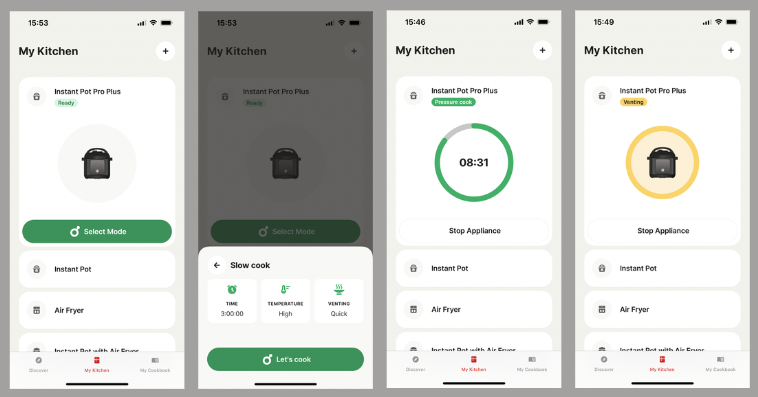
Today, Fresco announced the launch of its KitchenOS platform, a renaissance of the smart kitchen software suite. As part of the announcement, the company revealed that Instant Brands, makers of the popular Instant Pot smart pressure cooker, will be the first brand to launch the new KitchenOS with the Instant Pot Pro Plus.
The new KitchenOS, which includes new firmware, apps, and smart recipes, is the result of a two-year effort by the Dublin-based company designed to enable multi-tasking control and a new personalized user experience.
In an interview with The Spoon, Fresco’s CEO, Ben Harris, said the company realized in 2021 that in order to achieve a sustainable approach to the smart kitchen, they would have to rebuild the platform from the ground up. They began operating in a new location, accelerating their pace last year after a Series B investment of $20 million.
“When we introduced the Drop scale nine years ago, we received a lot of interest from appliance manufacturers who saw the need for a neutral kitchen platform and the inevitability of a single interface across the kitchen and their expectation that there would be a single screen for orchestration,” said Harris. “They all want back-end infrastructure, they all want applications, they want IoT written for them, but customized with the same things under the hood.”
This led to more partnerships and more custom-built applications for electronic products, but the problem, according to Harris, was that as incoming requests began to multiply for custom-built customer-facing applications, it really started to reduce the company’s ability to build products.
“We’re going to fix something on the platform over here, and it’s going to cause problems over there,” said Harris.
According to Harris, the company faced three major problems during this period. First, they had to create a new firmware for every single device, which meant it took nine months to launch a new product. Second, the company had to create a new UI for all the devices. And finally, they had to create new recipes for the machine to work with the firmware and the operating system.
Limited communication of different products was another problem. Because each brand had its own custom operating system and completely different firmware, appliances of one brand could communicate with other appliances of another brand through the Fresco app. Harris and the Fresco team knew that to deliver on the promise of a smart kitchen, this would need to change.
At the same time that they realized that this approach was not dangerous, Harris and the rest of the team began to discuss the evolution of the Fresco platform with one of the company’s advisors, Steve Horowitz. Horowitz, who was added to the board when his company invested in Fresco (then Drop), was with Google in the early days of Android and helped lead the engineering team that created what would become one of the world’s leading mobile apps.
In 2021, the company went back to the drawing board and began rethinking how to build a scalable platform that didn’t require building new custom applications and delivered with the promise of true machine-to-machine connectivity. To achieve this, the company began working on what Harris described as a universal firmware and UI for electronics that will work with all devices connected to the Fresco platform.

According to Harris, getting there required a step back to assess the compatibility of all appliances and a rethinking of the company’s approach to the kitchen appliance space.
“We were building electrical appliances according to their category, such as stand mixer, oven, blender,” said Harris. “But we actually realized that we needed some kind of communication layer between the recipes and between the electronics.”
Harris says that this retrospection made them realize that there are 77 common cooking methods in the kitchen – such as baking, broiling, steaming, etc.
“All of a sudden, we now had, architecturally, from the back end and from a customer UI perspective, this universal set of concepts that we can have to join recipes and machines, and have control over appliances,” Harris said. “We’ve redesigned the consumer experience with this multi-modal appliance control that sits within our partner apps, to reflect this top-to-bottom experience that ultimately allows us to offer the vision of this universal appliance control that can organize all of your appliances.”
This new approach will need to be bought in by their partners. That’s because it will require each machine to have a new firmware and a new operating system that includes access to a regular Fresco account alongside the electronic product account. From the customer’s point of view, it is this identification of a single Fresco account, which resides between different brand applications, that can enable cross-brand connectivity.
“When you set up an account with partner apps, you’re basically agreeing to set up a dual account with Instant Brands and Fresco at the same time,” Harris said. “And you agree to the terms and conditions of Instant Brands and Fresco. Then that allows both the individual tenants of Instant Brands and each partner, and the kind of connection that Fresco brings.”
One obvious concern that appliance brands may have with having a single Fresco account embedded within different applications to connect products across is that customer data privacy is protected for both the customer and individual products. According to Harris, that privacy was a priority for them in the design of their new platform.
“That’s a real, clear, hard line,” Harris said. Harris said that each brand would get its own “data warehouse for lack of a better term”, and they ensured that each set of data would comply with all data privacy laws. Harris said that when a customer logs in, their data will be part of an aggregated, anonymized database used to help electronics manufacturers build better products. But, in the end, “no one sees someone else’s user data, and they have their own electronics and their own users to communicate with.”
In addition to the new structure to allow the interaction of various devices, Fresco also focused on the reconstruction of the customer experience, using design principles from the likes of Apple Watch and other Apple Carplay to help guide users during cooking. Unlike early guided cooking platforms, however, Fresco focuses on ensuring that the user will have as much or as little help as they need and makes sure to convey clear information to customers in a way that ensures they are informed and in control.
In rethinking the customer experience, Harris gave a big shout out to Wire writer Joe Ray, whose review of the Drop/Fresco platform gave them clarity on what they needed to focus on.
“Joe Ray has done an amazing job of announcing problems with the experience we’ve built. And obviously that was the catalyst for the process, in checking the basics, and asking ourselves if we’re delivering on our promises.”
According to Harris, the complete redesign of the code base was a long and arduous process, but it was necessary given the direction of the smart home and smart kitchen. He pointed to Matter (he says Fresco will integrate as devices comply with Matter), and how all the major smart home brands were compliant with the standard. However, kitchen products, he pointed out, were very different and needed a platform like Fresco.
“This is where the future is, this is what Matter is building,” said Harris. “All these devices are starting to work together in any environment. We’re just accelerating to deliver it today, instead of waiting years before that problem becomes a reality.”