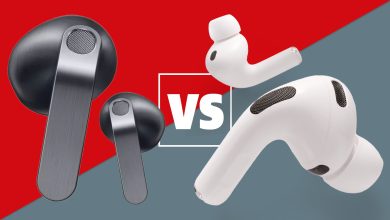
Samsung Galaxy Buds 4 Pro vs Bose QuietComfort Ultra (2nd Gen): $249 vs $299
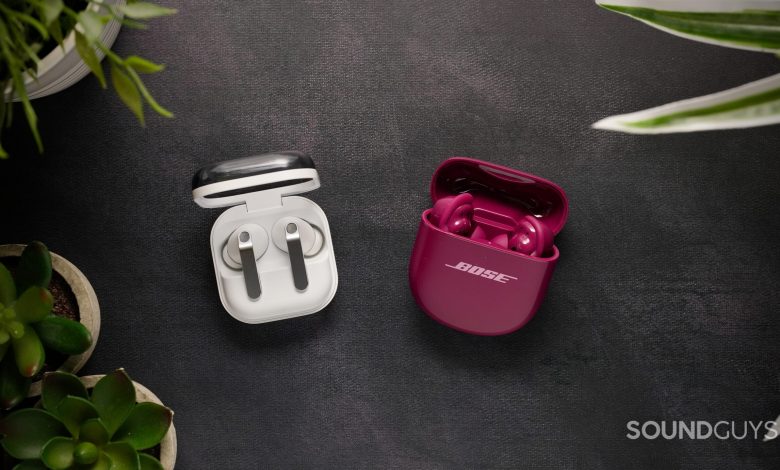
Samsung’s Galaxy Buds 4 Pro cost $249 and lean heavily into Galaxy phone features, while Bose’s QuietComfort Ultra Earbuds (2nd Gen) come in at $299 with a focus on noise canceling and cross-platform flexibility. Both score highly in our lab tests, but their tuning and feature priorities are very different. So let’s break it all down and find out which pair of earbuds makes more sense for you.
This article was originally published on March 1st, 2026, and is the first version.
What’s it like to use the Samsung Galaxy Buds 4 Pro compared to the Bose QuietComfort Ultra (2nd Gen)?
Samsung’s stem design contrasts with Bose’s stabilizer band fit.
The Samsung Galaxy Buds 4 Pro use a stem-style design, which makes the earbuds easier to adjust in your ears and gives you a clear surface for squeeze and swipe controls. They’re smaller and lighter than Bose’s pair and sit fully inside the ear without stability fins, keeping the fit and look less bulky overall. The case is slimmer and easier to pocket, and on a recent Galaxy phone, pairing and device switching feel tightly integrated. They also carry an IP57 rating, which offers stronger dust- and water-resistance than Bose’s IPX4 rating.
The Bose QuietComfort Ultra Earbuds (2nd Gen) are larger and use stability bands to lock into place instead of stems. If you have medium to large ears, they feel secure and stable, and that strong seal plays a significant role in their ability to cancel noise. The touch controls are customizable and straightforward through the Bose app, and Bose includes true Multipoint for connecting to two devices at once. The case is bulkier than Samsung’s but adds wireless charging for extra convenience.
Do the Samsung Galaxy Buds 4 Pro or the Bose QuietComfort Ultra (2nd Gen) have more features?

The app is the primary control point for advanced options.
The Samsung Galaxy Buds 4 Pro lean heavily into ecosystem-driven features, especially if you’re using a recent Galaxy phone. You get built-in EQ presets through the Galaxy Wearable app, along with Adapt Sound, spatial audio, Auracast support, and Samsung Seamless Codec on compatible devices. The EQ presets let you customize your sound without third-party tools. However, many of the higher-end features are tied to newer Galaxy hardware, so the whole experience depends on your phone.

Harley Maranan / SoundGuys
The main app interface for the Bose QuietComfort Ultra Earbuds and Bose QuietComfort Ultra Earbuds (2nd Gen).
The Bose QuietComfort Ultra Earbuds (2nd Gen) focus more on onboard listening tools and customization. They include spatial audio, customizable listening modes, in-app fit testing, and support for Snapdragon Sound features on compatible devices. Bose also allows shortcut customization through the app. That said, the three-band EQ remains limited, offering less precise control compared to Samsung’s preset system.
How do the Samsung Galaxy Buds 4 Pro and Bose QuietComfort Ultra (2nd Gen) connect?

The Galaxy Buds 4 Pro case is slimmer and lacks wireless charging, while Bose’s larger case supports Qi charging.
The Samsung Galaxy Buds 4 Pro use Bluetooth 6.1 and support SBC and AAC, along with Samsung Seamless Codec on compatible Galaxy devices. Pairing is fast on Samsung phones, and switching between devices within the Galaxy ecosystem feels automatic. However, they do not support true Multipoint, so you can’t stay connected to two devices simultaneously. Switching between a phone and a laptop requires manual reconnection.
The Bose QuietComfort Ultra Earbuds (2nd Gen) use Bluetooth 5.3 and support SBC, AAC, and the aptX Adaptive family, including aptX Lossless on compatible Snapdragon Sound devices. Bose includes true Multipoint, allowing the earbuds to remain connected to two devices at once. That makes them more convenient if you frequently move between a phone and a computer during the day.
Is battery life better on the Samsung Galaxy Buds 4 Pro or the Bose QuietComfort Ultra (2nd Gen)?

Compact fit from Samsung, locked-in feel from Bose.
The Samsung Galaxy Buds 4 Pro lasted 6 hours and 1 minute in our standardized ANC battery test. That result aligns closely with Samsung’s 6-hour rating and keeps them competitive with other flagship earbuds. The charging case supports multiple additional charging ports via USB-C, but it does not support wireless charging.
The Bose QuietComfort Ultra Earbuds (2nd Gen) lasted 5 hours and 34 minutes in the same ANC test. While per-charge endurance falls slightly short of the Samsung earbuds, the Bose case supports both USB-C and Qi wireless charging, which adds flexibility for desk or bedside charging.
Do the Samsung Galaxy Buds 4 Pro or the Bose QuietComfort Ultra (2nd Gen) block noise better?
On average, the Bose QuietComfort Ultra Earbuds (2nd Gen) reduce outside noise by 85%, while the Samsung Galaxy Buds 4 Pro reduce noise by 84%. In practical terms, that’s nearly identical overall attenuation.
The difference comes down to fit and consistency. Bose combines active noise canceling with its stabilizer band design to help maintain a secure seal during movement. Samsung relies entirely on the ear tip seal, but still delivers strong low-frequency attenuation where ANC matters most for travel and commuting.
Across the midrange and higher frequencies, both earbuds follow similar attenuation patterns, with slight variations depending on fit and ear shape. As always, effective noise canceling starts with a proper seal in your ear canal. Even a slight break in the seal can reduce performance.
On paper, this is essentially a tie. Comfort and fit will likely determine which one performs better for you.
Do the Samsung Galaxy Buds 4 Pro sound better than the Bose QuietComfort Ultra (2nd Gen)?

Closer to our preference curve versus a more pronounced V-shaped tuning.
The answer depends on what kind of sound you prefer.
The Samsung Galaxy Buds 4 Pro follow our headphone preference curve more closely overall. Bass strength is elevated but restrained, and the upper mids and treble avoid the sharper peaks seen in Bose’s tuning. That results in a more even balance across bass, midrange strength, and brilliance, particularly on vocal-heavy tracks. Samsung also includes built-in EQ presets, allowing you to adjust the sound profile if needed.
The Bose QuietComfort Ultra Earbuds (2nd Gen) take a more aggressive approach. Bass strength is significantly elevated below 100Hz, and brilliance in the upper frequencies is also pushed higher than our target curve. This creates a pronounced V-shaped presentation with stronger low-end impact and brighter highs. Some listeners will enjoy the added emphasis at both ends of the spectrum, while others may find the contrast between bass and mids more noticeable over long listening sessions.
Objective Measurements
The Samsung Galaxy Buds 4 Pro track our preference curve more closely overall. Bass is elevated, but not to the same degree as Bose. Through the midrange, Samsung stays relatively controlled, without the same dip-and-spike behavior. In the upper frequencies, the Buds 4 Pro still show some elevated treble, but the rise is more restrained compared to Bose’s sharper peaks.
The Bose QuietComfort Ultra Earbuds (2nd Gen) show significantly elevated bass below about 100Hz, sitting well above our target curve in the sub-bass and mid-bass regions. That extra low-end emphasis gives them a heavier, more powerful presentation, but it can also overshadow midrange detail. In the upper mids and treble, Bose also pushes higher than the curve, particularly around the 3kHz region and again above 8kHz. This explains why they can sound both punchy and bright at the same time.
In short, Bose leans toward a more aggressive V-shaped tuning, with boosted bass and treble, while Samsung stays closer to our target curve with a smoother overall balance.
How would most people rate the sound from 1 to 5?

Samsung’s strong Timbre and slightly better Distortion score help secure its 4.8 overall rating.
Both earbuds earn an overall score of 4.8 out of 5 in our Multi-Dimensional Audio Quality Scores (MDAQS).
The Samsung Galaxy Buds 4 Pro score 4.9 in Timbre, 4.3 in Immersiveness, and 3.7 in Distortion. That reflects strong tonal accuracy, with slightly cleaner reproduction than Bose.

The Bose QuietComfort Ultra Earbuds (2nd Gen) also earn a 4.8 overall score, with slightly lower Distortion performance.
The Bose QuietComfort Ultra Earbuds (2nd Gen) also score 4.9 in Timbre and 4.2 in Immersiveness, but post a lower 3.2 in Distortion. That difference aligns with their more aggressive bass and treble tuning.
In practical terms, most listeners will rate both pairs highly. The overall scores are tied, but Samsung holds a small edge in distortion performance.
- Timbre (MOS-T) represents how faithfully the headphones reproduce the frequency spectrum and temporal resolution (timing information).
- Distortion (MOS-D) represents non-linearities and added noise: higher scores mean cleaner reproduction.
- Immersiveness (MOS-I) represents perceived source width and positioning: how well virtual sound sources are defined in three-dimensional space.
Do the Samsung Galaxy Buds 4 Pro or the Bose QuietComfort Ultra (2nd Gen) have a better microphone?
The Bose QuietComfort Ultra Earbuds (2nd Gen) deliver stronger call performance overall. With bone-conduction voice pickup enabled, they separate your voice from background noise more effectively in busy environments. Speech sounds clear and relatively natural, and wind noise is handled more consistently. For commuting or frequent calls in noisy spaces, Bose has the edge.
The Samsung Galaxy Buds 4 Pro perform well in quiet environments, where voices sound clear and present. In louder settings, however, more background noise comes through compared to the Bose. They’re perfectly usable for everyday calls, but they don’t isolate your voice as aggressively when the environment gets busy.
Take a listen to our samples below to hear the difference for yourself.
Samsung Galaxy Buds4 Pro microphone demo (Ideal conditions):
Bose QuietComfort Ultra (2nd Gen) microphone demo (Ideal conditions):
Samsung Galaxy Buds4 Pro microphone demo (Windy conditions):
Bose QuietComfort Ultra (2nd Gen) microphone demo (Windy conditions):
Which microphone sounds better to you?
71 votes
Samsung Galaxy Buds 4 Pro vs Bose QuietComfort Ultra (2nd Gen): Price and availability
The Samsung Galaxy Buds 4 Pro cost $249, while the Bose QuietComfort Ultra Earbuds (2nd Gen) cost $299. That $50 difference makes Samsung the more affordable option at full retail.
If price is your main concern, the Galaxy Buds 4 Pro offer similar overall performance for less money. Bose commands a premium, but that added cost goes toward features like true Multipoint and broader platform compatibility.
Should you get the Samsung Galaxy Buds 4 Pro or the Bose QuietComfort Ultra (2nd Gen)?

IP57 durability versus IPX4 protection.
The real difference here comes down to sound tuning and feature priorities. Both perform well in our lab tests, and noise canceling is effectively a tie. The bigger separation is in tuning, connectivity, flexibility, and price.
If you use a recent Galaxy phone and prefer a tonal balance that stays closer to our preference curve, the Samsung Galaxy Buds 4 Pro make more sense. They offer IP57 durability, built-in EQ presets, and a lower starting price. Their presentation is less exaggerated in the bass and treble, which may appeal to listeners who want a more even tonal balance.
If you prefer stronger bass strength, brighter upper frequencies, and proper multipoint connectivity, the Bose QuietComfort Ultra Earbuds (2nd Gen) are the better fit. They also deliver stronger call performance and work smoothly across Android devices and iPhones without ecosystem restrictions.
Neither pair is objectively better overall. The right choice depends on whether you prioritize tonal balance and value, or a more pronounced V-shaped sound with broader device flexibility.
Get the Samsung Galaxy Buds 4 Pro if you:
Get the Bose QuietComfort Ultra (2nd Gen) if:
-
Want true Multipoint to stay connected to two devices at once
-
Prefer a bass-forward, brighter V-shaped presentation
-
Make frequent calls and want stronger background noise rejection
Which earbuds would you buy?
40 votes
Thank you for being part of our community. Read our Comment Policy before posting.