PSI A21-M Review – HiFiReport
PSI, it’s truly a case of “better late than never” in our acquaintance.
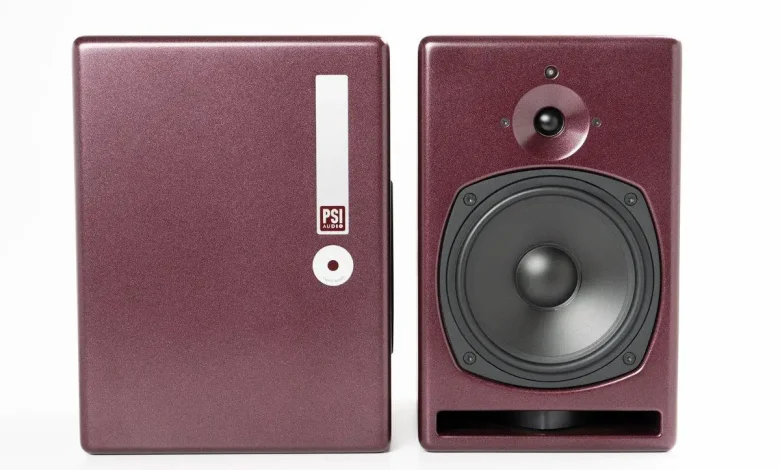
My first encounter with PSI was at MidiMall in Neihu. Paul, the owner, personally gave me a tour of the company, introducing many professional recording equipment. Among them, a pair of small, wine-red bookshelf speakers placed on the recording console caught my attention. They looked familiar, yet I couldn’t quite place the brand. Paul said, “This is PSI, Swiss-made monitoring speakers, known for being purely analog and incredibly capable.”
Swiss Design & Build
Hearing “Swiss design and manufacturing,” my immediate thought was that they must be expensive. However, Paul mentioned that they are actually reasonably priced, representing genuine Swiss craftsmanship, handcrafted in their factory. Moreover, every pair of PSI speakers undergoes comprehensive measurements in their in-house anechoic chamber before leaving the factory. Each pair comes with its own acoustic data, demonstrating a level of professionalism beyond question.
I borrowed the A21-M for a test. The wine-red cabinet and compact size, even for professional studio monitors that often prioritize function over form, showcased excellent build quality. While not boasting a high-gloss piano finish, the surface polishing was remarkably refined.
Brand History: Since 1975
The story of PSI, a Swiss company, began with its founder, Alain Roux. In 1975, while still a university student in Lausanne, he started building speakers for others. Business must have been good because two years later, in 1977, he founded Roux Electroacoustique, specializing in electroacoustic products. In 1988, the company was renamed Relec SA and moved to Yverdon-les-Bains.
However, PSI speakers didn’t emerge until later. Alain Roux initially produced numerous Hi-Fi speakers and professional PA equipment, along with extensive OEM manufacturing. Among their most notable OEM clients was Studer. From 1992 to 2003, Relec SA exclusively designed and manufactured professional studio monitors for Studer, including the globally best-selling A1, A3, and A5 models. This demonstrates Relec SA’s strong R&D and manufacturing capabilities, allowing them to secure Studer’s OEM business for over a decade.
What happened next? In 2004, Studer changed ownership, and the new management decided to discontinue studio monitor production. That’s when the PSI Audio brand was born! If you’ve heard of Studer studio monitors but never experienced them, don’t worry, PSI Audio is here now, carrying on that legacy.
Design Philosophy: Textbook Principles
Regarding the design philosophy of studio monitors, PSI Audio emphasizes principles that are almost textbook fundamentals: flat frequency response, linear phase response, controlled diaphragm movement, accurate square wave reproduction, and so on. These are all concepts taught in audio engineering textbooks. However, PSI Audio has its own methods to achieve these goals, and these unique technologies are embedded within the A21-M.
What are these unique technologies? The first is CPR, which stands for Compensated Phase Response System, not cardiopulmonary resuscitation. The second is AOI, representing Adaptive Output Impedance system. These are the two core technological innovations in the A21-M.
CPR: Phase Response Compensation
CPR, or “Compensated Phase Response,” primarily focuses on correcting “time-phase” issues. In a two-way speaker design, the crossover network can introduce time-phase errors between the tweeter and woofer. Human hearing is more sensitive to these errors at higher frequencies and less so at lower frequencies. PSI Audio believes that human hearing is most sensitive in the 300 Hz to 3000 Hz range (frequencies above 3000 Hz are mostly harmonics). Therefore, CPR aims to ensure accurate time-phase alignment above 150 Hz.

How is this achieved? By slightly slowing down the tweeter’s output. Through the crossover, a minute group delay is applied, precisely aligning the timing of the mid-high frequencies with the low frequencies. How small is this group delay? Just 0.5 ms—extremely short, yet this tiny delay enables PSI Audio to achieve accurate time-phase coherence.
AOI: Driver Control
The second unique technology in the A21-M is AOI, which can be described as output impedance matching. This is implemented to ensure “controlled diaphragm movement.” When the power amplifier drives the speaker driver, the driver’s mechanical motion generates back electromotive force, and the speaker’s impedance also fluctuates, making it harder for the amplifier to maintain control.
The solution? AOI! This is PSI Audio’s proprietary feedback mechanism. It primarily senses changes in the voice coil current and feeds back to the amplifier module for instantaneous response, outputting stronger (or weaker) current to precisely control the driver diaphragm’s pistonic motion. In the A21-M, there are two AOI circuits, one each for the tweeter and woofer, allowing the amplifier module and driver impedance to be dynamically matched. The pure analog circuitry ensures that the AOI operates without any time delay.

This covers the technical aspects of PSI Audio. The company is indeed rich in technological substance, with much more to discuss. However, CPR and AOI are what set PSI Audio apart, so let’s focus on these two for now and return to the A21-M speaker itself.
In-house Tweeter Design
The A21-M utilizes a silk soft dome tweeter with a powerful neodymium magnet motor. Importantly, this is not an off-the-shelf unit; it’s a tweeter handcrafted by PSI Audio. This is no small feat.
Using readily available tweeters would be significantly more cost-effective. However, PSI Audio’s decision to handcraft their own, especially in Switzerland, undoubtedly raises production costs. The rationale is clear: stringent quality control.

This commitment to stringent quality control is further evidenced by the anechoic chamber test data provided with each pair of speakers. PSI Audio boasts a 160 square meter anechoic chamber to measure every PSI Audio speaker. Moreover, every component inside each speaker is tested and matched.
High SPL: 121dB Max Output
The A21-M’s tweeter is driven by a 45-watt Class AB amplifier module, while the 21 cm woofer is powered by a 280-watt Class G/H amplifier. This configuration is relatively uncommon. These are PSI Audio’s in-house developed modules, combining the accuracy of Class AB amplification with higher efficiency and minimal heat generation. Both power modules are equipped with AOI, enabling real-time impedance matching between the amplifier and drivers.
The A21-M is classified as a nearfield studio monitor, suitable for listening distances of 1 to 3 meters. On the front baffle, besides the two drivers, there’s an LED indicator above the tweeter, displaying the A21-M’s operating status. A lit LED indicates the A21-M is powered on. The LED also serves as a limiter indicator. When the A21-M is overdriven, the limiter automatically protects the speaker, and the LED will start flashing. If the speaker is further pushed to the point of power module overheating, the A21-M will automatically enter standby mode to protect itself. However, during my listening session, the LED only flickered once or twice, and that was when I deliberately pushed the volume to observe the limiter’s activation. The sound pressure level was incredibly high. The manufacturer specifies a maximum SPL of 121 dB for the A21-M. It’s best not to subject your ears to such levels unnecessarily.

Listening Setup: 868P & VOLT 176
During the A21-M listening test, I opted for two setups. One involved using the EAR 868P preamplifier with a YBA CDT-450 CD transport and Merging NADAC as the source. The other setup used the Universal Audio VOLT 176 audio interface directly connected to the A21-M, with a Macbook Pro as the source. The first setup leaned towards a home audio scenario, while the second resembled a typical DAW-based studio setup for the A21-M.
With the 868P preamp, the A21-M gained a touch of tube warmth, accurately reproducing the sonic characteristics of the front-end equipment. Using the VOLT 176, the A21-M exhibited greater transparency and transient response, more in line with the typical studio monitor profile. Especially with the VOLT 176’s built-in 1176 Compressor, the effect of engaging and disengaging it was clearly audible through the A21-M, confirming its “accurate” monitoring capability.
Bass Adjustment & Room Acoustics
However, achieving “accuracy” also requires user intervention. The A21-M’s rear panel features two knobs: “Level” controls the A21-M’s sensitivity, and “Roll Off” adjusts the bass level. The “Roll Off” is a crucial setting that needs careful adjustment. If the A21-M is positioned far from the back and side walls, it can be set to 0 dB. If placed close to a wall or recessed into a wall (a common studio installation method), the bass roll-off can be set to -6 dB. If the A21-M is placed in a corner, even greater roll-off is needed, with a recommended setting of -12 dB.

These are just reference values, however. The optimal setting should always be determined by actual listening tests in the specific room.
For instance, when I placed the A21-M on Solid Steel SS-6 speaker stands, positioned more than three meters from any wall, setting the bass roll-off to 0 dB resulted in ample and balanced bass. However, when I moved the A21-M to an IKEA desktop, paired with the VOLT 176 and Macbook Pro, desktop resonance caused excessive and somewhat muddy bass. This wasn’t an issue with the A21-M itself but rather the resonance of the desktop. Using IsoAcoustics stands helped a bit, but the desktop’s lack of mass still contributed to resonance. In this situation, reducing the A21-M’s bass roll-off became necessary.
In essence, the A21-M’s inherent sonic performance is accurate. However, room acoustics and resonance from surrounding surfaces can lead to excessive or deficient bass. To restore the A21-M’s accurate monitoring characteristics, appropriate adjustments to the bass roll-off are essential.
Sound Signature: Full & Engaging
In terms of sonic character, as I mentioned at the beginning, it’s truly a case of discovering PSI too late. Many associate studio monitors with a dry, clinical sound, necessary for critical evaluation of recordings. However, the A21-M presents a full, rich, rounded, and engaging sonic profile, fully revealing both the authenticity and beauty of recordings. It’s instantly appealing, sparking an impulse to buy a pair for personal use. However, for my desktop setup, the A21-M is a bit too large. If the smaller A14-M had arrived instead, I might have actually taken them home.
Pairing the A21-M with the 868P preamp added a touch of tube warmth to its accuracy. With a nearfield listening position in an equilateral triangle, roughly 2 meters from the A21-M and with speakers spaced about 2 meters apart, the soundstage naturally unfolded, and the speakers seemed to disappear. Listening to the Oscar Peterson Trio album “We Get Requests,” “Quiet Night and Quiet Stars,” the exquisite jazz trio performance was vividly rendered in the center stage. Piano was centered, double bass to the right, and drums to the left. The piano tone was full and rounded, with each note carrying a soft glow. The double bass delivered a full-bodied walking bass line.
Toe-in Sensitivity
Because the A21-M’s bass level is adjustable, you can tailor it to your preference. However, this also tests the user’s listening acuity. Achieving accurate bass reproduction in various placement environments requires spending some time with the speakers to master their adjustments. Initially, when I listened to the A21-M from a greater distance, I felt the bass was slightly excessive and tended to reduce the roll-off. However, by properly adjusting speaker toe-in, less roll-off was needed, approaching the 0 dB setting.
Listening to Anne-Sophie Mutter and John Williams’ “Across the Stars,” specifically “Rey’s Theme,” the violin melody floated centrally between the A21-M speakers, backed by the expansive orchestral soundscape. Being a crossover classical recording, the A21-M accurately reproduced the low frequencies, especially the slightly enhanced lines of the double basses, contrasting with the violin melody. Furthermore, the A21-M precisely conveyed the layering of the orchestral arrangement, with the brass and woodwind sections broadly positioned at the back of the soundstage, and the string section more forward, collectively supporting the solo violin line. Listening to music with the A21-M not only reveals the beauty of the music but also uncovers the subtle craftsmanship in the recording.
VOLT 176: Direct & Dry Sound
Switching to the VOLT 176 and Macbook Pro, the A21-M’s sound became noticeably drier, closer to a studio monitoring character. Using electric guitars for testing, the A21-M’s clear and articulate performance made adjusting various digital effects processors easy. Of course, the stereo A21-M setup provides a different listening experience compared to typical guitar amp setups, which are usually mono. Using A21-M for guitar monitoring requires adapting to its soundstage and spatial presentation. It doesn’t feel as direct or punchy as a guitar amp. However, these are different tools for different purposes and not directly comparable. Yet, I increasingly understand why many professional guitarists are adopting all-digital plug-in effects processors, recording directly into DAWs – it’s incredibly convenient, with zero noise. For single-coil pickups, noise gates can be easily engaged to eliminate hum.
Using the VOLT 176 audio interface with the A21-M, the sonic warmth is naturally less pronounced than with the 868P preamp. However, the A21-M’s response became more direct and cleaner. In a fully digital workflow, only a pair of balanced cables connects to the A21-M, allowing for clearer monitoring of the recording.
Listening to Johnny Cash singing “Hurt,” the VU meters on the VOLT 176 showed significant compression, even hitting the red zone. Through the A21-M, the slightly dry sound highlighted Johnny Cash’s weathered voice. The clear articulation of the acoustic guitar even captured subtle string buzz. The sustained piano chords intensified the emotional surge in the chorus of “Hurt,” before resolving back to the fingerpicked acoustic guitar chords, offering a moment of respite before the next emotional climax in the chorus.
Compression & Overload Clarity
Watching the VOLT 176’s meters, whenever they clipped into the red zone, the A21-M clearly revealed the slight distortion. Why would a recording studio do this? Because it’s the effect Johnny Cash and the recording engineers intended! “Hurt” was Johnny Cash’s comeback piece, filled with mixed emotions, a feeling of inadequacy in loving those who loved him. The intense emotion builds, and at its peak, it’s bound to be raw and strained. The recording shouldn’t strive for perfection; it should push into the red zone! Listening to Dire Straits’ classic “Money For Nothing,” the A21-M presented a beautiful soundstage, especially the ethereal quality of the intro. Synthesizers floated in the air, accompanied by Mark Knopfler’s seemingly boundless vocals. The drum beat gradually intensified, leading to the distorted power chords and the iconic guitar riff becoming distinct. The drum hits on the A21-M were crisp and punchy. Combined with Mark Knopfler’s overdriven guitar tone, it was truly exhilarating, especially in a nearfield setup, about 1 meter from the A21-M. The A21-M transformed into oversized headphones, sounding incredibly satisfying even at moderately loud volumes.
Pure Analog Architecture: Signal Path
Finally, I want to address the A21-M’s “pure analog” design. Using the VOLT 176 with the A21-M, the signal undergoes only one digital-to-analog conversion in the VOLT 176. In contrast, DSP active speakers, upon receiving an analog input, first perform an analog-to-digital conversion, then DSP crossover processing, followed by another digital-to-analog conversion before reaching the amplifier modules. This results in three conversions in the signal path. The A21-M’s pure analog path is clearly more streamlined.
Reluctantly returning the A21-M, I almost asked to keep them. Unfortunately, the A21-M is slightly too large for my desktop setup. However, this encounter with PSI Audio was truly eye-opening. Its accurate music reproduction capability, combined with monitoring the dB meters while listening, allows you to discern which recordings intentionally lower the recording level and which add significant compression. These recording techniques serve musical expression, ranging from delicate to raw. The A21-M accurately conveys the intended emotion of the recording.
Specifications
* Type: 2-way 2-driver bass-reflex bookshelf active speaker
* Drivers: 27 mm tweeter x 1; 210 mm woofer x 1
* Frequency Response: 38 Hz – 23 kHz
* Built-in Amplifier Power: 280 + 45 Watts
* Signal-to-Noise Ratio: 98 dBA
* Maximum SPL: 121 dB
* Analog Input: XLR x 1
* Crossover Frequency: 2.4 kHz
* Dimensions: 250 x 400 x 300 mm
* Weight: 12.8 kg