WiiM Sound Smart Speaker Review – HiFiReport
Overview
The WiiM Sound is a mid-range all-in-one wireless streaming speaker — WiiM’s first venture into the powered speaker market — that combines a custom-tuned 2-way driver system, 100W peak output, hi-res 24-bit/192kHz streaming, and a one-tap AI room correction system in a compact, vertically oriented cabinet. Launched in late 2025, the Sound represents a deliberate step by Linkplay Technology beyond the world of streamers and amplifiers into the territory where Sonos, Apple, and Naim compete for the living room. What makes the arrival notable is that WiiM has not hedged its ambitions: the Sound lands at a mid-range price that places it in direct competition with the Sonos Era 100 and Apple HomePod — two of the most established names in wireless speakers — and early reviews across multiple major publications suggest it more than holds its own.
The wireless speaker market is unusually mature and competitive. Sonos has defined the user experience benchmark for years, Apple’s HomePod competes on ecosystem integration, and established hi-fi brands like Naim and Bluesound play at the premium end. For WiiM to enter this space with a first product that draws favorable comparisons to a Naim Mu-So Qb2 — a unit costing well over twice as much — is a remarkable opening statement. AVForums tested the Sound as a direct replacement for the Naim unit in a real-world installation and found that the gap in performance did not justify the gap in price. Multiple reviewers echoed this conclusion independently. The WiiM Sound earned a Best Buy recommendation from Audacity Australia and strong endorsements from Audio T and AVForums within weeks of launch.
The WiiM Sound carries a 4.4-star rating on Amazon across its early reviews, though as a product launched in Q4 2025 its review volume is naturally still building. What it already has is an unusually broad base of independent professional coverage — more than most products accumulate in their first two months — all pointing in the same direction: a device that sounds better than its price suggests, is smarter than its size implies, and fits more flexibly into a mixed-platform household than any competing wireless speaker currently available. There are real limitations to acknowledge, particularly the absence of AirPlay, and we will address those with full honesty.
This review examines the WiiM Sound across six dimensions: its driver technology and feature set, build and display design, audio performance (with and without RoomFit), real-world placement and system-building scenarios, what early users and reviewers are reporting, and a clear verdict on where it sits in the crowded wireless speaker market.
Key Features & Tech Specs Explained
2-Way Driver System: Why Three Drivers Beat One
The WiiM Sound uses a 2-way driver configuration: one 4-inch paper-cone woofer handling bass and mid-bass, plus two 1-inch silk-dome tweeters covering the upper midrange and high frequencies. A precision crossover network divides the frequency bands and sends each frequency range to the driver optimized for it — think of it like a road junction that routes trucks (low frequencies, needing physical cone movement) and motorcycles (high frequencies, needing lightweight rapid movement) to separate lanes rather than having everything compete on the same path. This arrangement produces lower distortion at each driver because neither has to work outside its design range. The result is better separation between the bass and treble, cleaner transients, and the wider soundstage that multiple reviewers noted as a particular strength of the Sound.
The paper-cone woofer specifically is chosen for its combination of stiffness and natural damping — it moves accurately without introducing its own resonances at the top of its range. The silk-dome tweeters are prized for smooth, extended high-frequency response without the metallic hardness that cheaper dome designs can produce at volume. The total specified frequency response of 50Hz to 20kHz means the Sound reaches down to the lower registers of bass guitar and kick drum without a subwoofer — a useful baseline for a single-box speaker, though users who want genuine low-end extension for electronic music or film soundtracks will find the companion WiiM Sub Pro a natural pairing. Peak output is rated at 100W, which is generous for a unit of this size and contributes to the “sounds bigger than it looks” reaction consistent across multiple reviews.
AI RoomFit: The Feature That Levels the Playing Field
AI RoomFit is WiiM’s one-tap acoustic calibration system, and it is arguably the most discussed feature in every review of the WiiM Sound. When activated through the WiiM Home app, the system plays a series of measurement tones through the speaker and uses the microphone on your smartphone to capture how those tones sound in your specific room at your specific listening position. It then calculates a custom parametric EQ profile (a multi-point frequency adjustment) that compensates for the acoustic effects of your room — reducing bass boominess from wall proximity, taming room resonances, and improving tonal balance wherever you choose to place the speaker.
The practical significance of this feature cannot be overstated. Wireless speakers routinely end up in acoustically challenging positions — on kitchen countertops, bookshelves, windowsills — where reflections and nearby surfaces can severely color the sound. AVForums tested the Sound on a wooden sideboard above two hollow cupboards and found RoomFit effectively eliminated the bass horn effect, delivering punchy, controlled low end with maintained pace and energy — a result that many competing speakers at higher prices cannot achieve because they lack room correction entirely. TechRadar found that RoomFit performed better when used with an iPhone than an Android device, delivering more accurate equalization results, a practical note worth flagging: iOS users get the best calibration outcome. WiiM’s forum community has documented that the RoomFit algorithm continues to evolve via server-side updates, meaning calibration accuracy improves over time without requiring hardware changes. The Bluesound Pulse Flex, a direct competitor, carries no room correction at all — meaning the WiiM Sound has a structural acoustic advantage in real-world home placements that money cannot easily replicate in the competing product.
Wi-Fi 6E and Ethernet: Future-Proof Connectivity
The WiiM Sound connects via Wi-Fi 6E (the latest generation of Wi-Fi, operating on the less congested 6GHz band in addition to 2.4GHz and 5GHz), Ethernet, and Bluetooth 5.3. Wi-Fi 6E delivers meaningfully faster throughput and lower latency than previous Wi-Fi generations — important not because audio streaming demands enormous bandwidth, but because a less congested wireless environment means more stable, uninterrupted connections in crowded apartment buildings or multi-device homes. The Ethernet port is included for users who prefer or require wired connections, an option absent from most competing smart speakers at any price. Darko.Audio noted that WiiM adds Wi-Fi 6E where Bluesound Pulse Flex lists only dual-band Wi-Fi without specifying the standard — a practical infrastructure advantage for the WiiM in network-dense environments.
Bluetooth 5.3 supports SBC and AAC codecs, plus WiiM’s “LD3” codec for use with WiiM-branded accessories. The speaker also includes a 3.5mm analog input for direct connection of non-streaming sources like a laptop, portable player, or TV headphone output — a small but useful practical feature.
Streaming Protocol Stack: Broader Than Any Competitor
The WiiM Sound supports Google Cast, Spotify Connect, TIDAL Connect, Qobuz Connect, Amazon Music (Alexa Cast), DLNA/UPnP, Roon Ready, and LMS (Logitech Media Server) — allowing it to join Squeezebox-based systems that have been running in homes for years. The WiiM Home app natively integrates Amazon Music, TIDAL, Deezer, YouTube Music, Qobuz, Pandora, TuneIn, Plex, BBC Radio, and numerous additional services. This is a broader native streaming footprint than Sonos, Bluesound, or Bose offer in a single device. The one significant omission is AirPlay: the WiiM Sound does not support Apple’s AirPlay protocol at all, which means iOS users cannot use Apple’s native streaming path. Apple Music users can still access the service via Google Cast from the Apple Music app, but the elegance of native AirPlay integration — grouping with HomePods, casting from within iOS’s media controls — is not available. This is a genuine limitation for Apple-centric households and one acknowledged consistently by all reviewers.
1.8-Inch Touch Display: Useful, Not Gimmicky
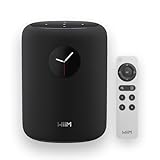
The circular 1.8-inch touch display on the front face shows album artwork, track title, playback clock, and volume level, and responds to tap gestures for play/pause, skip, source selection, EQ presets, and RoomFit access. Audio T described the display as both functional — allowing pause, play, and skip — and engaging, with album artwork visible during playback and standby wallpaper options. At 1.8 inches, album art is too small to read from across a room, but the display’s primary value is as an at-a-glance status indicator and a quick-access panel when you don’t want to reach for your phone. The WiiM Voice Remote 2 Lite is included in the box and covers the same functions from across the room, also adding push-to-talk Alexa access. The combination of display, remote, and app means the WiiM Sound is genuinely operable without a smartphone in hand once it is set up — a practical daily usability advantage over many competitors.
Build Quality & Design
The WiiM Sound is a vertically oriented cylinder-adjacent form factor — roughly square in footprint at 14.65 by 14.65 centimeters and 19.35 centimeters tall, weighing 2.49 kilograms. The cabinet is wrapped in a dark, textured acoustic grille that covers all four sides and the top, with the circular touch display centered on the front face as the primary visual accent. The overall impression is clean and modern without being particularly distinctive — it will sit comfortably in a contemporary interior without attracting attention. Reviewers have generally described the build quality as solid and appropriate for the price tier, noting the cabinet feels well-damped with no audible resonance at volume. There is no rubber base grip noted in specs, though the mass of the cabinet provides adequate stability.
The rear connectivity panel provides the 3.5mm analog input, the RJ-45 Ethernet port, and the power cable connection. The top surface includes physical touch controls (volume, play/pause, and a multifunction button) as a backup to the display and remote. What the Sound does not include is an output for subwoofer via RCA — integration with the WiiM Sub Pro is handled entirely wirelessly through the WiiM app, which is elegant but requires the sub to have its own power connection near where you place it.
The accessory bundle is notably generous: the WiiM Voice Remote 2 Lite (with its own USB-C charging cable), a power cord, and an RCA cable are all included. The voice remote retails separately for other WiiM products, making its inclusion here meaningful added value. Build quality and accessory completeness land where they should for a mid-range speaker in this category — not luxurious, but thoughtfully assembled and well-supplied.
Sound / Performance
Audio T found the WiiM Sound well-balanced straight out of the box with the EQ off — bass well-judged, midrange and treble nicely balanced without any frequency band dominating, and an impressive soundstage for a single-box unit that projects music beyond the physical confines of the compact cabinet. The Sound’s most consistent praise across all reviews centers on its midrange — vocals, acoustic instruments, strings, and pianos are reproduced with a naturalness and clarity that reviewers consistently described as competitive with or superior to the Sonos Era 100. In direct comparison with the Sonos Era 100, one reviewer found the WiiM Sound to be more tonally controlled and mature, with voices and midrange more clearly defined and high frequencies appearing cleaner.
The bass response without RoomFit is present and reasonably well-extended — the 4-inch woofer earns its keep — though reviewers noted that in larger spaces or near reflective surfaces, some boominess can appear that responds well to RoomFit correction. With RoomFit engaged, the Sound handles difficult placements — including wall proximity and bookshelf positions — delivering punchy, controlled bass and clean mids even in acoustically compromised environments, and even low-bitrate internet radio streams sounded listenable. This is a meaningful real-world benefit: most wireless speakers reveal their limits when placed imperfectly, while the WiiM Sound adapts.
The stereo pairing mode — available when two WiiM Sound units are grouped as left and right channels — represents a significant step change in performance. Reviewers who evaluated the stereo pair described a lively, engaging, and surprisingly powerful presentation that transforms the Sound from a strong single-unit option into a convincing desktop or bedroom stereo replacement. AVForums tested a WiiM Sound as a replacement for a Naim Mu-So Qb2 — a unit retailing at well over double the price — and found the gap in performance did not justify the pricing difference, with RoomFit giving the WiiM a practical advantage in acoustically challenging placements that the Naim could not match.
The hi-res 24-bit/192kHz support means the Sound can receive and process full-resolution files from Qobuz or a DLNA server at the highest available quality — a technical specification that exceeds most Sonos products, which top out at 24-bit/48kHz. Whether this translates into an audible difference on the Sound’s built-in drivers is a nuanced question, but it ensures the playback chain does not introduce a ceiling below the content’s ceiling, which is the correct design philosophy. Source: hifireport.com © HiFiReport, all rights reserved.
Real-World Use Cases
The WiiM Sound’s natural habitat is the room where you spend time but don’t have a dedicated hi-fi setup — a kitchen, bedroom, office, or living room where you want good sound, easy streaming, and minimum fuss. In this role it excels: setup takes under three minutes from box to music, RoomFit calibration takes another two, and the result is a speaker that sounds optimized for your specific room with zero ongoing maintenance. The 1.8-inch display and included remote mean daily use does not require a phone, which matters for the kitchen counter or bedside table scenarios where reaching for a device is inconvenient.
For users already invested in the WiiM ecosystem, the Sound becomes the most flexible zone option available. It joins WiiM multiroom groups alongside any streamer, Amp, or Pro Plus, participates in Google Cast groups that include Nest speakers and Chromecast TVs, and integrates into Alexa multi-room audio setups. Two WiiM Sounds paired as stereo form a capable primary listening system for a medium-sized room — reviewers described the stereo pair as genuinely satisfying for extended music listening rather than merely functional. Adding the WiiM Sub Pro wireless subwoofer extends the bottom end for electronic music, home cinema soundtracks, and larger room deployments without any cables between the two units. Source: hifireport.com © HiFiReport, all rights reserved.
For Google Cast households specifically, the WiiM Sound is close to an obvious choice. Since it lives natively in the Google Cast ecosystem alongside any Nest speaker, it can join or lead any group, respond to cast commands from any Cast-enabled app, and integrate into Google Home routines. This gives households with Google TV, Nest hubs, and Android phones a streaming speaker that behaves exactly like their other Cast devices while delivering substantially better audio quality. Source: hifireference.com © HiFiReference, all rights reserved.
What Real Users Are Saying
Early verified purchaser feedback centers on three consistent themes. First, the sound quality surprises people — particularly the midrange performance, which is repeatedly described as richer and more natural than expected from a speaker in this form factor and price tier. Users coming from smart speakers or soundbars consistently describe the WiiM Sound as the first wireless speaker in their home that they genuinely enjoy listening to for extended sessions, not just for background audio. The depth and width of the soundstage from a single unit draws specific mention from multiple reviewers and buyers who describe music as sounding “larger” than the physical box suggests it should.
Second, the RoomFit feature receives enthusiastic practical endorsement. Users who place the Sound in acoustically awkward positions — on bookshelves, near walls, in kitchens with reflective surfaces — describe meaningful improvements after running calibration, specifically mentioning reduced boominess and improved vocal clarity. The process is fast enough that users report running it in multiple locations to find the optimal placement, treating it as a tool rather than a one-time setup step. Community forum participants have additionally noted that the RoomFit algorithm continues to improve via updates, making calibration results better over time without any action on the user’s part.
Third, the WiiM Home app and ecosystem integration draw consistent praise. Users with mixed Apple and Android households specifically appreciate Google Cast support enabling both platforms to cast directly from their apps. The breadth of natively integrated streaming services — more than most competitors — eliminates the workaround most streaming speakers require for services like Qobuz or DLNA-based local library playback. The one consistently noted limitation is AirPlay: iPhone-primary users flag its absence as a friction point, particularly for users with HomePods elsewhere in the home who want consistent group behavior across all speakers. This is the single most common criticism in early feedback and the primary differentiator to evaluate before purchasing.
Pros & Cons
Pros:
- AI RoomFit room correction delivers measurable and audible improvements in real-world placement scenarios — bookshelves, kitchen counters, near walls — using the smartphone microphone for calibration, with the algorithm improving via server-side updates over time, based on multiple third-party evaluations.
- Midrange and vocal reproduction are consistently described by independent reviewers as superior to the Sonos Era 100, with a natural clarity and tonal control that outperforms competing units at similar and higher price points.
- Broadest streaming protocol support in the category: Google Cast, Spotify Connect, TIDAL Connect, Qobuz Connect, DLNA, Roon Ready, LMS, and Amazon Music via Alexa Cast — more native service integration than Sonos, Bluesound, or Apple in a single unit, based on spec analysis.
- Wi-Fi 6E and Ethernet provide stable, high-bandwidth connectivity options that exceed most competing smart speakers’ network specifications, based on spec analysis.
- True stereo pairing with a second WiiM Sound, plus 5.1 surround integration with compatible WiiM components, enables scalable system building from a single speaker to a complete home theater, based on spec analysis.
- Voice Remote 2 Lite included in the box adds Alexa voice control and one-press preset playback without requiring a separate Echo device or always-on microphone.
- Hi-res 24-bit/192kHz playback support exceeds Sonos’s 24-bit/48kHz ceiling, ensuring no artificial quality ceiling is introduced below the source material, based on spec analysis.
Cons:
- No AirPlay support of any kind — iOS users cannot use Apple’s native streaming path, and the WiiM Sound cannot join AirPlay groups with HomePods or Apple TVs; this is the most consistently flagged limitation across all independent reviews.
- No HDMI ARC input, meaning the Sound cannot serve as a TV soundbar replacement without a separate HDMI-capable WiiM product in the chain, based on spec analysis.
- RoomFit calibration produces better results when using an iPhone than an Android device, based on TechRadar testing — Android users may get less accurate optimization from the calibration process.
- Bass response in larger rooms without a subwoofer is adequate but not authoritative; users who frequently listen to bass-heavy genres or film soundtracks at volume in larger spaces will likely want to add the WiiM Sub Pro, based on reviewer feedback.
Who Should Buy This?
The WiiM Sound is the ideal choice for anyone who wants a capable, room-corrected streaming speaker for a kitchen, bedroom, office, or living room, and who operates in a Google-centric or mixed-platform household. Its Google Cast integration, broad streaming service support, and RoomFit calibration make it the most practically versatile wireless speaker available at this price — particularly for people who want to place it in a non-ideal acoustic position (which describes most real-world wireless speaker placements) and still get good sound. The included remote, 1.8-inch display, and Ethernet port add daily usability and reliability that most competing smart speakers lack. Existing WiiM ecosystem users considering a powered speaker endpoint for a secondary room will find it integrates with perfect naturalness.
The WiiM Sound is also a strong recommendation for anyone who has been using a single Sonos Era 100 or similar unit for music listening and finds it sonically underwhelming. Multiple independent listening comparisons have favored the WiiM Sound’s midrange and vocal reproduction over the Sonos, and the RoomFit advantage means the WiiM will perform better in typical home placement scenarios than a fixed-tuned competitor. Those who want to step up from a single unit to a proper stereo system can add a second WiiM Sound without changing any other hardware, and the Sub Pro makes a clean subwoofer addition when more bass is needed.
Apple-centric households — those with multiple HomePods, heavy Apple Music use through AirPlay, or a preference for iOS-native speaker grouping — should carefully evaluate the AirPlay absence before purchasing. Apple Music is accessible via Google Cast from the Apple Music app, but the absence of native AirPlay grouping with HomePods will be genuinely limiting for users who have built their home audio around that ecosystem. For those users, the WiiM Sound Lite (which trades the touchscreen for a lower price) or the older WiiM ecosystem components connected to AirPlay-compatible powered speakers may be a better fit. Similarly, users who need HDMI ARC for TV audio integration will need to consider a WiiM Amp-based solution instead.
Verdict
Overall score: 8.5/10 (Sound quality 50% / Features & ecosystem 20% / Build & design 15% / Value 15%)
The WiiM Sound is a confident, well-executed first entry into the wireless speaker market, and it arrives more fully formed than most debut products from companies expanding into a new category. The 2-way driver system sounds genuinely good, with midrange and vocal performance that outpaces well-established competitors at similar price points. AI RoomFit is not just a marketing feature — it delivers audible, practical improvement in the real-world placement conditions that most wireless speakers encounter, and it continues to get better through updates. The protocol stack is unmatched in the category. The inclusion of a voice remote, a touch display, Ethernet, and Wi-Fi 6E at this price is generous and reflects WiiM’s consistent philosophy of over-delivering on specifications.
The missing AirPlay support is a real limitation that will disqualify the WiiM Sound for a segment of potential buyers, and it should be evaluated honestly before purchase. It is not a defect so much as a deliberate strategic choice that reflects the economics of Apple’s licensing — but the practical consequence for Apple-household users is real. For everyone else, the WiiM Sound represents one of the most capable and flexible wireless speakers available at its price point, and AVForums’s benchmark comparison against a Naim unit costing more than twice as much stands as the clearest summary of what WiiM has accomplished here.
Verdict: Strongly Recommended — for Google Cast and mixed-platform households seeking a room-corrected, hi-res, multi-room wireless speaker. Evaluate AirPlay compatibility carefully if you’re embedded in the Apple ecosystem.
- Touch what you hear – 1.8″ round display shows album art, time, track info and gives instant control—play/pause, skip, sources, Quick EQ, presets—no phone required.
- Hi‑Res power, precisely tuned – Up to 24‑bit/192 kHz, 100W peak amp, 4″ paper‑cone woofer + dual 1″ silk‑dome tweeters for natural mids, smooth highs, and room‑filling clarity.
- AI RoomFit calibration – One tap optimizes sound for your space and placement—balanced bass, clean vocals, and engaging detail wherever you set it.