Lumin U2 Mini Review – HiFiReport
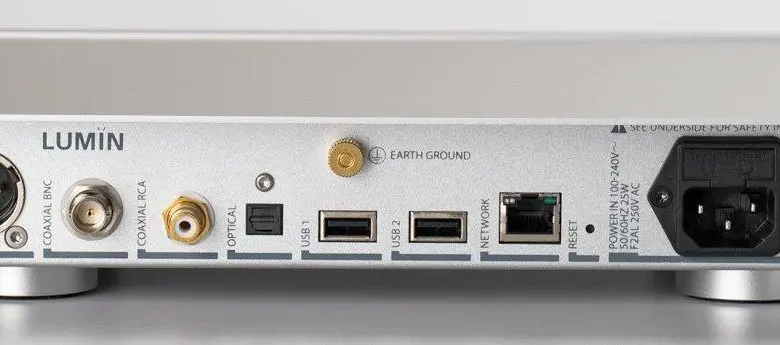
Receiving the U2 Mini brought back fond memories of my experience with the U1 Mini.
The U1 Mini was not only rich and incredibly stable, but also boasted perfect connectivity and wide format support. Most importantly, it delivered great detail, accurate tone, and a pleasing sonic presentation. In all respects, it was a truly unique digital transport.
Now, with the U2 Mini in hand, it looks almost identical to the U1 Mini in my memory. However, I know that the specification has been improved, and the performance is very strong. But what about noise? Will it get even better? I really want to know.
New Processor Inside
The U1 Mini was one of Lumin’s most popular products, and the recently launched U2 Mini is its successor.
The Lumin model naming convention is very straightforward. The letter represents the specific model, and the next number indicates the generation. So, the U2 Mini is the second generation model.
The appearance of the U2 Mini has not changed, and the dimensions are the same. Since the interface was already wide, there was never any addition or subtraction. So, what exactly has been improved in the U2 Mini? Simply put, the “techniques” remain the same, but the “inner strength” has been improved: the details are now higher.
The U2 Mini is equipped with a newly developed Lumin processor that is faster and more powerful. Combined with newly written software, the U2 Mini offers great flexibility in upsampling and downsampling.
Previously, the U1 Mini was only capable of upscaling any music format up to DSD128. Now, with improved processing power, the U2 Mini supports upsampling to DSD256 and PCM 384kHz, increasing its flexibility and compatibility.
Various Format Conversions
Upsampling/downsampling capabilities and ease of configuration are essential for digital broadcast transport. This is because the transport must be used with the DAC, and the transport does not know what formats the DAC can determine. Therefore, the settings must be configured in advance.

For example, if your DAC can record DSD but can handle PCM up to 192kHz, and your music library contains DSD files, you need to set the transport output to convert DSD to PCM 192kHz. This prevents playback problems or DAC crashes when a DSD file is accidentally played.
In addition, the sound characteristics of different DAC input points and digital cables vary. If you want to fine-tune the sound or check the cables, it is important to use the output format settings of the streaming transport correctly.
For example, DAC USB inputs often have advanced format support, often exceeding your existing file formats. In such cases, you may not need to configure the output format of the broadcast transport. However, coaxial, optical, or AES/EBU inputs often support up to DSD64 and PCM 192kHz. If you plan to use these inputs, keep in mind whether they support the file formats in your library.
On the other hand, the U2 Mini’s resampling capabilities offer even greater pleasure to audiophiles who like to balance.
Previously, audiophiles used to rely on software for sampling, such as Roon, which allows setting PCM to DSD output for a different sonic experience.
With the U2 Mini, you can freely up-sample or down-sample and convert between PCM and DSD. Not only can PCM be upsampled or downsampled to PCM or DSD, but DSD can also be downsampled or downsampled to DSD or PCM. Actually, the maximum conversion is DSD256 or PCM 384kHz. As long as your DAC supports it, you can convert as you wish.
Advanced Digital Volume Control
Another great feature of the U2 Mini is the inclusion of the LEEDH Processing digital volume control.
LEEDH Processing is a pure digital volume processing technology developed by Gilles Millot, principal of the French speaker brand Acoustic Beauty. It uses a special algorithm to accurately change the amplitude of digital audio signals without changing their waveform. Importantly, there is no signal loss during the process, which ensures the integrity of the signal when it reaches the DAC, only with a reduced volume.

LEEDH Processing does not consume excessive CPU resources, and since it is an algorithm instead of hardware, it can be easily implemented on various processors such as DSPs and FPGAs, providing a wide range of performance.
Thanks to the ease of LEEDH Processing digital volume control, users can directly adjust the volume with the U2 Mini. This allows for a simplified system configuration where the DAC is connected directly to a power amplifier or powered speakers, eliminating the need for a preamplifier and resulting in cleaner sound.
If you are using a pre/power amplifier or integrated amplifier without a remote control, you can set the amplifier’s volume to a fixed position and control the volume using the U2 Mini. The U2 Mini uses an application to adjust the volume, which is simple and straightforward, allowing for well-analysed adjustments.
The LEEDH Processing function can be turned on or off via the Lumin app, giving users complete control. When turned off or set to 100% volume, the signal completely bypasses LEEDH Processing. If activated, the volume can be adjusted using the application.
Mastering upsampling and downsampling
In terms of streaming functionality, the U2 Mini offers extensive support for both streaming media and music service platforms. These include UPnP, Roon Ready, AirPlay, Tidal, Tidal Connect, Qobuz, Spotify Connect, TuneIn, and more. This means that in addition to controlling the U2 Mini with the much-loved Lumin app, you can also listen using your favorite interface without compromise.
In addition, the U2 Mini fully supports MQA decoding, opening MQA music up to its maximum capacity of 24bit/384kHz.
During the listening tests, I paired the U2 Mini with several DACs, tested the transmission interfaces, and tested the U2 Mini’s up/down functions. I found the U2 Mini to maintain excellent stability and compatibility, consistent with my previous experience with Lumin players.
I first listened at home using the Holo Audio Spring 3 DAC with USB. The Spring 3’s USB input supports up to DSD1024, so I didn’t have to make any settings on the U2 Mini. I can easily play any source or file and enjoy the natural, smooth, transparent, and warm sound of the R2R DAC.

Yes, I was also involved in developing the U2 Mini, converting all the music to DSD256 format before transferring it to the Spring 3 for recording. The sound has become more focused and expressive, with improved sonic density and a deeper soundstage. The layering of sonic elements from front to back has been greatly varied, resulting in a more audiophile-grade experience.
Lumin’s app interface for format conversion and upsampling/downsampling is very easy to use and intuitive. I spent a lot of time experimenting with different sonic nuances. Importantly, the transition was seamless, without any stutter or noise, which shows the excellent performance of the U2 Mini and the refined integration between hardware and software.
Naturally High Quality
I also tested the U2 Mini in HiFiReport’s listening room, pairing it with a NADAC mixer. The reference source was the YBA CDT450 CD transport.
The NADAC has four input ports: AES67, AES/EBU, SPDIF coaxial, and optical, but no USB. I used AES/EBU, which supports up to 24bit/192kHz PCM.
Since my NAS contains some DSD files, to ensure playback compatibility, I adjusted the U2 Mini’s sample output rate, downconverting DSD256, DSD128, DSD64, and 384kHz to 192kHz, and 352.8kHz to 176.4kHz. This ensured compatibility with all file types.
Listening to a few tracks and comparing them to similar CDs played on the YBA CDT450 reference transport, it quickly became clear that the U2 Mini is naturally high quality, allowing a capable DAC to fully realize its potential. Backgrounds are clean, textures are pure, and details are rich, accurately rendering the timbral texture of vocals and instruments with high fidelity.
In addition, the U2 Mini clearly revealed the effect of the network tweaks I made above, providing a concrete reference level. For example, changes such as changing network switches, changing network cables, using switch line power, or adding a fiber optic splitter before the switch are all visible through the U2 Mini and downstream equipment, which helps me speed up equipment testing.
Finally, to answer the question asked at the beginning of this article: is the U2 Mini better than the U1 Mini? This is not an easy question for me to answer for sure. The previous review of the U1 Mini was old, my memory has faded, and the reference machines used were not completely identical, making a direct comparison difficult. However, based on my use experience and listening impressions, the U2 Mini unequivocally meets the criteria for an excellent digital transport.
In fact, Lumin is already a brand with a good reputation, and the U2 Mini just confirms this reputation.
Details
* Genre: Streaming Game Transport
* Supported Sample Rates: Up to DSD512, PCM 32bit / 768kHz, MQA
* Digital Effects:
* USB: Up to DSD512, PCM 32bit / 768kHz
* Optical: Up to DSD64 (DoP), PCM 24bit / 192kHz
* RCA: Up to DSD64 (DoP), PCM 24bit / 192kHz
* BNC: Up to DSD64 (DoP), PCM 24bit / 192kHz
* AES/EBU: Up to DSD64 (DoP), PCM 24bit / 192kHz
* Input: RJ45 Network Cable, USB Storage Device
* Supported streaming features: UPnP, Roon Ready, Tidal Connect, Spotify Connect, compatible AirPlay, lossless Flac Radio Station
* Supported Streaming Services: Spotify, Tidal, Qobuz, Tunein
* Dimensions: 300 × 60 × 244 mm (Width × Length × Depth)
* Weight: 2.5 kg