Walmart Shares Gains From Online Shopping As Consumers Look For Ways To Fight Inflation
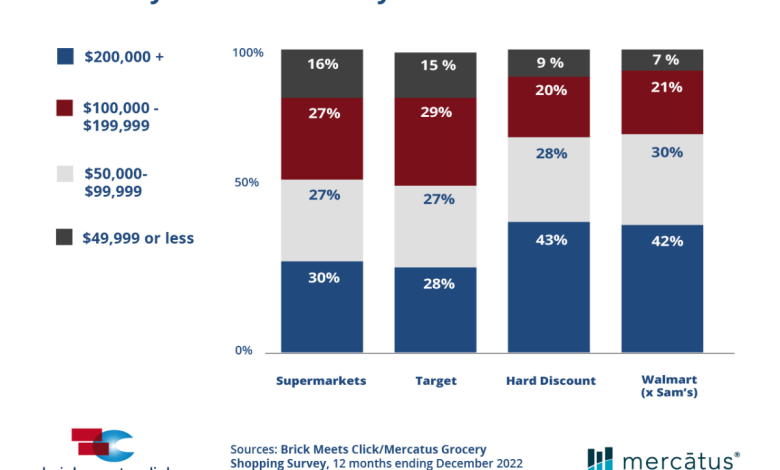
While online grocery shopping continued to grow last year, the demographics of those who shopped have changed dramatically according to a new report from grocery researcher Brick Meets Click.
A new report, detailing egrocery’s performance in different retail formats, said Walmart was the big winner in 2022 as more customers looked for ways to save money. According to the report, which broke down the four major formats such as supermarkets, Walmart, Target, and Hard Discount (ie, Aldi and Lidl), Walmart saw its share of online grocery shoppers grow among both low-income and high-income households.
According to Brick Meets Click, households making less than $50,000 a year were 25% more likely to shop at Walmart than at a supermarket, and Walmart’s overall share of online groceries in this household segment grew 2.1% compared to a shrinking 1.5% of the supermarket’s share. At the higher end of the spectrum, Walmart gained ground in households making more than $200,000 a year, increasing its reach in this segment by 2.1%. In contrast, supermarkets saw their reach drop by 1.2% in 2022 compared to the previous year.
The reason for the switch to Walmart in both segments was continued inflation. Low-income families have been driven by what the researcher calls a “flight to value,” where they buy products priced at “everyday low prices” found at Walmart and deep discounters like Aldi. And while high-income households are three times more likely to shop online at a supermarket, the format lost share to Walmart in 2022 as high-income earners also look for ways to save in stores.
As for Target, the retailer also saw its share of high-net-worth households grow in 2022, which also partially contributed to the decline in the overall online share of the supermarket segment. Additionally, the Minnesota-based retailer also continued to attract younger shoppers relative to the supermarket segment, as younger households (ages 18-29) are 36% more likely to shop online at Target compared to a supermarket.
The report doesn’t specify where Amazon fits into all of this. According to The Street, Amazon’s total share of physical store groceries was about 2% of total grocery sales at about $17.5 billion by 2021. That compares to Target’s $20.3 billion in food and beverage sales in the same year.
In terms of how families get groceries, more than half of active monthly online shoppers (52.2%) picked up groceries at a curbside or store in March of this year, according to a separate researcher report. Home delivery, which typically refers to dry goods and shelf-stable products, fell from 47.5% of monthly grocery shoppers in March 2022 to 40.9% in March 2023, while grocery deliveries (which typically include fresh produce, milk, and meat) grew from 40.8% in March last year to 41.
Despite the growth of the online grocery category, the researcher says that in-store is still the leading form of grocery shopping. In a report released earlier this year, the total number of online grocery purchases accounted for just over a tenth (11.2%) of all grocery consumption at the end of last year and is expected to grow to 13.6% by the end of 2027.