Roee Nir, CEO and Cofounder of Forsea
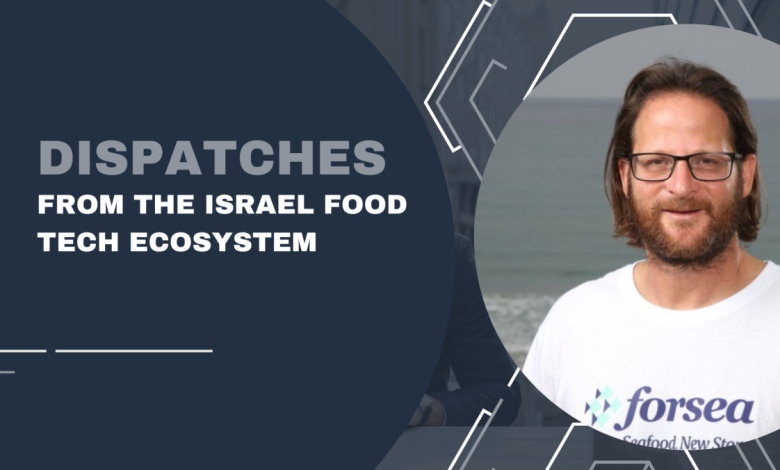
I had the opportunity to speak with Roee Nir, the CEO and founder of Forsea. Forsea produces farmed seafood, starting with farmed eel. Prior to Forsea, Nir led business development for a biopharmaceutical company in immunology. We discussed the difference between farmed meat and farmed seafood, customer preferences, navigating the regulatory landscape, the foodtech ecosystem in Israel, and how startups are raising capital in Israel.
J: Why is eel your first product?
R: We are starting with eel because our strategy is to target high value fish with a real market demand that is not met by endangered species. It is a destination for endangered species on the IUCN red list and the eel has been responding to these trends remarkably because the eel has declined by 90 to 95% in recent decades and the wholesale price is between $60 to $75 per kilogram. Just to understand how big the market demand is, Japan, for example, consumed 160,000 metric tons in the year 2000. Now, it eats about 14. So, there is a huge gap between the current demand and supply and for us that was not a smart thing to deal with in this market.
J: How did you as a founder become passionate about this problem?
R: We are in the middle of a revolution. If we look at fish and seafood, their demand is expected to double by 2050. Now, less than 7% of fisheries are fished at below-sustainable levels. Aquaculture has its own environmental and food security issues. There is a great need to bridge the supply and demand gap.
J: Israel is very strong and meat is grown, mainly because there are many people who don’t eat meat here. How do you see the difference in the development of farmed meat compared to farmed seafood?
R: Planted meat had some background in medical research related to tissue and organ engineering and so on. The challenge was to take it from that process to the correct use in food. With fish, there was no research and all the fish and seafood companies are doing very basic research because the cells grow differently. Each of us is looking at different markets in the beginning (tuna, scallops, shrimp, etc.) that need to be changed. There are ancillary companies joining the ecosystem related to cell line development, scaffolding, growth factor development, contract manufacturing, testing, etc.
J: So when Kitchen came to you and approached you with the idea of this startup, and they had the technology, where was that technology based?
R: We are a completely different company than any other investment company. Almost all transplanted meat companies do more or less the same thing, they will go to a particular source of stem cells and use a process called directed differentiation to grow the cells. Then the cells have to communicate what they do by using the scaffold when the cells are sitting on the scaffold before maturation. This is used as a building block for tissue.
What my partner Iftach Nachman discovered is a way to take essential stem cells which are cells that have the ability to differentiate into any type of cell. And these are usually only created if you have a fertilized egg. So you have two to four to eight fertilized eggs, and so on. These cells load but have the ability to differentiate into any cell type. He found a way to take these cells and assemble them into a special type called an organoid and give these stem cells the feeling that they are in the early stages of their development. What happens is that these cells begin to grow as if they were not their own. They grow into many tissues that are naturally formed into edible pieces.
So we don’t use slow growth factors. We use a specific growth factor to direct this organoid tissue into the shape we want, but it is a very small application compared to the directed differentiation method. Then these many tissues of this organ begin to grow independently until they are less than a millimeter before we start building tissue in it.
And in this way, we face the biggest challenges of the cultivated meat space. We end the scaffolding phase because each of these organoids is its own connective tissue. They communicate with each other and we don’t need to put them on a scaffold. We simplify the manufacturing process so we can scale more. These advantages allow us to deliver our product quickly and achieve price parity quickly. Also, muscles are natural in the way we make cuts.
J: When do you expect consumers to be able to try your seafood?
R: We are in the R&D stage and plan to launch the first product to market by the end of 2025.
J: When a new product enters the market here in Israel, especially food technology, what kind of adjustments do you have to make regarding customer preferences?
R: The final product we are launching will probably be more suitable for Asian regions. As a company for our eel product, we would like to make changes in the market in Japan, not in Israel. I think overall most companies will try Israel or Singapore as a test country but we all aim to sell globally. Because our industry is a CapEx-intensive industry and we need markets that justify such investments. Our vision is that our first launch will be in Asia.
J: With this product, what kind of guidelines or challenges do you have to navigate to protect the ownership of the property?
R: The first wave of companies must face two factors. One is regulation, and the other is market education. The way is prepared by them for us. Any company that gets approval, it’s a huge development. I am confident that our program will be as successful as any farmed meat company. From an IP perspective, everything we do is completely changing. We post a few these days, based on research we’ve done in our lab. But in reality everything we do changes a lot and this is how we protect ourselves.
J: There are probably many challenges as a first-time market entrant, especially in terms of customer acceptance. What are some of the challenges associated with developing not just technology, but a business that needs to have customers?
R: First of all, all the consumer research done says that the most important thing in a product is the taste. So it is up to us to deliver a quality product. From a marketing perspective, we, as a company, do not plan to be the ones who market the product. For example, we are now looking for strong partners in different areas with whom we intend to cooperate in order to make the correct market adaptation to the target market. And such companies that are seafood producers and seafood traders already have their relationships with restaurants and food stores. They are the ones who will take the approach of introducing the product to the market. That’s our strategy. Especially with eel, more than 80% of it is sold in restaurants and that is also our strategy: start with restaurants and then go to shops.
J: Are there any other food technology companies from Israel or elsewhere that you highly admire for their innovation or business strategy?
R: I think Aleph is doing an amazing job. I like their strategy. I love their technology and think it is very well managed. I love Imagindairy technology as well, they have very deep technology in the milk space. And mushfoods, 50/50 hamburger.
J: It feels like the startup ecosystem here within food technology is very well connected. Would you say that the ecosystem here is generally a very close-knit and supportive community?
R: First of all, in farmed meat, no one needs to talk now about competition. Even those that will launch their products soon, the market is still big and everyone is just starting out. Everyone should work together to help us all grow this industry, as long as it doesn’t interfere with other people’s IP.
As part of the larger ecosystem in Israel, we all work together. We are Israelis and we communicate a lot within ourselves. We love to meet, we love to share ideas, and we love that this is the most exploding medium industry in Israel. We also share with investors. Share investors are a very connected thing.
J: And you talked about investors, so how is raising money here?
R: Many of us, certainly all Kitchen companies, have received funding from the Israel Innovation Authority. We had to make a very difficult application and many meetings and when we were approved for funding by the Israel Innovation Authority and the Kitchen, we were given 3 million shekels ($900,000). And it’s a very smart thing to do from the government’s point of view because it’s their way of encouraging innovation. Then you have to start raising and from the previous stages you can almost identify the angels. But most of my investors are Vc and only one angel. My preference would be VCs or CVCs, professional investors who not only know the business but support further fundraising in the next stages, network, etc. There are fewer investors in Israel than in the US or Europe so more investors are American or European. But there are also Israeli VC’s who have started to show more interest.
J: You’re talking about business money, is that common here?
R: It is a source of income. Of course, VCs are more active, and by nature, they are much smaller than CVCs and their process is much longer and more conservative. For the right companies, it is. There are fewer investors in Israel than in the US or Europe, so most investors come from the US or Europe.
Joy Chen is a contributor to Spoon and has been writing about robots and other proteins for the past year and a half. Although he is originally from the United States, he is currently studying at Tel Aviv University in Tel Aviv, Israel.