MSI GeForce RTX 5070 Ti Ventus 3X PZ Review – 16 Pin Power Well Hidden
Introduction
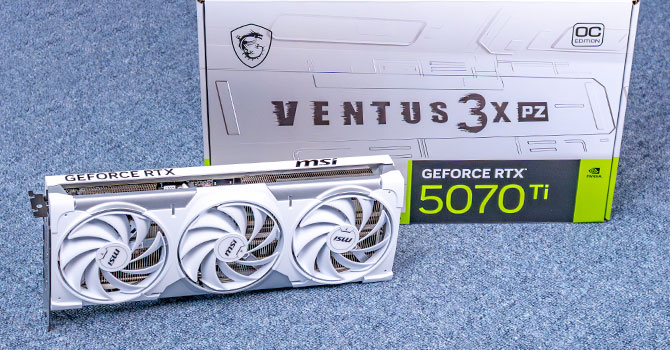
The MSI GeForce RTX 5070 Ti Ventus 3X PZ is the latest addition to the company’s RTX 50-series graphics card lineup. It’s part of the MSI Project Zero ecosystem of motherboards and graphics cards with hidden cabling for a clean look in modern, bezel-less cases. MSI Project Zero is the company’s answer to the ASUS BTF, series motherboards that feature key connectors and headers on the back side of the PCB. Compatible cases with large enough cutouts and slots behind the motherboard tray ensure that you route your cables out of sight.
The MSI Project Zero has a very different approach to graphics card power compared to the ASUS BTF. ASUS has developed a GC-HPWR power delivery that is compatible with a PCIe slot, VLB style. This power supply slot is connected to the standard 12V-2×6 connector on the back side of the PCB. All well and good, except in cases where the crawl space behind the motherboard tray is tight, and you have to bend the 12V-2×6 cable a little tighter than required by the connector system, which requires at least 10 cm of vertical displacement of the cable before it is bent, to reduce the mechanical stiffness of the contacts in the connector.
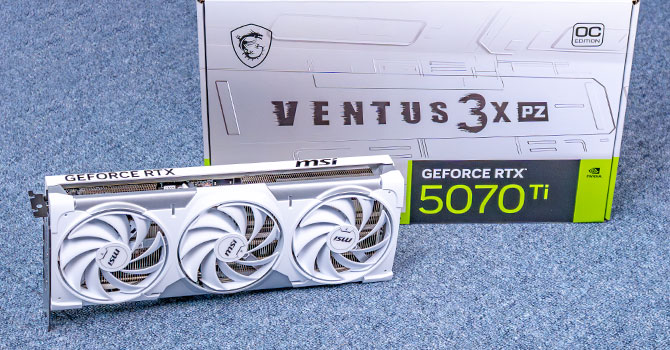
MSI’s approach is different. It doesn’t use a dedicated power delivery slot, but it repositions the 12V-2×6 input on the graphics card itself, so that it’s upside down (facing the motherboard PCB), and you route your normal 12V-2×6 cable from your PSU, and it stays out of sight. This approach is not that different from Sapphire’s, with its original RX 9070 XT NITRO+, which has the same hidden 12V-2×6 input. The MSI method ensures cable concealment while satisfying cable bending tolerances. With the cable in place, the magnetic backplate stack covers that backplate area. This Project Zero innovation aside, the new RTX 5070 Ti Ventus 3X PZ features the two-tone white and silver color scheme that MSI introduced with its RTX 50-series Ventus family.
The GeForce RTX 5070 Ti is built on Blackwell graphics architecture. Blackwell introduced a potentially revolutionary concept called Neural Rendering, where an AI-generated model works in tandem with the game pipeline to create richly detailed objects, which are then combined with traditional 3D rasterized content in the same way as ray-traced elements. Given how advanced generative AI has become, well past the uncanny valley, you can imagine the creative possibilities Neural Rendering opens up. Blackwell also added the Mega Geometry ray-tracing hardware base, which allows real-time ray-traced objects with the highest geometric complexity, and all of that detail fully interacts with lighting.
The new Blackwell streaming multiprocessor (SM) supports FP32 and INT32 calculations on all CUDA cores, while the older Ada Lovelace SM provided INT32 capabilities on only a portion of them. The shader reprogramming engine is now aware of neural shaders and neural objects, allowing these workloads to be programmed on Tensor cores. The new 5th Gen Tensor Core adds support for the FP4 data format to increase output with commercial accuracy. Meanwhile, the 4th Gen RT Core includes more specialized hardware, including blocks that enable Mega Geometry—allowing ray-traced objects to use much higher triangle counts, and rays that work with all that extra detail.
The GeForce RTX 5070 Ti uses the same GB203 silicon as the RTX 5080. While the RTX 5080 fully powers all 84 streaming multiprocessors (SMs) and a total of 64 MB L2 cache on the die, the RTX 5070 Ti is configured with 70 SMs and 48 MB of LTD. This configuration delivers 8,960 CUDA cores, 280 Tensor cores, 70 RT cores, 280 TMUs, and 96 ROPs. The reduced ROP count is the result of all GPC being disabled to reduce the SM count. The memory subsystem represents a major improvement over the RTX 4070 Ti of the previous generation, which offers 16 GB of memory on a wide 256-bit GDDR7 interface. With a memory speed of 28 Gbps, the total bandwidth reaches 896 GB/s, an impressive 77% increase compared to the RTX 4070 Ti.
NVIDIA recently announced the DLSS 4.5 feature set, which updates the high-resolution component with a second-generation Transformer-based model trained on a wider dataset than the original DLSS 4 that the GeForce RTX 50 series debuted with. Transformer-based upscalers offer a significant increase in image quality over older convoluted neural network (CNN) based upscalers. With DLSS 4.5, NVIDIA also introduced 6x multi frame generation, which pulls up to five frames following every frame provided normally using AI, effectively multiplying the framerate by 6x.
Perhaps the best feature of MSI’s RTX 5070 Ti Ventus 3X PZ is that you don’t need an MSI Project Zero motherboard, or a special backplane for that matter. Besides its new PCB and hidden power design, the MSI RTX 5070 Ti Ventus 3X PZ remains part of the company’s custom-designed graphics card series, with its Tri Frozr cooler using the company’s latest TorX 5.0 fans with webbed impellers that ensure axial airflow. MSI prices the card at $830.
| Price | The cores | ROPs | Total A clock |
Improve A clock |
Memory A clock |
The GPU | Transistors | Memory | |
|---|---|---|---|---|---|---|---|---|---|
| RTX 4070 | $500 | 5888 | 64 | 1920 MHz | 2475 MHz | 1313 MHz | AD104 | 35800M | 12 GB, GDDR6X, 192-bit |
| RX 7800 XT | $470 | 3840 | 96 | 2124 MHz | 2430 MHz | 2425 MHz | Navi 32 | 28100M | 16 GB, GDDR6, 256-bit |
| RTX 4070 Super | $600 | 7168 | 80 | 1980 MHz | 2475 MHz | 1313 MHz | AD104 | 35800M | 12 GB, GDDR6X, 192-bit |
| RX 7900 GRE | $550 | 5120 | 160 | 1880 MHz | 2245 MHz | 2250 MHz | Navi 31 | 57700M | 16 GB, GDDR6, 256-bit |
| RTX 4070 Ti | $700 | 7680 | 80 | 2310 MHz | 2610 MHz | 1313 MHz | AD104 | 35800M | 12 GB, GDDR6X, 192-bit |
| RTX 5070 | $550 | 6144 | 80 | 2325 MHz | 2512 MHz | 1750 MHz | GB205 | 31100M | 12 GB, GDDR7, 192-bit |
| RTX 4070 Ti Super | $900 | 8448 | 96 | 2340 MHz | 2610 MHz | 1313 MHz | AD103 | 45900M | 16 GB, GDDR6X, 256-bit |
| RX 7900 XT | $620 | 5376 | 192 | 2000 MHz | 2400 MHz | 2500 MHz | Navi 31 | 57700M | 20 GB, GDDR6, 320-bit |
| RX 9070 | $560 | 3584 | 128 | 2070 MHz | 2520 MHz | 2518 MHz | Navi 48 | 53900M | 16 GB, GDDR6, 256-bit |
| RX 9070 XT | $720 | 4096 | 128 | 2400 MHz | 2970 MHz | 2518 MHz | Navi 48 | 53900M | 16 GB, GDDR6, 256-bit |
| RTX 5070 Ti | $830 | 8960 | 96 | 2295 MHz | 2452 MHz | 1750 MHz | GB203 | 45600M | 16 GB, GDDR7, 256-bit |
| MSI RTX 5070 Ti Ventus PZ |
$830 | 8960 | 96 | 2295 MHz | 2482 MHz | 1750 MHz | GB203 | 45600M | 16 GB, GDDR7, 256-bit |
| RX 7900 XTX | $750 | 6144 | 192 | 2300 MHz | 2500 MHz | 2500 MHz | Navi 31 | 57700M | 24 GB, GDDR6, 384-bit |
| RTX 4080 | $1200 | 9728 | 112 | 2205 MHz | 2505 MHz | 1400 MHz | AD103 | 45900M | 16 GB, GDDR6X, 256-bit |
| RTX 4080 Super | $1300 | 10240 | 112 | 2295 MHz | 2550 MHz | 1438 MHz | AD103 | 45900M | 16 GB, GDDR6X, 256-bit |
| RTX 5080 | $1150 | 10752 | 112 | 2295 MHz | 2617 MHz | 1875 MHz | GB203 | 45600M | 16 GB, GDDR7, 256-bit |
| RTX 4090 | $2000 | 16384 | 176 | 2235 MHz | 2520 MHz | 1313 MHz | AD102 | 76300M | 24 GB, GDDR6X, 384-bit |
| RTX 5090 | $2900 | 21760 | 176 | 2017 MHz | 2407 MHz | 1750 MHz | GB202 | 92200M | 32 GB, GDDR7, 512-bit |