Intel Panther Lake Review – The Gaming King of Performance

Introduction
Welcome to our launch review of Intel’s new Panther Lake processor architecture. This marks a significant leap forward from its predecessor, Lunar Lake, with major improvements and innovations. To test what Intel has achieved with Panther Lake, we check it out with the impressive 2026 ASUS Zenbook DUO UX8407AA. This laptop, with its advanced design, exemplifies ASUS’ commitment to quality. While the changes from the previous generation may seem subtle, they enhance the premium feel of the device, making it a perfect showcase for the improvements Panther Lake brings.
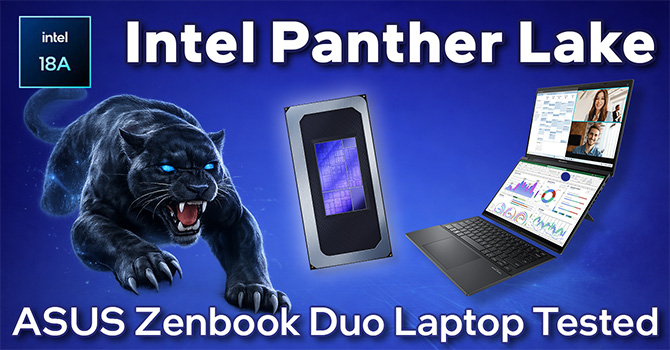
Undoubtedly, the biggest highlight of the new Zenbook is the new CPU and iGPU combo, but the dual screen setup is also very impressive. This year’s Zenbook DUO features the Intel Panther Lake-based Core Ultra X9 Series 3. Specifically, the Core Ultra X9 388H is at the heart of this machine. This new generation chip includes 4 P-cores, 8 E-cores, and 4 LPE-cores. That’s plenty of power for almost any workflow or entertainment, barring demanding tasks usually reserved for mobile workstations.
Intel claims a significant jump coupled with much lower power draw—especially during light tasks—compared to older Lunar and Arrow Lake chips. This gives us real hope that the battery life may live up to the hype.
The new Intel Arc B390 Graphics isn’t just another iGPU perfect for playing Tetris and browsing the web. What really stands out is the 16 MB of shared L2 cache—a huge amount for an integrated solution. It also features 12 Xe Cores and 12 dedicated ray tracing units. If you add the fact that you can set a fixed size of VRAM (which allocates shared memory to the iGPU), the Arc B390 may become the new king of its class.
We’re officially in the age of AI—or at least the dawn of it. That makes Intel’s NPU 5 aimed at everyone from power users to casual fans who use AI tools every day. It effectively delivers up to 50 TOPS, accelerating tasks such as image production, real-time rendering, and AI-driven video editing.
System performance is also boosted by the fast LPDDR5x-9600 RAM. As expected for small and light, memory is sold down. While this saves space and keeps weight down, it does mean you sacrifice performance. Still, 32 GB of RAM sounds like a decent amount of memory that should be enough for the next few years.
Since it is a dual screen device, you might think that the port selection might be very limited. Not really, but don’t expect I/O like a 3kg laptop. Still, a fully functional Thunderbolt 4 and one Type A, without a full HDMI 2.1 port sounds reasonable to me. The tradeoff is that you may lose one of the faster Type-C ports when the power adapter is plugged in.
To extract more performance from the new CPU, ASUS has installed a thermal system with large fans to expel hot air as quickly as possible. In my experience, bigger fans usually mean lower noise levels too.
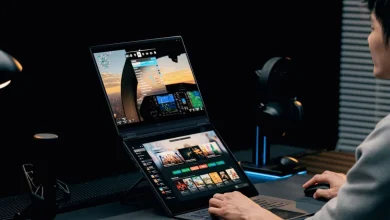
Apart from the new technology CPU, the two displays are excellent. They look as good in person as they do on paper, thanks to vibrant colors and a 2880×1800 resolution that delivers a sharp image. OLED touchscreens offer a refresh rate of 144 Hz for extra smoothness, an infinite contrast ratio, and DisplayHDR 1000 Black True certification. These two are a great choice for watching movies, playing games, working, creating content, you name it!
The device is loaded with goodies like a nice detachable keyboard, Wi-Fi 7, an IR webcam, a 6-speaker audio system powered by Dolby Atmos, and somehow, ASUS managed to squeeze a massive 99 Wh battery system into this crowded chassis.
It all sounds good on paper, but let’s put this device through some real abuse to see if it’s worth the money.
Details
| Details | |
|---|---|
| Manufacturer: | ASUS |
| Model: | ASUS Zenbook DUO (UX8407) |
| Weight: | It starts at 1.35 kg without the keyboard 1.65 kg with keyboard |
| Processor: | Intel Core Ultra 7 355/Panther Lake 4 P-Cores+4 LPE-cores/8 threads up to 4.7 GHz, 12 MB L3 cache 25 W Basic Power Intel Core Ultra 9 Processor 386H/Panther Lake 4 P-Cores+8 E-cores+4 LPE-cores/16 threads up to 4.9 GHz, 18 MB L3 cache 25 W Basic Power Intel Core Ultra X9 Processor 388H/Panther Lake 4 P-Cores+8 E-cores+4 LPE-cores/16 threads up to 5.1 GHz, 18 MB L3 cache 25 W Basic Power |
| Chipset: | Intel Panther Lake PCH |
| Display: | Display: 2× 14″/2880×1800 (16:10)/OLED/144 Hz ~500 nits/100% sRGB/anti-reflective coating Display HDR True Black 1000 |
| Operating system: | Windows 11 |
| Included Graphics: | Intel Graphics 4 Xe3 Intel Arc B390 |
| Memory: | up to 32 GB of sold LPDDR5x-9600 |
| Storage: | 1× M.2 2280 PCI Express 4.0 x4 |
| Optical Drive: | Nothing |
| Communication: | 1× 10 Gbps USB Type-A/3.2 Gen. 2 2× 40 Gbps Thunderbolt 4 with DP Alt Mode/100 W PD HDMI 2.1 FRL Audio combo jack |
| Communications: | Wi-Fi 7+Bluetooth 5.4 1080p IR web camera |
| Sound: | 6 speaker sound system 2 × high-frequency tweeters + 4 × low-frequency woofers enhanced with Dolby Atmos |
| Input device: | ASUS ErgoSense touchpad with hydrophobic coating Detachable keyboard with backlight |
| Power: | 1× 100 W USB-C AC adapter 99 Wh battery system |
| Guarantee: | Two years (depending on the region) |
| MSRP: | It starts at €2600/$3080 |