Sony INZONE E9 vs Sennheiser IE 200 Review: Competitive Gaming or Pure Sound?
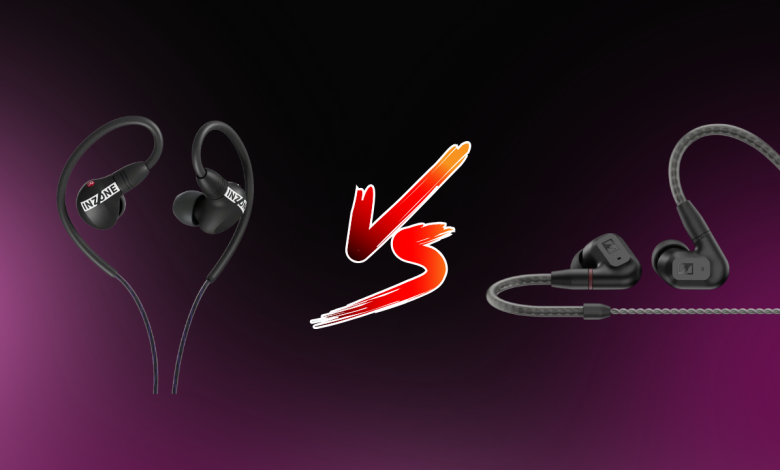
In-ear monitors have become very special over the past few years. Some are tuned specifically for competitive games, prioritizing positional accuracy and clarity, while others focus on musical balance and improving tone for everyday listening. The Sony INZONE E9 and the Sennheiser IE 200 occupy two very different places in that show. Built with esports in mind, the INZONE E9 is designed to deliver accurate spatial signals and deliver midrange detail for a competitive advantage. The IE 200, on the other hand, continues Sennheiser’s long-standing commitment to natural tonality and accessible performance for the audiophile. Comparing the two reveals not only different tuning philosophies, but two completely different listening priorities.
What You Get
| ZONE E9 | IE 200 |
|
|
See & Feel
The Sony INZONE E9 has a lightweight, functional design that feels purpose-built for long gaming sessions. Its shells are compact and strong, sitting securely in the ear without much pressure. The aesthetics are understated and functional rather than luxurious, matching your original work style. It’s designed to disappear while you focus on playing the game. The Sennheiser IE 200 follows a very classic design language. The housings are compact and extremely light, with a shape that naturally curves around the ear. The braided cable feels flexible and durable, and the overall design carries a more premium impression. Although it looks small, it has the polish you expect from a Sennheiser product aimed at music listeners.
Design
Both IEMs use dynamic drivers, but the INZONE E9 has a more specific configuration designed for competitive gaming conditions. The IE 200’s 7mm TrueResponse driver is very much in line with the same driver philosophy found in Sennheiser’s high-end IE series. Unlike the Gaming-centric E9, the IE 200 aims for tonal balance across the spectrum. Its compact driver size allows for compact housing while maintaining impressive clarity and compactness. In terms of playback, both IEMs are functional and easy to use. However, the IE 200 benefits from scaling with high-quality DACs and portable amplifiers, while the E9 is clearly designed to work well within Sony’s USB-C gaming ecosystem.
Sound stage
Sony INZONE E9 presents a sound stage that prioritizes directional images over amplification. The Sennheiser IE 200 delivers a natural and compact soundstage. It does not exaggerate the range, but provides a convincing separation and air between the instruments. The recording sounds accurate without being clinical, and the presentation maintains a sense of musical space rather than analytical sharpness. You get a more spatial presentation with the INZONE E9, which is designed to stand in front and left and right rather than an immersive scope. When paired with Sony’s spatial processing, it is very effective at accurately placing audio signals on competing subjects. The stage is not very deep or in tune with the spirit of the music, but it excels in strategic awareness.
The Low End
The INZONE E9 keeps the bass controlled and restrained, while the IE 200 provides a balanced and satisfying low end. With the E9, the Sub-bass presence is moderate, and the mid-bass effect is strong rather than loud. Meanwhile, the IE 200’s lows are clear and manageable, with enough presence to give body to drums and bass lines without overwhelming the mix. It avoids excessive bloom while still providing musical engagement. There’s a lack of weight in the INZONE E9 compared to the IE 200, but it’s a sound that’s more tailored for competitive gaming than satisfying immersion.
Mids
Mid-range clarity is where the Sony INZONE E9 shows more power than IE 200. Voices and critical in-game audio cues are presented forward and cleanly, making dialogue and natural sounds easy to distinguish. Tuning emphasizes comprehensibility, which directly benefits game performance. The IE 200’s midrange is natural and smooth in comparison. The vocals sit comfortably within the mix rather than being aggressively forward. There’s a pleasing sense of tonal accuracy that makes acoustic instruments and vocals feel real and unvarnished.
They are high
Whether you like clean or controlled highs will be a big indicator of your choice of IEMs. The INZONE E9 does a good job of highlighting audio cues with its bright treble. It offers solid detail reproduction, although it can sometimes sound a bit sharp depending on the source and volume. That light serves your competitive purpose but can depend on analysis from listening. The IE 200 is slightly balanced and clean in timbre. Treble detail is present without being harsh, and there is a smoothness that contributes to tireless listening sessions.
Summary
The Sony INZONE E9 and the Sennheiser IE 200 represent two different approaches to in-ear monitor design. The INZONE E9 is a dedicated, competitive gaming IEM built for clarity, image accuracy, and esports performance. The IE 200 is a balanced, musical earphone designed for natural flexibility and everyday listening. If your main goal is competitive advantage and positional awareness in FPS titles, the INZONE E9 is a very strategic choice. If you’re looking for a well-rounded IEM that delivers musical balance and versatility across genres, the IE 200 will likely be a very satisfying long-term companion. Both are great, but in completely different arenas.
Sony INZONE E9 and Sennheiser IE 200 available at Audio46.
—
MAJORHIFI may receive commissions from sales.