Building the Cosmos: The Design Behind Apple Vision Pro Spaces

We sit down with Yuri Imoto and Matt Dessero about the process, purpose and art of world building
Read Tech
Building the Cosmos: The Design Behind Apple Vision Pro Spaces
We sit down with Yuri Imoto and Matt Dessero about the process, purpose and art of world building
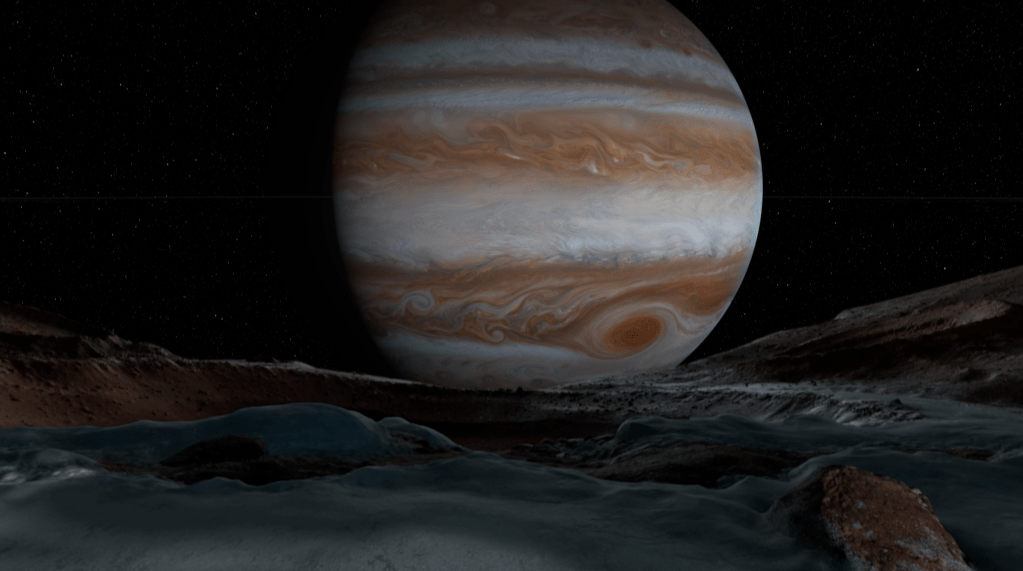
There’s a certain quiet quality that descends when you put on the Apple Vision Pro and find yourself at the edge of a mountain lake—not in the bedroom either, but not anywhere else. The immersive experience takes on a strange edge, one that Apple’s design teams have worked hard to make feel inevitable rather than engineered. Every placement of stones, every shadow, every change of ambient light is the product of deliberate, precise art.
That sense of presence immediately announced itself during the interview itself, conducted via FaceTime within Vision Pro. Sitting across from the Apple team in a shared space, the Spatial Personas were impressive—not as human scale models, but as realistically evocative representations, with enough detail to support the rhythm of conversation. The feeling of being in the same room, of learning to change slightly in speech or weight of posture, was nothing new than a quiet confirmation that something meaningful had changed in the way we understood the shared physical space.
Yuri Imoto, from Apple’s visionOS Product Marketing team, and Matt Dessero, Human Interface Designer who leads the team of visual artists, shared how these environments were conceived and built—especially the recently introduced Jupiter environment, which represents a logical evolution in both interaction and environment design.
Nature is our foundation
Matt Dessero, Human Interface Designer
Surroundings are not just backdrops, they are measured emotional instruments. “The environment is our foundation,” explained Dessero. “We ask ourselves what mood these places will create in our users. Will they evoke a sense of calm? Will they focus? A sense of wonder?” This level of design thinking and follow through on its delivery is what sets Apple apart from the rest.
In places that go to Earth, like Mount Hood or Yosemite, this starts with extensive physical activity. The teams explore and photograph the areas on site with 360-degree panoramic photography and video footage from morning to night, getting accurate lighting cues. High-resolution texture capture of rock faces and tree bark was paired with LiDAR scans to create a composite 3D geometry mesh. The result is not a picture but a reconstruction of a time zone.
We really want to make sure that the environment feels alive
Yuri Imoto, vision OS Product Marketing
What elevates these places beyond visual fidelity is the attention paid to sound. The custom model acoustic meshes how sound works within each physical environment—the sound from Yosemite’s granite walls or the soft hum of the forest floor. “We really pay attention to these details and the sound quality,” says Imoto, “because we really want to make sure that the environment feels alive and doesn’t sound like this static scene you’re sitting in”.
The team also uses deliberate planning improvements. In the case of Mount Hood, for example, the road visible in the original location has been completely removed, returning the scene to something closer to its pre-industrial state. This is not so much about changing reality as it is about constructing the world to provide a psychological effect.
Designing an outdoor space presents a very different problem. There is no weather window to wait outside, no fog delay, no security clearance—but also limited to no ground truth. The lunar landscape was constructed from limited photographs taken during the 1972 landing. And with the location of Jupiter, the team had to build a sound world from almost nothing.
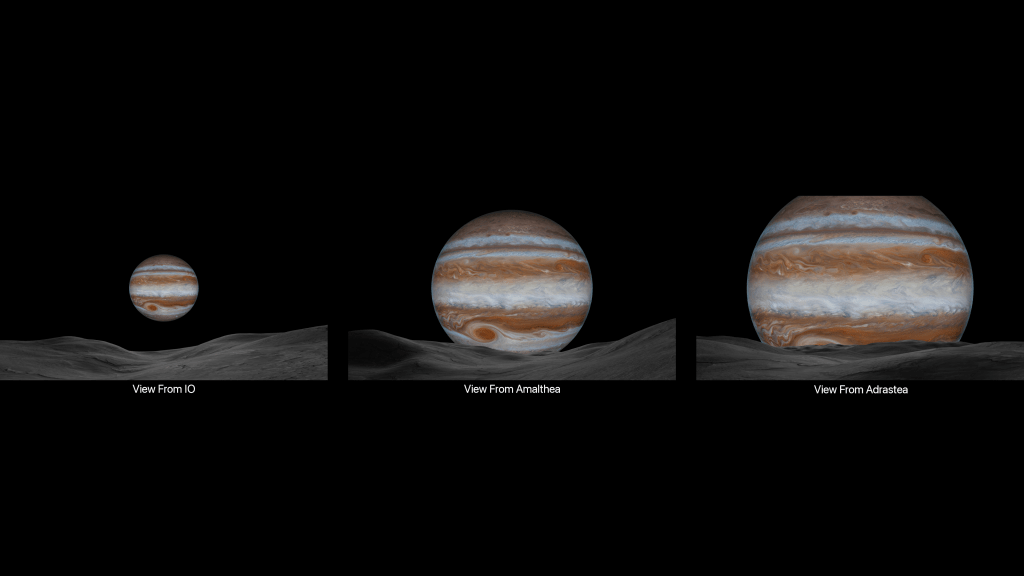
Choosing to place the observer on Amalthea—Jupiter’s third moon, about 90 miles in diameter—was itself a written decision. Jupiter needed to dominate the landscape without consuming it, inspire fear without causing a sense of existential inferiority. Amalthea’s scale and orbital shape directly provided the correct visual relationship between viewer and subject.
Because Amalthea was rarely photographed in high resolution, the texture and topography had to be taken into account. Apple’s team turned to scientists at NASA’s Jet Propulsion Laboratory for guidance. The partnership proved revolutionary. “What we found at JPL is that this moon was actually created from rocks that were pulled together by Jupiter’s gravity and held together by ice. So they think there’s a lot of ice on this moon… that’s what we tried to represent here,” Dessero noted.
JPL’s revisions to the design also prompted the addition of Jupiter’s faint orbital rings and the development of subsurface light scattering from the moon’s ice shelves—details that would not be visible to most users consciously but could be registered as an unspoken sense of physical accuracy.
Perhaps the most interesting aspect of Jupiter’s terrain is how it was made. Because conventional monitors cannot convey the scale relationships that define the spatial experience, Dessero and his team created the environment and participants within Vision Pro itself.
“The construction of what you see here is all done by me directing the singer from inside the headset,” explained Dessero. “It’s important to planning. I mean, I can’t even tell you how important it is to go down to the rocks, where all these pieces are in front.” While artists and engineers can closely approximate how things will render and feel, it’s important to see them in real time in Vision Pro to properly critique and adjust them.
Using middleware to design middleware speaks to something important about local computing. Form cannot be separated from knowledge if knowledge is form. The common pipeline of designing on a flat screen and then testing on a headset introduces a representational gap that distorts creative judgment. Monitoring and building in-situ closes that gap.
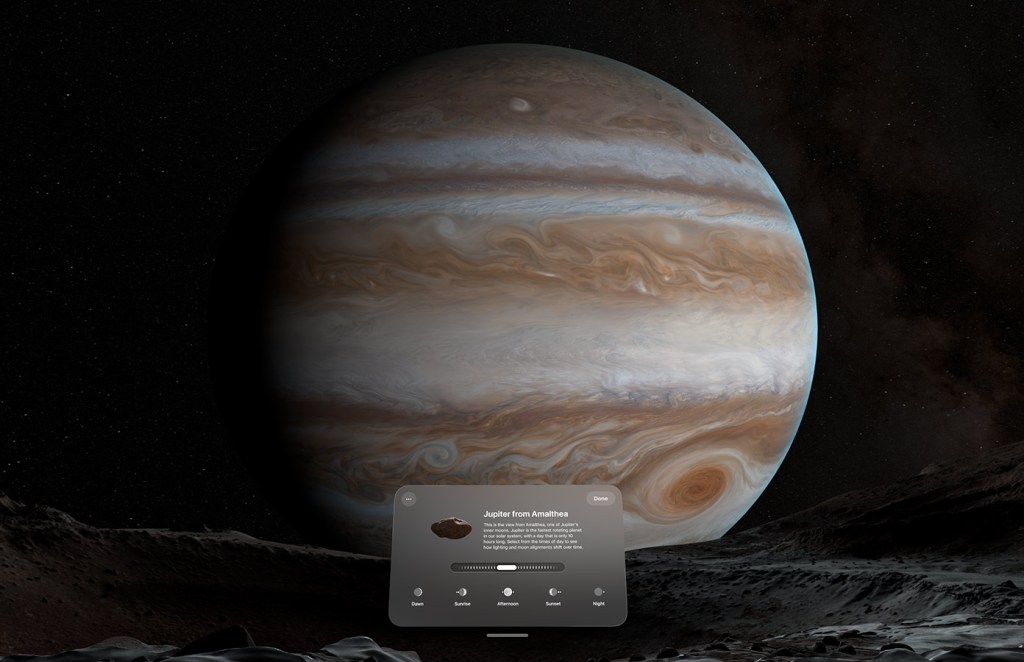
Jupiter is also the first place to introduce meaningful real-time interactions. Users can scrub through the time of day, watching shadows migrate across icy roads as Jovian storms blow in the background and neighboring moons trace slow arcs across the horizon.
What emerges from both terrestrial and extraterrestrial environments is a consistent design philosophy: emotional intent precedes technical execution, and no detail is too small to be explored. The road removed from Mount Hood and the snow spread underground in Amalthea operate on completely different scales but reflect the same basic discipline—refusing to accept “enough” when the goal is a sense of true presence.
Dessero thinks about the Jupiter project: “It’s a great example of designers, artists and engineers coming together here at Apple, solving problems, inventing and finding ways to bring this to life, which is to say, it’s really a testament to a lot of love for the craft.”
That love of craftsmanship is what separates these places from the spectacle. There are no displays of technical skill—they are spaces designed to be lived in quietly, unhurriedly and with the kind of attention that makes the user forget, however briefly, that any of it is being done at all.