How Aircraft Carriers Handle Storms at Sea Without Losing Jets

The modern aircraft carrier is, by almost any standards, a behemoth. The US Navy’s Ford-Class carriers are large, with impressive technology and combat capabilities as well. But despite their impressive size and ability to serve as battle-ready cities at sea, aircraft carriers, like all other ocean-going vessels, can be battered by major storms as they operate in waters around the world.
With their ability to launch and recover large numbers of advanced combat aircraft, we sometimes overlook the fact that these large floating air bases can be thrown into the ocean in a spectacular manner. And with their flight decks and hangar bays full of aircraft, how does the Navy ensure that these expensive and important aircraft will not be damaged or washed ashore when their carriers are tossed into rough seas?
It’s a multi-layered process that starts with high-tech weather models to predict storms, specific flight planning and protection systems on board, and finally, several systems and navigation techniques to keep aircraft – and all other carrier personnel and equipment – safe during severe storms.
Preparing for rough seas
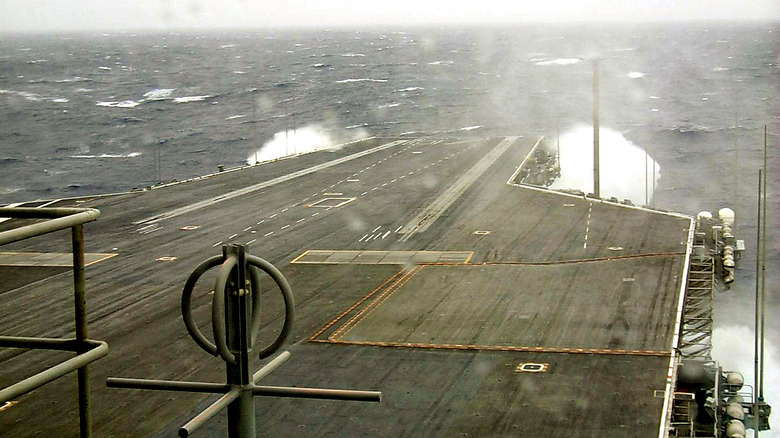
Carriers battle ships first and foremost, but some of the biggest dangers they’ve faced have actually come from Mother Nature. In World War II, Typhoon Cobra wreaked havoc on the carriers and support ships of Admiral Halsey’s Task Force 38 in the Philippines, damaged or destroyed approximately 150 aircraft and resulted in the deaths of hundreds of sailors. In 1988, the first historic Midway-class carriers famously survived a 26-degree roll during a typhoon in the Sea of Japan.
Modern carriers benefit from the latest weather monitoring technology, and that is the first step in protecting a carrier’s air wing during storms. Carriers rely on aerographers, both shore-based and ship-based, who monitor weather and sea patterns to issue accurate forecasts on the bridge. If possible, courses are adjusted so that ships can avoid severe storms, but there are times – especially in combat situations – when that is not possible.
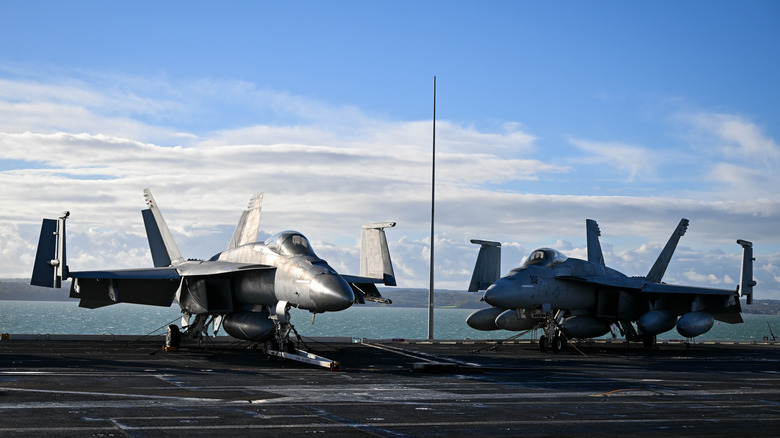
The next step, then, is to prepare the flight decks and hangar bays for the storm. Different plans are put in place according to the severity of the storm and the size of the swell, but the aircraft on the ground will usually be moved from the most suitable locations for launching to the center, where there is less movement and danger. Each plane will be attached to the deck in several places using heavy chains, and wheel bars to prevent it from rolling. Some aircraft are also moved below the deck to the hangar bay; the crew also secures these, and the watertight hangar bay doors are sealed against the elements.
Surviving the storm
From there, carriers have any number of systems and procedures to help them navigate the swollen areas as safely and securely as possible. The carrier’s navigation team and navigators adjust the ship’s heading, usually to ensure that it takes the waves at a slight angle. Speed is adjusted, and the ship adjusts ballast tanks and stabilizers to keep it as upright and stable as possible as it rides through the storm.
Many of these methods and technologies are not exclusive to aircraft carriers and are used by all types of large ships during storms at sea. It’s just that for carriers, there’s the added challenge of securing and securing dozens of incredibly expensive combat-ready aircraft, all of which must be locked up and kept safe until the storm passes.
As long as aircraft carriers operate at sea, they will have to deal with storms – and the Navy has elaborate procedures for protecting its aircraft at sea. However, on rare occasions, accidents resulting in damage or loss of aircraft carriers can and do occur. That said, the two American jets that crashed into aircraft carriers in 2025 were not lost in heavy seas, but due to mechanical failure and a lack of warning during the dive.