Oura wants information about the ring to run your home quietly

A recently granted US patent (12,558,037 B2) shows that Oura is thinking beyond sleep scores and daily readiness. Published on February 24, 2026, the documents reveal how data from the Oura ring can automatically control other devices around you.
At its core, this is about converting life signals into actions. The patent describes a system where data from a wearable ring is interpreted as body or physical condition, and then used to trigger changes in external devices without the user needing to touch anything.
That’s what the patent covers
The patent is titled “Strategies for using data collected by wearable devices to control other devices”. And it focuses on a specific series of events rather than new sensors or new health metrics.
First, the ring collects life data. Examples refer repeatedly to signals such as heart rate, heart rate variability, skin temperature and movement. This is familiar to anyone who has used an Oura ring.
Second, that data is analyzed to identify physical condition or physical activity. The patent uses examples such as sleeping, waking up, exercising, feeling stressed or entering a state of relaxation. The detection logic resides in software, usually on a paired phone, and can rely on classifiers rather than simple thresholds.
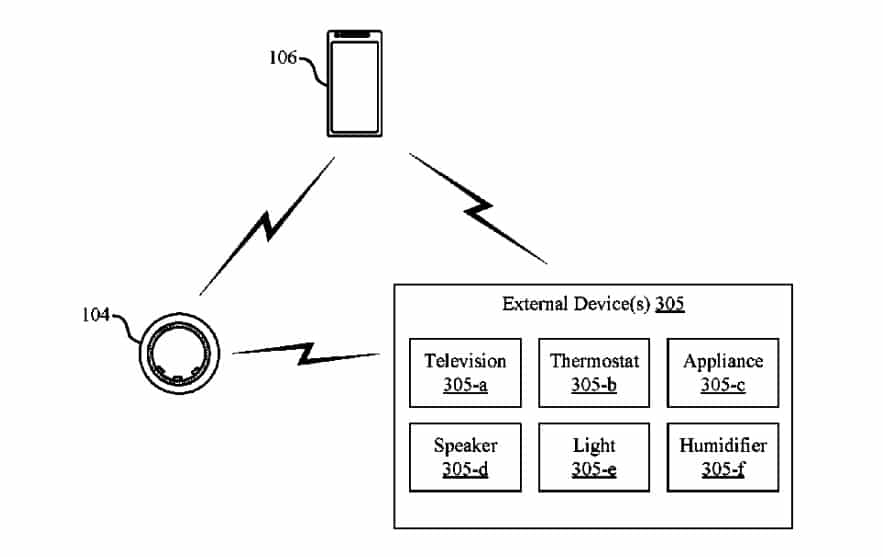
Third, once the condition is identified, the system sends instructions to one or more external devices. Those commands change the way the device works. That could mean turning something off, adjusting a level, or changing a mode.
The bottom line is that the wearable-based environment is just the beginning. This is not a timer, button press, or voice command. A patent always includes an environmental reference as a control signal.
Sleep as an obvious start
Most of the examples in the patent rely heavily on sleep changes. If the system detects that the user is falling asleep, it can dim the lights, turn off the television, pause media playback or adjust the thermostat. When awakening is realized, opposite actions can occur.
This is in line with the way Oura has already established itself. Sleep and recovery are its strongest areas, and sleep changes are pure symptoms compared to positive conditions like stress.
The patent also addresses security-related issues. If the user falls asleep while the device is running, the system can turn it off. That example comes up more than once, suggesting that Oura sees safety as a secondary but useful reason for automation.
One of the most interesting pieces of the patent is how it works with exercise. It’s not just about whether you exercise, it also looks at things like how long you’ve been training and how hard the session was.
What matters is what comes next. Claims allow actions to enter a later window once the exercise is over. Simply put, the ring shows that you are trained, and it puts things in place to help you recover.
The patent mentions examples such as preheating a sauna or whirlpool. Those are just examples and not something most people have at home, but the concept is clear. This is about post workout automation, not trying to control things while you’re in the middle of a session.
User control is still important
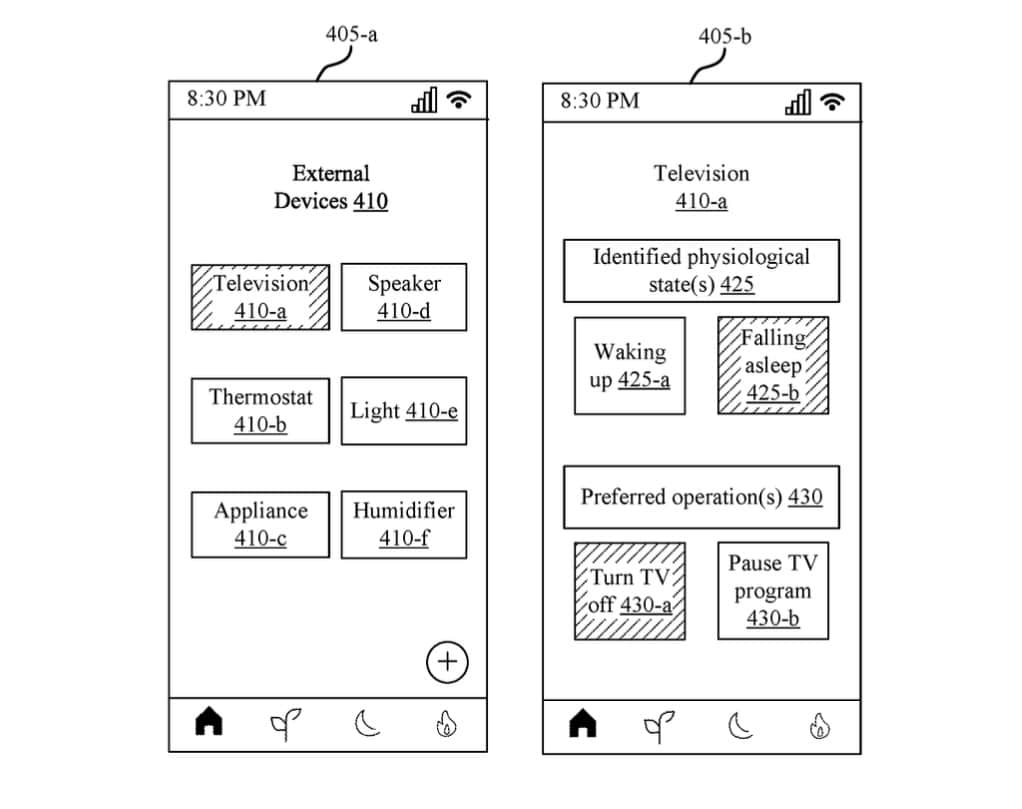
Despite all the talk of automation, copyright makes a point of keeping the user in control. It defines a graphical user interface where users define the relationship between detected conditions and device actions.
In the example screens, the user selects an external device, then selects a physical state such as sleep, and then selects what should happen. That rule is saved and reused whenever the system encounters the same situation again.
This is important because it avoids the feeling of the system. It also helps copyright to remain broad, as it does not include rigid codes of specific behavior.
Our takeaway
This patent is less about smart homes and more about where Oura wants to live for the long term. It basically means that your target regions should be important outside of the app, not like charts or scores you look at in the morning. Those states become triggers that other systems can respond to.
If something like this ever turns into a real feature, it will probably start slow. Actions based on sleep are the most obvious and safest place to start. Once you get into passive or closed-minded behavior, accuracy and trust become huge issues.
For now, this reads more like a signal than a product roadmap. Oura is clearly thinking about pushing the ring beyond tracking and into an active role, even if that idea stays on paper for a while.
The company has published several patents in recent weeks and months. We recently saw one for capturing blood pressure readings from a finger, and a patent for connecting smart ring data to a virtual reality headset.
This article first appeared on Gadgets & Wearables, the first media outlet to report the story.
Source: US Patent Office
Sign up for our monthly newsletter! Check out our YouTube channel.
And of course, you can follow Gadgets & Wearables on Google News and add us as a favorite source to get our expert news, reviews, and opinions in your feed.
The post Oura wants information on a ring to run your home quietly appeared first on Gadgets & Wearables.