Is It Worth Upgrading After Just One Year?
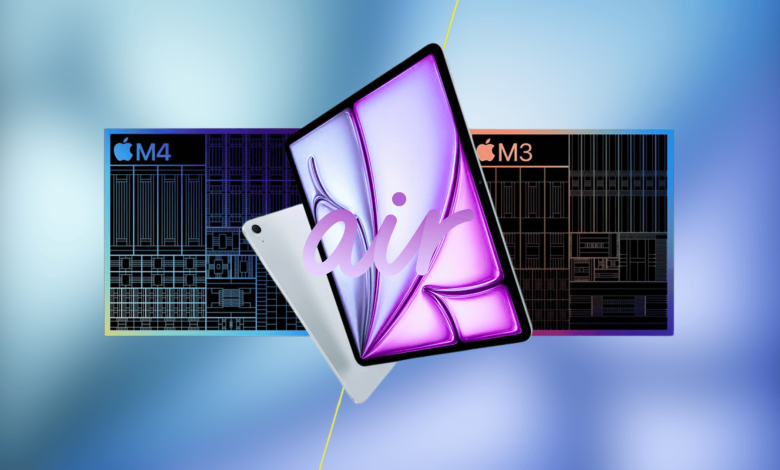
Apple introduced the new iPad Air with the M4 chip, just a year after the M3 version arrived. That naturally raises one question: if you already own an iPad Air M3, does this upgrade make sense in the near future?
On paper, the M4 model brings faster performance, more memory, improved connectivity, and deeper integration with iPadOS 26. However, the real value depends on how you use your iPad. If you rely on demanding applications like Final Cut Pro or Pixelmator Pro, the jump may be important. For simple tasks like browsing, streaming, and taking notes, the M3 still holds its own.
Performance: M4 vs M3
The biggest change is from the M3 to the M4. Apple says the M4 iPad Air is 30 percent faster than the M3 model. It also offers up to 2.3 times faster performance compared to the older M1 version.
Here’s a side-by-side comparison:
| A feature | iPad Air M3 | iPad Air M4 |
|---|---|---|
| CPU | 8-core | 8-core (new architecture) |
| The GPU | 9-core | 9-core with advanced ray tracing |
| Integrated Memory | 8GB | 12GB |
| Memory Bandwidth | Under the M4 | 120GB/s |
| The Neural Engine | 16-core | 16-core faster (up to 3x vs M1) |
| 3D rendering | Hardware acceleration | 4x faster vs M1 in ray tracing |
The M4 brings better graphics features, including second-generation hardware-accelerated mesh shading and ray tracing. If you play graphics-heavy games or work with applications that render 3D, you’ll see more realistic lighting, reflections, and shadows.
For most everyday users, the difference between the M3 and M4 will feel overwhelming. Apps open quickly, and multitasking is very efficient. However, the M3 already delivers solid performance for readers and general productivity.
Memory and AI Skills
The M4 model increases the integrated memory to 12GB, which is 50 percent more than before. It also increases memory bandwidth to 120GB per second.
That is important to:
- AI models are on the device
- Live transcription in notes
- Background removal in video editing
- Advanced image search
- Multitasking with multiple windows
The Neural Engine in the M4 is significantly faster compared to the M1, and supports the Apple Intelligence features built into iPadOS 26. While the M3 already supports AI tasks well, the extra memory in the M4 gives it more headroom for future software updates.
If you plan to keep your iPad for several years, the extra RAM in the M4 improves its long-term value.
Connectivity: N1 and C1X Chips
The new iPad Air M4 introduces Apple-designed N1 and C1X chips.
Key improvements include:
- Wi-Fi 7 support
- Bluetooth 6
- Thread support
- Up to 50 percent faster mobile data
- Up to 30 percent lower modem power consumption
If you often work on mobile data or rely on fast Wi-Fi transfers, this is a sensible upgrade. For home Wi-Fi users on older routers, the upgrade may not be visible yet.
Display, Design, and Size
Both models include:
They also share a similar design language and color choices. The experience with the display remains the same, so there is no major visual redesign this year.
Services are always available, including:
- Apple Pencil Pro
- Apple Pencil (USB-C)
- Magic keyboard
If you’ve already invested in these accessories for your M3 iPad Air, you can reuse them with the M4.
The iPadOS 26 Experience
The M4 iPad Air launches with iPadOS 26, which introduces:
- New windows system
- Menu bar support
- Improved files app
- Preview the PDF app
- Better background work management
- Local audio capture controls
These features also apply to M3 models that support iPadOS 26. However, the extra memory on the M4 makes multitasking feel smoother, especially with several apps open in windowed mode.
Price Comparison
Apple has kept the price the same:
- 11-inch starts at $599
- 13-inch starts at $799
Storage options range from 128GB to 1TB.
Since the price remains the same, new buyers get more performance for the same cost. However, existing M3 owners should consider resale value before upgrading.
So, Is It Worth the Upgrade?
Here is a practical explanation.
Upgrade to M4 if:
- Stream 4K video regularly
- Use heavy 3D or gaming functions
- It depends on AI tools and multitasking
- You want Wi-Fi 7 and fast mobiles
- Plan to keep the device for 4 to 5 years
Stay with the M3 if:
- Use the iPad primarily for media, browsing, and notes
- I bought an M3 recently
- You don’t need Wi-Fi 7
- You are already satisfied with the current performance
After just one year, the upgrade from the M3 to the M4 feels like an evolution rather than a surprise. M4 is faster, future-proof, and better for the workflow you want. However, the M3 remains powerful enough for most users in 2026.
If you’re coming from an M1 or higher, the M4 makes a strong case. If you already own an M3, upgrading now only makes sense if performance limits your daily work. For many users, waiting for another generation brings better value.