Blood Red Water Bursts Through Antarctic Ice – Now Scientists May Know Why
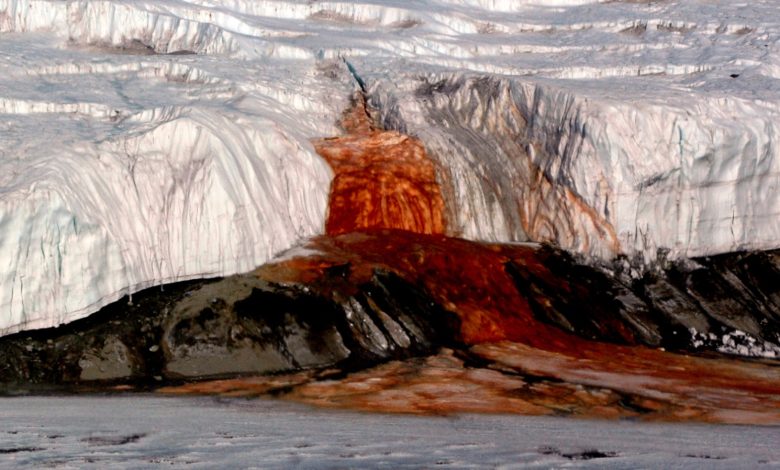
On the eastern side of Antarctica, there is a glacier called Taylor Glacier, and for more than a century, it has been doing something strange. Every now and then, a rush of what looks like blood comes out of the ground and stains the surrounding snow. This phenomenon first appeared back in 1911. Before long, the ice took the name “Blood Falls.”
Now, scientists have long known the basics of why ice does what it does. Beneath the ice, there is ancient salt water – known as brine – that is full of iron. You can guess what happened then. When that salt water reaches the surface and hits the air, the iron combines with oxygen, turning red with rust within minutes. That part has been understood for a while now.
What was not understood was what exactly caused the explosion. Why does fresh water suddenly decide to escape, and what happens under the ice when it does? A new study published in the journal Antarctic Science now explains. He held the event for the first time and explained it well. The answer seems to involve the ice itself literally sinking. Let’s dive in.
The findings of a new study
The findings of the study actually come from random chance. Back in September 2018, a GPS tracker on the face of Taylor Glacier happened to be recording near a camera pointed at Blood Falls and a temperature sensor at nearby Lake Bonney. Luck is always welcome in a field where studies sometimes hinge on things like a lost robot rescued from Antarctic ice carrying valuable data.
Nevertheless, all three instruments recorded something unusual at the same time. The glacier sank and receded, a camera caught a new red discharge at Blood Falls, and a lake sensor found a cold plunge at exactly the depth where liquid water can live. Peter T. Doran, a geoscientist at Louisiana State University, saw an opportunity and connected the dots on all three of those datasets with a team of researchers. It may be difficult to see how these events are related, but Doran’s team is here to explain.
They explained in their paper that the weight of the ice traps the salt water beneath it, and over time, that pressure keeps building. Ice can’t hold that squeeze forever, though. The slow movement of the ice eventually pushes the water from the runoff towards the crevices, where it escapes by blowing – some flowing up Blood Falls, and the other quietly into the lake. When that water runs out, there is less pressure that lifts the snow from below, so the snow settles down and loses speed. Think of it like deflating a pillow – something that sits on top. Only here, the pillow is an ancient water source, and the surface is a glacier.
This is not the first attempt at an explanation
This is not the first time researchers have tried to find an explanation for Blood Falls. For example, a 2017 study led by Jessica Badgeley at Colorado College used radar to actually map the pathways within the ice that the ocean travels through before reaching the surface. That was a big deal because it showed that liquid water could persist in very cold ice — the core of Taylor Glacier sits at about 0°F — which was something scientists didn’t think was possible. The salinity of the water reduces its freezing point enough to keep it moving, and the heat released by the ice at the edges apparently warms the surrounding ice enough to keep the channels open.
Then in 2023, Johns Hopkins researchers discovered that the red color comes mainly from iron-rich nanospheres instead of traditional minerals. Those were never detected because they are not crystalline, so the previous detection methods used simply missed. Now, a new study builds on all of this.

![iOS 26.4 beta 2 changes and features: strategies for future development [Video]](https://cdn.runwayritz.com/2026/02/iOS-264-beta-2-changes-and-features-strategies-for-future-390x220.jpg)