AVM CS 30.3 All-in-One Streaming CD Amplifier Review – HiFiReport
I have never encountered an audio company that values All-in-One devices as much as AVM. Truly, none.
While other brands might release one or two such models, no other company produces them in such volume as AVM.
AVM even offers All-in-One products in every series within their range. Moreover, if you are not strictly demanding “all” features, their “Almost-All-in-One” offerings are even more numerous.
AVM’s philosophy is straightforward: audio should be accessible in every home because music is a universal need.
Their aim is to simplify the process of listening to music, allowing people to enjoy high-quality sound without excessive complexity.
In an interview, AVM’s Global Sales Director, Harald Feld, stated that while AVM does produce separate components designed for “hard-core” audiophiles, they are more inclined to provide consumers with a simple and convenient “solution.” Just add a pair of speakers, and you’re ready to listen to music.
Nowadays, many urban homes have limited space, making it difficult to accommodate numerous audio components. All-in-One systems become the most practical choice.
Therefore, AVM offers multiple multi-functional, even All-in-One devices, across their entry-level, advanced, and high-end series.
This ensures that consumers, regardless of their budget, can find suitable AVM equipment within their affordable price range.
Entry-Level All-in-One
The most accessible All-in-One amplifier currently in AVM’s lineup is the CS 30.3.
It’s a stereo integrated amplifier delivering 125W per channel, but it also incorporates a built-in DAC, streaming capabilities, phono stage, and the increasingly rare CD player. The front panel even includes a headphone output.
Purchasing a CS 30.3 saves you the space of an entire rack of equipment and, of course, the budget for a complete audio system.
The understated aesthetic, devoid of flashy embellishments, is a hallmark of AVM design.
As an entry-level model, the CS 30.3 is even more minimalist, yet its overall design language closely resembles its mid-range and high-end siblings. This consistency in design elements across different series is another characteristic of AVM.
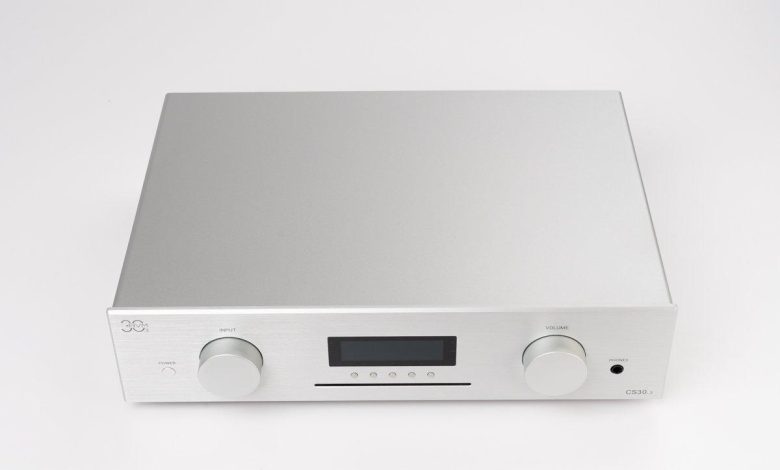
The front panel features two large knobs. The left knob is for input selection and also volume control.
A central display screen presents all information in white text on a black background, ensuring clarity.
However, the display screen is relatively small, making the text slightly diminutive and requiring closer inspection to read clearly.
Below the display is a row of circular buttons, unmarked by text or symbols.
Pressing any of these buttons will immediately bring up its function on the display, including playback controls and menu navigation.
Beneath the buttons is the slot-loading CD drive.
On the right side of the panel, next to the volume knob, is the headphone output jack.
Users can operate the CS 30.3 via the front panel knobs and buttons, the included remote control, or, most conveniently, through their mobile devices.
AVM RC X App Control
How is this mobile control achieved? Through an App.
AVM clearly understands the direction of their products. The future (and arguably the present) is the era of the Internet of Things. Home appliances are becoming interconnected, and audio equipment cannot lag behind.
Therefore, all AVM devices with streaming capabilities can be controlled via an app.
AVM’s in-house developed AVM RC X App handles all operations. It not only manages playback and song selection but also facilitates multi-room control (if you have multiple AVM streaming devices in your home) and firmware updates.
In practical use, the app is remarkably smooth, and during my testing period, I never experienced any lag or crashes.
This seamless network control is attributed to AVM’s proprietary AVM X-Stream Engine streaming platform.
AVM recognizes that with the rise of streaming, audio is no longer just about hardware or solely focused on analog excellence. Robust software support is now essential.
Despite being an entry-level product, the CS 30.3 incorporates the same acclaimed AVM X-Stream Engine found in their high-end models.
Consequently, the full range of features accessible through the AVM RC X app is identical to those found in mid-range and high-end units.
Furthermore, when a firmware update is released, the app automatically prompts the user, ensuring that your CS 30.3 is always running the latest version, keeping both functionality and performance up-to-date.
During my review period, I encountered a firmware update, and the App inquired if I wanted to update to the newest version.
The entire update process was smooth, with download and installation progress visible both on the unit’s display and in the App.
Extensive Connectivity
In terms of other functionalities, I believe the CS 30.3 is remarkably comprehensive.
Beyond streaming and Bluetooth reception, it offers coaxial and optical digital inputs and outputs.
The inputs are designed to utilize the built-in DAC for connecting other digital sources, while the outputs are available for future upgrades to a higher-end DAC.
A USB Type-A port allows for connecting external storage devices for digital file playback.
A standout digital input is the HDMI ARC, which enables connection to a TV, allowing the audio system to enhance video content, greatly increasing entertainment value.
This is also practical for HiFiReport reviewers, given the vast music resources available on YouTube. Modern TVs are almost all network-enabled, making watching music channels on YouTube a delightful experience.
For analog connectivity, the CS 30.3 provides two sets of RCA high-level analog inputs for connecting other sources.
There are also two sets of RCA inputs dedicated to phono amplification. Intriguingly, it’s not one set for MM and one for MC, but rather one set as a phono input and the other for inserting MC cartridge impedance matching plugs.
The accessory box includes three sets of 6 RCA impedance matching plugs, rated at 100Ω, 200Ω, and 1kΩ respectively.

If using an MC cartridge with your turntable, you need to select the appropriate matching plug based on the cartridge’s impedance and insert it into the “Load” input on the rear panel of the CS 30.3.
Additionally, it features two sets of RCA analog outputs: one set is pre-amplified with volume control, and the other is a high-level direct output.
The former is useful for connecting an active subwoofer or for bi-amping setups, while the latter can be used to connect recording equipment or to use the CS 30.3 solely as a source, connecting to other amplifiers.
The extensive input options and the inclusion of output terminals make the product highly versatile and full of potential.
While All-in-One devices aim for user-friendly simplicity, the CS 30.3 is anything but simplistic in its capabilities.
Personalized Settings
The menu offers numerous personalized settings for users to explore. Activating “Tone Control” allows adjustment of bass, treble, loudness, and channel balance.
For the most direct sound, bypassing EQ, the “Linear” option is available.
Furthermore, the selection between MM and MC phono input is also located within the menu.
Operating directly on the CS 30.3 unit might require some time to adjust to the button controls. It is recommended that users utilize the AVM RC X App for operation, as it is simpler and more intuitive.
Clear, Clean, Neutral Sound
About six months ago, I reviewed AVM’s mid-range All-in-One amplifier, the Evolution CS 5.3.
Its tube preamp and solid-state power amp design gave the CS 5.3 a transparent, warm, detailed, and smooth sound.
The entry-level CS 30.3, lacking tube amplification, presents a slightly different sonic character compared to the CS 5.3.

The CS 30.3 exhibits a clean, refined, and somewhat analytical sound signature. Its resolution is excellent, details are prominent, and musical layers are clearly delineated.
This character is most apparent when streaming music or playing CDs.
When using analog inputs with external sources, the sonic flavor of the front-end equipment is introduced.
However, it remains evident that the CS 30.3, in both its analog and digital sections, strives for a clear, clean, neutral, and highly resolving presentation.
Grand Orchestral Performance
When playing orchestral music, it can deliver a spacious and grand soundstage with clear structure and distinct layers.
For example, listening to Manfred Honeck conducting the Pittsburgh Symphony Orchestra in Beethoven’s Symphony No. 6, one can deeply appreciate the CS 30.3’s rational and precise nature.

This Reference Recording (RR) release is known for its clean and highly resolving sound. The CS 30.3 truly highlights these qualities.
During woodwind passages (especially the oboe), the sonic images are focused, the forms delicate, and the positioning precise.
The introductory measures, hinting at the main theme, emerge gently, filled with joyful emotion.
Honeck propels the music forward with a brisk tempo, and as the first theme unfolds, the woodwinds within it are distinctly audible.
The clarity presented by the CS 30.3 is remarkable, leaving no ambiguous gray areas.
The second theme begins with strings, followed by woodwinds. The delicate violins rise gracefully, succeeded by powerful rhythms.

Between these movements, dynamics, and contrasts, the musical nuances are all within the grasp of the CS 30.3.
Lively and Energetic
This clean and transparent tonal character, with its bright and clear texture, is particularly well-suited for showcasing the refined aspects of small-ensemble chamber music.
Listening to the “Bach Trio” album, a collaboration between Yo-Yo Ma, Chris Thile, and Edgar Meyer, where they rearranged pieces for cello, mandolin, and bass, the music takes on a unique flavor.
The crisp sound imbues the mandolin with an even more agile and vibrant personality, as if each note is leaping to life. This sense of dynamism and vibrancy makes the music lively and energetic.
The bowing texture of the cello is beautiful, with lingering harmonics.
The bass, occasionally venturing downwards, acts as both a basso continuo and provides accompaniment and harmony. The low frequencies are deep and substantial, yet maintain clear resolution.
Revitalizing Old Recordings
I also appreciate how the CS 30.3 imparts a fresh vibrancy to older recordings.
Take, for example, Oscar Peterson Trio’s “We Get Requests” album. This recording from the early 1960s is full of analog warmth, including the rich and full bass and the round, woody piano tones.
Listening through the CS 30.3, it remains the familiar “We Get Requests,” the Oscar Peterson we know, but with a brighter tonality, as if the old furniture has been polished, giving the music a renewed vitality.
The CS 30.3 makes the rhythm section, bass and drums, sound clearer. Drum hits are more defined, cymbal sounds are clearer, and bass plucks are more distinct.
With lusher and more vibrant foliage, the beauty of the flowers is better highlighted.
Moreover, the CS 30.3 does not achieve this by simply “lifting” the sound, reducing bass quantity to enhance resolution.
It still maintains ample and healthy bass presence. When Ray Brown’s bass is plucked, the Q- sound with a soft, lingering decay is truly pleasing to the ear.
Its bass is not lacking at all; it simply offers more bass resolution than others.
For instance, in the opening of “People,” after the piano motif, a rapid bass arpeggio emerges from the right rear, the sonic image is remarkably clear, and the sense of movement is vividly apparent.
Indeed, the CS 30.3 does not skimp on bass; it enhances it with resolution.
Punchy Bass for Pop Music
This characteristic is also very appealing for modern pop music. The bass is punchy and tight, and electronic beats are well-defined.
Combined with the vivid vocal image brought by high resolution and a bright, almost honeyed sound, the CS 30.3 is beckoning to pop music enthusiasts.

For instance, in Christine and the Queens’ self-titled track “Christine,” the electronic drums that run throughout the song are powerful, full, and deep. The CS 30.3 retains the psychedelic feel of these electronic rhythms, but makes them punchier, more agile, and more articulate.
As for Max Cooper’s electronic music, the bouncing electronic sounds fill the space, rising and falling, with a solid and energetic texture.
The sonic layers he creates are also well-defined in depth.
The CS 30.3 accurately renders the 3D spatiality he orchestrates.
If you are a fan of this genre of music, I believe you will be convinced by the CS 30.3.
All-in-One or Separates?
Before concluding, I want to discuss my thoughts on All-in-One devices.
Compared to separate components in the same series, All-in-One devices inevitably involve a degree of compromise.
However, aren’t we who choose All-in-One systems also seeking a form of compromise? Ultimately, whether it’s separates or integrated systems, their fundamental purpose is to reproduce music.
Regardless of our space, large or small, or the cost of our system, our goal in buying audio equipment is still to listen to music, isn’t it? For the “purpose of music,” All-in-One systems offer unparalleled convenience.
This enjoyment is something you have to experience to truly appreciate.
The CS 30.3 is not only feature-rich and versatile but also delivers satisfying sonic performance.
Its clean, clear, highly resolving, and solid sound aligns well with contemporary audio aesthetics.
The minimalist appearance, devoid of excessive ornamentation, is understated yet enduringly stylish.
Furthermore, the fact that the entire AVM range is manufactured in Germany fulfills the “Made in Germany” aspiration for many of us.
If your budget is ample and space is abundant, building a separate component system is certainly an option, and it undoubtedly offers many audiophile pleasures.
However, if your budget is limited, space is constrained, or you prefer not to spend time assembling a system, AVM’s CS 30.3 is the perfect “special of the day” prepared for you.
Specifications
* Type: All-in-One Integrated Amplifier
* Output Power: 125 Watts × 2
* Playable Discs: CD
* Digital Inputs: USB A, Coaxial, Optical, HDMI ARC, Bluetooth
* Network: LAN, Wi-Fi
* Network Functions: UPnP, AirPlay 2, Roon Ready, Spotify Connect, Tidal Connect
* Supported Streaming Services: HIGHRESAUDIO, QOBUZ, Internet Radio
* Analog Inputs: RCA High-Level, RCA MM/MC Phono
* Analog Outputs: RCA (Fixed Volume), RCA (Variable Volume), Headphone Output
* Digital Outputs: Coaxial, Optical, Volume Adjustable
* Dimensions: 340 × 10 × 320 mm (W×H×D)