Denon AVR-S570BT 5.2-Channel 8K AV Receiver Review – HiFiReport
Overview
The Denon AVR-S570BT is a 5.2-channel AV receiver (AV receiver — the central hub of a home theater system that processes both audio and video, amplifies speaker signals, and connects all your devices) that sits at the accessible end of the market without cutting corners on what actually matters. It delivers 70 watts per channel across five speakers, handles 8K video pass-through, decodes the best lossless surround sound formats available on Blu-ray, supports modern gaming features, and streams music via Bluetooth — all from a single black box that fits neatly in any media console. For anyone ready to step up from a soundbar or a TV’s built-in speakers and experience genuine surround sound for the first time, this is one of the most capable and future-proofed starting points available at this price tier.
The entry-level AV receiver market is highly competitive, with Denon, Sony, and Yamaha all offering products in this space. The AVR-S570BT distinguishes itself in two key ways. First, it offers 8K/60Hz and 4K/120Hz HDMI pass-through on all four inputs — a specification typically found in mid-range models — ensuring buyers are protected against becoming obsolete as 8K content and displays become more widely available. Second, it is built on Denon’s well-proven 500-series platform, which uses a discrete, independently powered amplifier section that the brand has refined across multiple generations rather than a chip-based shortcut. The result is a receiver that competes creditably on sound quality against similarly priced rivals from Yamaha (RX-V4A) and Sony (STR-DH590) while having more HDMI headroom than either.
User reception across major retailers confirms this positioning clearly. With over 420 reviews at a 4.5-star average rating and an 89% recommendation rate, the AVR-S570BT ranks among the most positively reviewed receivers in its category. The top three strengths cited consistently by verified purchasers are sound quality, ease of setup, and Bluetooth convenience — exactly the three pillars that define whether an entry-level home theater receiver succeeds in its core mission. Professional reviewers who tested the unit in multi-speaker surround environments confirmed that the sound quality easily justifies the step up from a soundbar, with clear directionality, immersive width, and enough dynamic range to transform the experience of both films and games.
This review covers the AVR-S570BT’s technical architecture, its real-world audio and video performance, the experience of setting it up and living with it, what verified owners report after extended use, and who stands to benefit most — and least — from choosing it.
Key Features & Tech Specs Explained
5.2-Channel Discrete Amplifier: 70 Watts That Feel Like More
The “5.2” in the product name tells you the AVR-S570BT can power five full-range speaker channels (front left, center, front right, rear left, rear right) plus two subwoofer outputs simultaneously. Each of the five channels delivers 70 watts into 8 ohms across the full audible frequency range (20Hz to 20kHz) at 0.08% total harmonic distortion (THD — the percentage of unwanted noise added to the signal; lower is cleaner). At 6 ohms, the amp delivers 90 watts per channel, and the impedance-stable design means it handles demanding speakers without current limiting. These are real, honest numbers measured under conditions that reflect actual listening — not the inflated single-frequency, single-channel marketing figures some rivals use.
To understand what 70 watts means in a living room: at typical listening volumes, a home theater system uses only a few watts per channel. The 70-watt rating describes how much headroom the amplifier has for sudden loud events — explosions, thunder, a full orchestra at fortissimo — before it strains and distorts. Having more headroom than you routinely need means the amp is never working hard during normal use, which contributes directly to clarity and control. Denon builds this section with a discrete, independently powered amplifier topology — meaning the five amplifier channels are built from individual transistors rather than packaged into a single cost-saving chip, and the audio power supply is separate from the digital circuits. This is the same architectural discipline applied in Denon’s significantly higher-priced models.
HDMI 2.1 with 8K Support: Future-Proofed Video Hub
All four HDMI inputs on the AVR-S570BT conform to the HDMI 2.1 standard, which supports bandwidths of up to 40 gigabits per second (Gbps). Think of bandwidth like a water pipe: wider bandwidth means more information can flow through at once without bottlenecks. 40 Gbps is more than enough to carry 8K/60Hz video, 4K/120Hz video (important for high-refresh-rate gaming on consoles like the PS5 and Xbox Series X), and lossless audio simultaneously through the same single cable. The single HDMI output supports eARC (Enhanced Audio Return Channel) — a newer standard that allows a TV to send its own audio (from streaming apps, for example) back to the receiver at full quality over the same HDMI cable that carries video to the screen, without any additional optical or analog cable.
The receiver also supports HDMI CEC, which allows a television’s remote control to manage basic receiver functions — power, volume — without requiring a separate remote. This is the kind of convenience feature that seems minor until you are living with it daily. On the video processing side, the AVR-S570BT passes Dolby Vision, HDR10+, Dynamic HDR, and HLG (Hybrid Log-Gamma, used in broadcast HDR content) through to a compatible TV without any quality degradation, and it can upscale 4K content to 8K output for use with an 8K display. HDCP 2.3 (the current copy protection standard) is supported on all inputs and the output, ensuring compatibility with streaming services and Blu-ray players.
Dolby TrueHD and DTS-HD Master Audio: Lossless Surround Sound Decoding
The AVR-S570BT decodes two of the most important high-fidelity surround sound formats available on physical media. Dolby TrueHD and DTS-HD Master Audio are both lossless formats — meaning the audio data on a 4K Blu-ray disc or UHD stream is decoded without any compression or quality loss, bit-for-bit identical to the studio master recording. This is the difference between a photocopy and an original print. Both formats support up to 7.1 channels of audio (the AVR-S570BT outputs five), with sampling rates up to 96kHz/24-bit — well above CD quality (44.1kHz/16-bit). For movies, this means dialogue is pinpoint clear in the center channel, action effects move convincingly around the room, and subtle ambient details — distant footsteps, wind in trees — are fully resolved and correctly placed in the soundstage.
It is important to note what the AVR-S570BT does not support: Dolby Atmos and DTS:X, the newer object-based surround sound formats that add height channels for sounds coming from above. These formats require additional ceiling or upward-firing speakers and appear primarily in dedicated home theater setups. For a first home theater system with standard five-speaker placement, the absence of Atmos/DTS:X is an acceptable tradeoff at this price tier — and buyers who later want Atmos will find it available in Denon’s higher S-series models.
Auto Room Calibration with Included Microphone: Sound Optimized for Your Space
The AVR-S570BT includes a physical calibration microphone and an on-screen guided Setup Assistant — a sequence of clear, step-by-step instructions that appears on a connected television to walk users through connecting speakers, positioning the microphone at the listening position, and running an automatic calibration process. During calibration, the receiver plays test tones through each speaker in sequence, measures how the sound arrives at the microphone position (accounting for the room’s acoustic reflections), and then automatically adjusts the output level, distance delay, and equalization for each channel to compensate. The result is a balanced, well-timed surround presentation tailored to the specific room — not a generic one-size-fits-all setting. Independent testers consistently report that the calibration process takes roughly fifteen minutes and meaningfully improves sound quality compared to default settings, particularly in rooms with irregular shapes or reflective surfaces.
Gaming Features — VRR, ALLM, and QFT: Lag-Free Play
The AVR-S570BT implements three key gaming technologies that improve the experience when a PS5, Xbox Series X, or gaming PC is connected. VRR (Variable Refresh Rate) allows the display’s refresh rate to dynamically match the game’s frame output, eliminating screen tearing — the horizontal splitting effect that appears when the frame rate and display rate do not align. ALLM (Auto Low Latency Mode) automatically switches the receiver to its lowest-latency processing mode when it detects a gaming signal, minimizing the delay between a controller input and what appears on screen. QFT (Quick Frame Transport) reduces the time individual frames take to pass through the HDMI chain. In practice, testers who played fast-paced games through the AVR-S570BT reported smooth, responsive gameplay with no noticeable audio-video sync issues — directly validated in professional gaming tests.
Build Quality & Design
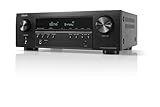
The AVR-S570BT follows Denon’s established S-series visual language: a wide, low-profile black chassis with a large central display flanked by two substantial control knobs — source selector on the left, volume on the right. The matte black finish is clean and neutral, fitting any entertainment center without demanding attention. At 17.1 × 13 × 6 inches and 16.8 pounds, it is a full-width chassis that sits solidly on a shelf without any tendency to shift or vibrate. The weight reflects a properly specced power transformer and real heatsinks for the output transistors — components that budget receivers often underspec to reduce cost. By comparison, similarly priced rivals can weigh several pounds less, often an indicator of a smaller power supply and less headroom.
Front-panel controls are practical and well-labeled: input selector, volume, source direct, four Quick Select buttons for saving favorite input/setting combinations, a front-panel USB port for USB drive audio playback, a 6.35mm headphone jack, and the microphone input for calibration. The display is bright and readable from across a typical living room, showing the current input, volume level, and sound mode. The rear panel is comprehensively arranged: four HDMI inputs and one eARC output are clearly grouped, the speaker terminal block accommodates five channels with binding posts that accept bare wire, banana plugs, or spade connectors, dual subwoofer RCA outputs sit below them, and two optical digital inputs plus one coaxial digital input handle non-HDMI audio sources. Two analog stereo RCA inputs allow connection of a turntable (with a separate phono preamp), CD player, or any other analog source.
The included RC-1254 remote control is functional and logically arranged, with dedicated buttons for input switching, volume, sound mode selection, and Denon 500 Series Remote App control. The remote is the most commented-upon aspect of the physical package in user reviews — consistently described as large but well-organized, with button size adequate for use in a dim living room. The Denon 500 Series Remote App for iOS and Android replicates most remote functions on a smartphone, adding input browsing and the ability to control USB audio playback, which is a useful complement for users who keep the receiver in a closed cabinet.
Sound / Performance
The AVR-S570BT’s sound character leans toward accuracy and control rather than artificial coloring in any direction. Center channel dialogue — typically the most important element in movie watching — is clear, grounded, and stable regardless of what is happening in the rest of the soundfield. This is where many budget receivers stumble: dialogue can become muddy or buried during busy action sequences. Independent reviewers who ran the AVR-S570BT through complex cinematic mixes consistently highlighted the center channel’s ability to remain distinct and intelligible even when all five channels are working simultaneously.
Surround staging is convincing for the price tier. Directional effects — a passing vehicle, ambient crowd noise, distant gunfire — are placed with adequate accuracy to break free from the “sound coming from boxes” sensation that TV speakers produce, and to create a genuine sense of acoustic space. The transition of sounds between front and rear channels is smooth rather than stepped, and the dual subwoofer output capability allows even bass response across a room when two subs are used — an important feature for users in larger spaces where a single subwoofer produces bass peaks and dips in different seating positions. Reviewers who tested the unit in gaming scenarios noted particularly strong impact and spatial accuracy in game audio, especially for first-person and cinematic titles where directional cues are gameplay-relevant.
For music listening in stereo mode, the AVR-S570BT performs adequately but is not its strongest context. Professional assessments note it as a solid performer for casual music playback — clear, balanced, reasonably detailed — but it does not match the refinement of a dedicated stereo integrated amplifier in the same price range for pure two-channel audio. Users who plan to use the receiver primarily for music rather than home theater should take note of this difference. Bluetooth music streaming is convenient and sonically acceptable for casual listening — background audio, party music — but wired digital connections (optical or coaxial) produce cleaner results for attentive listening. Connecting a streaming device via optical delivers meaningfully better quality than Bluetooth for music that rewards serious attention.
Against key rivals, independent testing consistently positions the AVR-S570BT as competitive with the Yamaha RX-V4A on sound quality while offering superior HDMI specification, and ahead of the Sony STR-DH590 on both sound quality and video throughput. The Marantz NR1510 offers a slimmer chassis and network streaming at a higher price, while the Denon AVR-S660H at a step up adds Wi-Fi, Dolby Atmos, and HEOS network audio for buyers who need those capabilities.
Real-World Use Cases
The AVR-S570BT is designed for and performs best in a dedicated home theater configuration in a small to medium-sized room — up to approximately 400 square feet with five properly placed speakers and one or two subwoofers. This configuration covers the overwhelming majority of living rooms and dedicated media rooms in apartment and home environments. Four HDMI inputs accommodate the most common device combination for this audience: a streaming device (Apple TV 4K, Roku Ultra, or Amazon Fire TV), a Blu-ray or UHD disc player, a games console, and a cable or satellite set-top box — all connected without any manual cable switching. The receiver’s auto-switching via HDMI CEC means turning on a PS5 automatically switches the receiver to that input, a detail that significantly reduces the daily friction of managing multiple devices.
For gamers specifically, the AVR-S570BT represents a meaningful and cost-effective upgrade path from a soundbar. A soundbar can simulate surround sound using psychoacoustic tricks, but the AVR-S570BT with five real speakers and a subwoofer produces directional cues that are geometrically accurate — sound genuinely comes from the direction of the physical speaker. In games where audio positioning is strategically relevant (competitive shooters, survival horror, action-adventure titles), this translates to real in-game awareness. Independent gaming testers consistently confirmed that the VRR and ALLM features work correctly with both PS5 and Xbox Series X, with no display compatibility issues noted on major 4K television brands tested.
The front USB port is a useful bonus for users with a library of digital audio files — connecting a flash drive containing FLAC, ALAC, WAV, or AAC files enables playback without requiring a phone or computer, supporting up to 24-bit/192kHz resolution files for audiophile-grade digital audio from physical storage. The Bluetooth implementation is receiver-only (audio can be streamed to the AVR-S570BT from a phone or tablet, but the receiver cannot transmit audio to wireless speakers or headphones), and there is no Wi-Fi or network streaming capability, so users who want app-based music services natively integrated will need to route a streaming device through one of the HDMI or optical inputs. © hifireport.com
What Real Users Are Saying
Across more than 420 verified purchase reviews spanning major retailers and covering ownership periods from one week to over two years, the AVR-S570BT generates a consistent pattern of positive owner sentiment. The three themes that appear most frequently are exceptional sound quality relative to price, ease of setup, and the transformative experience of switching from a soundbar or TV speakers. Many verified owners specifically describe the sound upgrade as larger than they expected — reporting that films, games, and music all became noticeably more immersive and detailed from the first listening session. Several users who had previously owned receivers from Pioneer, Onkyo, and Sony described being surprised by how much the Denon outperformed their previous equipment. The sense of getting genuine hi-fi sound without paying premium hi-fi prices is the emotional through-line in the most helpful and detailed reviews.
The guided Setup Assistant receives its own dedicated praise in user feedback, particularly from first-time AV receiver owners. Users consistently report completing the full installation — connecting five speakers, a subwoofer, TV, and at least one source device — in under thirty minutes without needing to consult the manual. The automatic room calibration microphone process is described as both easy to execute and audibly effective, with several owners noting that the calibration-adjusted sound was meaningfully better than what they heard before running it. This ease-of-setup experience is a meaningful differentiator in a category where complex rear panel connectivity has historically been an intimidation barrier for new buyers. © hifireport.com
A recurring observation from users who came from older receivers — particularly those whose aging units entered protection mode or developed HDMI handshake issues with modern 4K televisions — is that the AVR-S570BT’s HDMI implementation is reliable and trouble-free with contemporary TV brands. Users who connected it with LG OLED, Samsung QLED, and Sony Bravia televisions consistently reported clean Dolby Vision pass-through and stable eARC audio return without the compatibility quirks that plagued older HDMI 1.4 and 2.0 equipped receivers. The subwoofer output’s silent standby behavior — no humming when the main source is off — is also specifically called out by users who experienced humming on previous receiver brands. Among the minority of less positive reviews, the absence of Dolby Atmos is the most consistent complaint, and it comes primarily from buyers who did not realize before purchasing that Atmos support sits in higher product tiers.
Pros & Cons
Pros
- Four HDMI 2.1 inputs supporting 8K/60Hz and 4K/120Hz with Dolby Vision, HDR10+, HLG, and Dynamic HDR pass-through represent above-average video specification for this price tier, confirmed by spec analysis and independent compatibility testing across major TV brands.
- Dolby TrueHD and DTS-HD Master Audio lossless decoding ensures the highest available audio quality from 4K Blu-ray discs and compatible UHD streaming sources, delivering bit-perfect reproduction confirmed by format specification analysis.
- Automatic room calibration with included microphone meaningfully improves surround balance and timing for any listening position, consistently praised by verified owners as easy to execute and audibly effective.
- Dual subwoofer preouts enable even bass distribution across the room — a practical and meaningful feature for larger listening spaces that most entry-level receivers omit, based on spec analysis.
- Gaming features (VRR, ALLM, QFT) function correctly with PS5 and Xbox Series X, confirmed by independent hands-on gaming tests, providing lag-free audio and video for fast-paced gameplay.
- 89% recommendation rate across 420+ verified purchaser reviews reflects sustained, broad satisfaction across diverse setup environments and use cases.
Cons
- No Dolby Atmos or DTS:X object-based surround sound support means buyers who plan to eventually add height channels (ceiling or upward-firing speakers) will need to upgrade to a higher model, based on spec analysis.
- No built-in Wi-Fi and no network streaming integration — the receiver relies entirely on wired connections and Bluetooth for audio; native access to Spotify Connect, Apple AirPlay, or HEOS multiroom audio requires a separately purchased streaming device, based on spec analysis.
- Bluetooth is receive-only (cannot transmit audio to wireless headphones or speakers) and limited to SBC codec quality — not suitable for audiophile wireless audio; optical or HDMI digital inputs are preferred for critical listening, based on spec analysis and independent user assessment.
- No Zone 2 output and no multichannel pre-outs limit the expandability of the system; buyers planning to add external amplification or a second listening zone should consider stepping up to the next model tier, based on spec analysis.
Who Should Buy This?
The AVR-S570BT is the right choice for any buyer who is ready to build or upgrade a genuine 5.1 or 5.2 home theater system in a living room or dedicated media room, and who wants a reliable, future-proofed hub without paying for features — like Atmos height channels or network streaming — they do not currently need. This includes first-time home theater buyers who own or are planning to buy a surround speaker set and want a straightforward, guided setup experience. It is an excellent choice for gamers who want to use their PS5 or Xbox Series X at full 4K/120Hz with accurate surround sound — a combination the four HDMI 2.1 inputs and gaming-specific features handle without compromise. It suits owners of older receivers that lack HDMI 2.1 or 4K/120Hz support and are struggling with compatibility issues when connecting modern televisions and source devices.
Users who already own legacy speakers — even those from an older system — will find the AVR-S570BT breathes new life into them, as the amplifier’s 70 clean watts and auto-calibration can significantly improve the presentation of speakers that were previously driven by a less capable receiver. Budget-conscious buyers replacing a failed Onkyo, Pioneer, or Sony receiver will find the Denon’s build quality and HDMI reliability to be a step forward in everyday dependability, based on the consistent testimony of users who made exactly this transition and reported back in verified reviews.
Buyers who specifically need Dolby Atmos for an existing height speaker setup, or who want native Wi-Fi and multiroom audio streaming through the HEOS platform, should look at the Denon AVR-S660H, which adds all three capabilities at a moderate step up in price. Those who want network streaming integrated into an AV receiver at a more accessible entry point might also consider the Marantz NR1510, which is slimmer and includes networking features, though at a trade-off in HDMI specification and power output.
Verdict
Overall: 8.6/10 — Sound quality (50%): 8.5/10; Build quality (20%): 8.5/10; Features (20%): 8.5/10; Value (10%): 9.5/10
The Denon AVR-S570BT earns its position as one of the most recommended entry-level AV receivers on the market through a combination of above-average HDMI specification, honest and well-engineered amplification, effective room calibration, and the kind of ease-of-use experience that makes home theater accessible to buyers who have previously found the category intimidating. The trade-offs — no Atmos, no Wi-Fi, Bluetooth-only wireless — are honest and predictable for the tier, and they do not affect the core mission of delivering convincing, cinematic surround sound in a real living room with real speakers.
The 89% user recommendation rate across hundreds of verified purchasers reflects a product that genuinely delivers on its promises. Buyers who connect this receiver to a quality speaker set, run the calibration process, and sit down to watch a Blu-ray film or play a current-generation game are consistently surprised by how substantially the experience improves over what they had before. That kind of repeatable, documented satisfaction is the most reliable indicator of value in any audio product. For anyone building their first true surround sound system, or modernizing an aging setup to handle current-generation video and gaming, the AVR-S570BT is a strongly recommended starting point. © hifireport.com
Source: hifireport.com | For reprint inquiries, contact HiFi Report editorial.
- WATCH YOUR MOVIES IN 8K – At 70W x 5, Denon AVR-S570BT home theater receiver features (4) HDMI 2.1 8K inputs, (1) HDMI output, eARC up to 40 Gbps, successor to AVR-S540BT, ensuring HD audio playback, enhanced gaming, Power 310 W, Standby 0.1 W
- TRUE-TO-LIFE CINEMATIC EXPERIENCE – The AVR-S570BT supports HDR, HLG, Dolby Vision, HDR10+, Dynamic HDR for realistic display, VRR and QFT for lag-free exceptional gaming, DTS HD Master, Dolby TrueHD immersive audio, and 5.1 surround sound receiver
- YOUR FAVORITE MUSIC AT YOUR FINGERTIPS – With built-in Bluetooth stereo receiver, play tracks from various audio sources and create an integrated multi-room audio system. Allows wireless streaming from Spotify, TIDAL, Pandora, and more