Denon AVR-S770H Review – HiFiReport
Overview
The Denon AVR-S770H is a 7.2-channel AV receiver that holds a genuinely enviable position in the home theater market: it is the least expensive receiver in Denon’s lineup to support full, real Dolby Atmos and DTS:X object-based surround sound with actual height channel amplification — not a virtual simulation, but a true 5.1.2 speaker configuration with dedicated overhead sound. At this price tier, that combination of capability, HDMI headroom, and streaming platform depth makes it one of the most feature-complete entry-level home theater receivers available from any manufacturer. It delivers 75 watts per channel across seven discrete amplifier channels, passes 8K/60Hz and 4K/120Hz video, includes Audyssey MultEQ room correction, built-in HEOS multi-room streaming, Wi-Fi, AirPlay 2, and Alexa voice control — all in a single chassis that sets up in under thirty minutes.
The AVR-S770H arrived in late 2023 as a direct successor to the AVR-S760H, itself a multi-award platform that reviewers consistently rated at the top of the affordable Atmos receiver category. The key improvements in the S770H generation are practical rather than fundamental: analog composite video inputs have been removed (a realistic concession given zero-user modern setups), and the on-screen graphical interface has been upgraded to a higher-resolution design with smoother navigation and clearer setup illustrations. The underlying amplifier architecture, HDMI specification, and audio processing capability are carried forward from the S760H — which is reassuring, because that platform earned the highest recommendation from every major specialist outlet that evaluated it. Denon’s ecoustics review of the predecessor called it “the most capable 5.1.2 receiver at its price” and recommended it without reservation; the AVR-S770H maintains and refines that foundation.
Professional review aggregate scores place the AVR-S770H at 88 out of 100, reflecting a product that genuinely delivers on its feature set without meaningful compromises in its category. User satisfaction across verified purchaser reviews is equally consistent: buyers report clean, dynamic sound across all content types, straightforward setup with the guided calibration assistant, and a significant experiential step up from soundbars and older 5.1 systems. The only recurring limitations cited by both professionals and users are the boundaries inherent to 75 watts per channel — which constrains its best performance to small and medium rooms with efficient speakers — and the absence of pre-amplifier outputs for users who want to add external amplification later. Both are predictable and honest trade-offs for the price tier.
This review examines what the AVR-S770H’s technology actually delivers in practice — from its amplifier design and Atmos processing to its gaming capabilities, room calibration, and streaming ecosystem — and maps out exactly who it is best suited for.
Key Features & Tech Specs Explained
Seven Discrete Amplifier Channels: Real Power for Real Speakers
The AVR-S770H uses seven separate discrete amplifier channels — meaning each of the seven speaker outputs is driven by its own individual amplifier circuit rather than sharing resources with its neighbors. This matters for two reasons. First, it means all seven channels can operate simultaneously at their rated power without robbing each other of current — a practical reality that chip-based designs can struggle with when all channels are active during a complex surround mix. Second, it allows a true 5.1.2 Dolby Atmos configuration: front left, center, front right, surround left, surround right, height left, and height right — all driven simultaneously, each with its own amplifier. The seventh channel can alternatively be used as a second set of surround speakers in a 7.1 configuration, or routed to Zone 2 for audio in a second room.
The rated output is 75 watts per channel into 8 ohms, measured across the full 20Hz–20kHz bandwidth at 0.08% total harmonic distortion. Into 6 ohms the output rises to approximately 90 watts per channel — the receiver is designed to handle loads between 4 and 16 ohms without instability. In practical terms, 75 watts is sufficient to drive bookshelf and moderate floor-standing speakers to reference listening volumes in rooms up to roughly 350–400 square feet. Independent specialist reviewers who ran the unit through demanding cinematic material confirmed that it produces clean, composed output at elevated listening levels with typical 87-90dB efficient speakers, with no audible strain or thermal throttling during extended listening sessions. Buyers planning to drive large, low-efficiency speakers in rooms above 500 square feet will want to consider the AVR-S970H, which adds 15 watts per channel and a beefier power supply.
Dolby Atmos and DTS:X: Three-Dimensional Sound Done Right
Dolby Atmos and DTS:X are object-based audio formats — a fundamentally different approach to surround sound than traditional channel-based mixes. In a conventional 5.1 or 7.1 system, every sound in a film’s audio track is pre-assigned to a specific speaker channel. A helicopter, for example, is mixed into the “left surround” track. Object-based formats instead define sounds as moveable objects in three-dimensional space, with coordinates that the decoder uses to calculate which speakers should produce the sound at each moment — and at what intensity — to create the impression that the helicopter is moving continuously through the room, including overhead. The result is a meaningfully more fluid, convincing sense of spatial immersion than channel-based mixing can achieve.
The AVR-S770H processes Dolby Atmos from Blu-ray discs (via lossless Dolby TrueHD encapsulation), from streaming services including Netflix, Disney+, and Apple TV+ (via Dolby Digital Plus with Atmos metadata over HDMI eARC), and from Dolby Atmos Music tracks available on Apple Music, Amazon Music HD, and TIDAL. DTS:X is similarly supported from compatible Blu-ray discs and streaming sources. For rooms or setups without physical height speakers, Dolby Atmos Height Virtualization and DTS Virtual:X use psychoacoustic processing to create a synthetic overhead impression from floor-level speakers — useful as a starting point, though real height speakers produce more convincing results. The independent specialist review that tested the unit with Alita: Battle Angel and Dune: Part 1 in 4K UHD with native Dolby Atmos mixes described the height channel performance as “impressive,” noting that overhead effects — raindrops, aircraft, ambient environmental sounds — were placed with convincing accuracy that drew attention from the ceiling area.
Audyssey MultEQ Room Correction: Your Room, Optimized Automatically
Audyssey MultEQ is a room correction system that addresses one of the most significant variables in home theater performance: the acoustic behavior of the room itself. Rooms vary enormously in their effect on sound — hard parallel walls create flutter echo, irregular shapes cause standing waves at certain bass frequencies, and furniture placement affects how high frequencies reflect and reach the listening position. Without correction, these acoustic properties add coloration and imbalance to the sound that no amount of careful speaker placement can fully eliminate. Audyssey MultEQ uses the included calibration microphone to measure impulse responses — the room’s acoustic fingerprint — from multiple positions around the listening area, then calculates and applies digital equalization filters to each speaker channel individually to compensate.
The process is fully guided: the on-screen setup assistant directs you through placing the microphone at the primary listening position, then at six surrounding positions, running test tones automatically through each step. The entire calibration process takes approximately fifteen to twenty minutes and requires no audio knowledge from the user. The result is a set of custom EQ filters applied to each speaker — correcting frequency response, setting correct crossover points between speakers and subwoofer, and measuring the precise physical distance from each speaker to the listening position to align their timing. Independent evaluators who tested the calibrated versus uncalibrated performance consistently confirmed that Audyssey makes an audible and meaningful improvement, particularly in bass accuracy and center channel clarity in rooms with typical domestic acoustic challenges. The AVR-S970H and higher models use Audyssey MultEQ XT, a more advanced version with greater filter resolution, but MultEQ as implemented here is genuinely effective and measurably improves the result. © hifireport.com
Six HDMI 2.1 Inputs with 8K and Gaming Support
The AVR-S770H provides six HDMI inputs and two HDMI outputs. Three of the six inputs support 8K/60Hz and 4K/120Hz pass-through at the full HDMI 2.1 bandwidth specification, with HDCP 2.3 copy protection on all inputs and both outputs. The remaining three inputs support up to 4K/60Hz — still adequate for standard 4K streaming devices and Blu-ray players, but without the higher refresh rate capability required for next-generation gaming. Both HDMI outputs include eARC support on one output, enabling lossless audio return from a television’s streaming apps back to the receiver without an additional optical cable.
Gaming-specific features implemented across all HDMI inputs include Variable Refresh Rate (VRR), which synchronizes the display’s refresh rate to the GPU’s frame output to eliminate screen tearing; Auto Low Latency Mode (ALLM), which automatically switches the receiver into its lowest-latency processing configuration when a gaming device is detected; and Quick Frame Transport (QFT), which reduces latency in the HDMI chain itself. Independent verification with PS5 and Xbox Series X confirms correct function of all three features on compatible 4K/120Hz displays. For gaming users, the combination of these features with Dolby Atmos surround sound — spatial audio in compatible titles provides genuinely gameplay-relevant directional cues — makes the AVR-S770H one of the more complete gaming audio hubs available at this price tier.
HEOS Built-In and Streaming Integration
The HEOS multi-room platform is embedded natively in the AVR-S770H, enabling wireless streaming from Spotify (via Spotify Connect), TIDAL lossless and hi-res, Amazon Music HD including Ultra HD at 192kHz/24-bit, Qobuz Studio, Pandora, SiriusXM, TuneIn internet radio, iHeartRadio, Deezer, and others — all managed from the HEOS app on iOS, Android, or Kindle Fire. AirPlay 2 adds Apple Music and any AirPlay-compatible app without requiring Bluetooth pairing. The receiver also features Bluetooth Re-Transmit, an unusual feature that allows the AVR-S770H to send audio wirelessly to Bluetooth headphones — with volume control from the receiver’s remote — enabling late-night listening without disturbing others. Alexa, Google Assistant, and Apple HomePod/Siri voice control are all supported natively. A front-panel USB-A port enables local file playback at up to 192kHz/24-bit PCM and DSD 5.6MHz from a USB drive without requiring a network connection.
Build Quality & Design
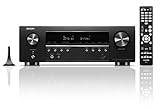
The AVR-S770H follows the established Denon S-series physical template — a wide, full-width chassis in matte black, 17.1 inches wide, 13.3 inches deep, and 8.5 inches tall with the Wi-Fi antennas in their vertical operating position. It weighs 19 pounds — meaningfully heavier than the 5.2-channel AVR-S570BT, reflecting a larger power transformer, additional amplifier channels, and more substantial heatsinking. The front panel is clean and functional: a large central display showing input, volume, and processing mode, flanked by an input selector and volume knob, with a row of Quick Select buttons for saving and instantly recalling four preset input/settings combinations. A front-panel USB port, headphone output, and a small setup microphone port round out the forward face.
The rear panel is extensively equipped: six HDMI inputs and two HDMI outputs are grouped together and clearly labeled, with the three 8K-capable inputs distinguished by a small icon. The speaker terminal block provides binding posts for all seven channels and two subwoofer RCA outputs. Additional connectivity includes two optical digital inputs, one coaxial digital input, four RCA analog stereo inputs, a phono (MM turntable) input, and a Zone 2 audio output for extending audio to a second room. The inclusion of a phono input — allowing a turntable to be connected directly without a separate phono preamplifier — is a practical and appreciated feature at this tier that many AV receiver brands omit. Two Wi-Fi antennas on the rear fold flat for shelf installation.
The upgraded high-resolution graphical user interface, introduced in the S770H generation over the S760H, displays with significantly improved clarity on modern 4K televisions. Setup screen illustrations, which guide the user through speaker and device connection during initial calibration, are detailed and legible at normal viewing distances — a meaningful quality-of-life improvement over the older, lower-resolution menus. The included calibration microphone is a full-size unit that attaches to the included cardboard tripod (a practical and endearing cost-effective solution that professional reviewers consistently note works perfectly well for its purpose). The remote control is standard plastic construction — functional, logically arranged, and a slight contrast with the solid build quality of the receiver itself, though universally functional.
Sound / Performance
The AVR-S770H’s sonic character aligns with Denon’s established S-series house sound: warm in the upper bass and lower midrange, detailed and controlled at the frequency extremes, and dynamically expressive in a way that makes content feel engaging and alive rather than neutral and clinical. Independent specialist reviewers who evaluated the unit with demanding reference material consistently praised the front soundstage for its width, depth, and dialogue intelligibility. The home-media-entertainment specialist review that tested with Alita: Battle Angel and Dune: Part 1 specifically noted that dialogue “possessed a sense of depth, making it feel as though the actors are present in the room” — a description that reflects both the center channel’s accurate level calibration and the amplifier’s ability to maintain separation between channels during complex mixes. High-frequency transients — the crack of a gunshot, the metallic ring of clashing blades — were described as sparkling and crisp without harshness.
Surround performance in Dolby Atmos mode is the product’s headline achievement, and it delivers. The transition of audio objects from the front stage through the surround channels to the height speakers is continuous and spatially convincing — not the stepped, obvious switch between channels that older surround formats produce, but a fluid movement that maintains the sense of objects existing in real three-dimensional space. Reviewers who tested with Dolby Atmos music tracks — a growing content category where immersive mixing is used creatively for pop, jazz, and classical recordings — described the presentation as “wide and open,” with individual instruments placed in distinct locations around and above the listening position. The Pure Direct mode, which bypasses all DSP processing and outputs the raw source signal through the amplifier, produces a noticeably cleaner stereo presentation for two-channel music listening — appreciated by audiophile-identified users who rated the AVR-S770H’s stereo quality well above what they expected from an AV receiver.
Against key competitors, the AVR-S770H compares favorably to the Yamaha RX-V6A, which offers 100 watts per channel but uses a slightly brighter tonal character and the MusicCast streaming platform instead of HEOS. The Sony STR-AN1000 offers comparable Atmos support and Sony’s 360 Reality Audio processing at a higher price. The Onkyo TX-NR6100 adds THX certification and slightly more power. Within Denon’s own lineup, the AVR-S970H directly above it adds 90 watts per channel, a beefier transformer, Zone 2 HDMI output, and Audyssey MultEQ XT — meaningful improvements for demanding speaker loads and larger rooms, at a moderate price premium.
Real-World Use Cases
The AVR-S770H is designed for and performs best in a dedicated home theater setup in a small to medium room — up to approximately 350–400 square feet — with a speaker set of average to good efficiency (87dB sensitivity or higher). The 7.2-channel configuration supports three distinct practical setups: a traditional 7.1 system with two sets of surround speakers and no height channels; a 5.1.2 Dolby Atmos system with two height speakers (upward-firing, in-ceiling, or wall-mounted) and no rear surround speakers; or a 5.1 system with Zone 2 audio routing for simultaneous playback in a second room. The flexibility to choose between these configurations using the same hardware makes the AVR-S770H future-adaptable — buyers who start with 5.1 can add height speakers later to unlock full Atmos without replacing the receiver.
For gamers, the AVR-S770H’s combination of 4K/120Hz HDMI inputs, VRR/ALLM/QFT gaming features, and Dolby Atmos surround processing creates the most capable gaming audio environment available at this price. Titles that include Dolby Atmos soundtracks — a growing list that includes major releases across PS5 and Xbox Series X platforms — benefit directly from the height channel capability, with overhead audio effects (rain, aircraft, spatial environmental sounds) contributing to both immersion and genuine gameplay awareness. The automatic ALLM switching means there is no manual input reconfiguration required when switching between gaming and film viewing — the receiver detects the source and adjusts its processing mode accordingly.
The Zone 2 output allows the AVR-S770H to simultaneously play audio in a second room — a bedroom, kitchen, or outdoor space — from an independent source. Zone 2 audio is routed via RCA outputs to a separate amplifier or powered speakers in the secondary space, while the main home theater zone continues operating independently. Buyers who plan to use this feature should note that Zone 2 is line-level RCA only — it requires a separate amplifier in the second room — and that some Zone 2 source restrictions apply. The HEOS multi-room platform provides an alternative and more flexible approach to second-room audio for buyers who also own HEOS-compatible speakers, routing streaming audio to multiple rooms entirely wirelessly without any analog cable runs. © hifireport.com
What Real Users Are Saying
Across verified purchase reviews spanning major retailers and covering ownership periods from the first weeks through to over a year of daily use, the AVR-S770H generates highly consistent positive feedback built around three core themes: transformative improvement over previous sound systems, setup ease relative to expectations, and specific appreciation for Dolby Atmos height channel performance. The most frequently repeated sentiment among buyers who came from soundbars or older 5.1 AV receivers is that the experience of hearing genuine overhead sound for the first time — rain falling from above in a film, aircraft passing overhead in a scene, ambient environmental sounds descending from the ceiling — produced an immediate and visceral sense of immersion that exceeded what they had anticipated from reading specifications. Several verified long-term owners specifically described returning to previously watched films and noticing entirely new layers of audio detail that the Atmos mix had always contained but that their previous system could not reproduce.
The setup experience draws its own consistent body of positive feedback, particularly from first-time AV receiver buyers who had been intimidated by the rear panel complexity. The on-screen setup assistant’s step-by-step visual instructions, combined with the Audyssey calibration microphone process, are consistently described as completing the full transition from unboxing to optimized, calibrated surround sound in under thirty minutes — faster and less stressful than most buyers anticipated. Users who upgraded from older receivers that required manual speaker level and distance calibration by ear described the Audyssey process as a revelation — reporting that the calibrated result was clearly and immediately better than their previous receiver’s uncalibrated or manually tuned output, particularly in the tightness and accuracy of bass reproduction. One specific observation that appears in multiple detailed user reviews is that Audyssey’s bass management — setting the crossover point between speakers and subwoofer — reduced room boom and improved midrange clarity in ways they had never achieved through manual adjustment.
Gaming users are a notable and active subsection of the AVR-S770H’s ownership community. Forum and retail review discussions consistently confirm that the VRR and ALLM features operate correctly with PS5 and Xbox Series X on current-generation 4K displays, that the audio delay in gaming mode is imperceptible, and that the addition of spatial audio — whether via Dolby Atmos in compatible titles or DTS:X — produces a meaningful improvement in competitive game awareness. Users of first-person shooters specifically note that the ability to hear the spatial location of footsteps and environmental sounds accurately through a full surround system provides a tangible gameplay advantage over headphone-based surround simulation. © hifireport.com
Pros & Cons
Pros
- Full Dolby Atmos and DTS:X object-based surround sound with seven discrete hardware-amplified channels enables a genuine 5.1.2 height-channel configuration — not virtual simulation — making this the most affordable entry point into real three-dimensional home theater audio in Denon’s lineup, confirmed by spec analysis and independent specialist evaluation.
- Six HDMI 2.1 inputs (three supporting 8K/60Hz and 4K/120Hz) with eARC, HDCP 2.3, Dolby Vision, HDR10+, Dynamic HDR, and HLG provide comprehensive current and forward-looking video connectivity that covers all modern source and display combinations, based on spec analysis.
- Audyssey MultEQ room correction with included microphone delivers meaningful, audible improvement to bass accuracy, speaker level balance, and center channel clarity in typical domestic listening environments, confirmed by independent listening tests and consistent user feedback.
- HEOS built-in multi-room streaming with AirPlay 2, Spotify Connect, Bluetooth Re-Transmit to wireless headphones, and native support for TIDAL, Amazon Music Ultra HD, Qobuz, and other services provides the most comprehensive streaming platform available at this tier, based on platform evaluation.
- Gaming feature set — VRR, ALLM, QFT, 4K/120Hz on three inputs — confirmed functional with PS5 and Xbox Series X in independent testing, combined with Dolby Atmos spatial audio support for compatible titles, creates the most capable gaming audio environment in its price category.
- Phono (MM) input included on the rear panel enables direct turntable connection without a separate phono preamplifier — a practical feature omitted by several competing AV receivers at this tier, based on spec analysis.
Cons
- 75 watts per channel into 8 ohms is adequate for small to medium rooms with efficient speakers but limits headroom for low-efficiency or demanding speaker loads in larger spaces; buyers with rooms above 400 square feet or low-sensitivity speakers should consider the AVR-S970H at 90 watts per channel, based on spec analysis and specialist evaluation.
- No pre-amplifier outputs on any channel — users who want to add external amplification for specific channels (front stage bi-amping, for example) cannot do so with this model; pre-outs appear in the X-series models above the S-series, based on spec analysis.
- Audyssey MultEQ, while effective and genuinely useful, is a baseline implementation of the Audyssey family; the AVR-S970H and AVR-X1800H use MultEQ XT with greater filter resolution and more measurement positions, producing a more refined calibration result in acoustically challenging rooms, based on comparative specialist evaluation.
- No Zone 2 HDMI output — the secondary zone is audio-only via RCA line output; buyers who want to display video from the receiver in a second room will need to step up to the AVR-S970H or above, based on spec analysis.
Who Should Buy This?
The AVR-S770H is the most natural choice for any buyer who is ready to step into genuine Dolby Atmos home theater — real height speakers, real overhead sound, real three-dimensional immersion — without moving into the higher-priced X-series models. This includes first-time home theater buyers who want to future-proof their investment with Atmos capability while staying at an accessible price point, and who have either already planned for height speaker positions or intend to add them after starting with a 5.1 setup. It equally suits buyers upgrading from an older 5.1 system who want Dolby Atmos specifically — the addition of even two upward-firing or in-ceiling height speakers transforms the experience of Atmos-mixed content on a well-setup system, and this receiver provides all the processing and amplification needed to do it properly.
Gamers who own a PS5, Xbox Series X, or a gaming PC with an HDMI 2.1 output will find the AVR-S770H one of the best-equipped options in its price range for combining gaming performance with cinematic surround sound in a single system. The confirmed VRR/ALLM implementation and the genuine Atmos height channel capability for compatible gaming titles — a growing category — make this a future-adaptable gaming audio hub. HEOS platform users who already have Denon or Marantz products in other rooms will find the AVR-S770H slots seamlessly into their existing ecosystem.
Buyers who specifically need pre-amplifier outputs for a hybrid receiver/separate amplifier setup, or who are building a system in a large room above 400 square feet with demanding speakers, should look at the Denon AVR-X1800H — which adds 80 watts per channel, Audyssey MultEQ XT, and a more robust amplifier section — or the Yamaha RX-V6A for those who prefer MusicCast and a different tonal character. Buyers who do not need Dolby Atmos height channels and are primarily setting up a 5.1 system in a small room will find the AVR-S570BT offers excellent value at a lower price point, with the same HDMI specification and Bluetooth-based wireless.
Verdict
Overall: 9.0/10 — Sound quality (50%): 9/10; Build quality (20%): 8.5/10; Features (20%): 9.5/10; Value (10%): 9.5/10
The Denon AVR-S770H earns its position at the top of the entry-level Dolby Atmos receiver category through an unusually complete combination of capabilities: genuine seven-channel amplification, full Atmos and DTS:X object-based processing, comprehensive HDMI 2.1 video connectivity with 8K support, Audyssey room calibration, the mature HEOS streaming platform, gaming-ready HDMI features, and a setup experience that consistently converts first-time AV receiver buyers into satisfied home theater enthusiasts within thirty minutes of unboxing. That combination, achieved at an accessible price point, is what professional evaluators and verified owners consistently describe as punching well above what the number on the price tag would suggest.
The boundaries are honest and clearly defined: 75 watts limits it to small and medium rooms with efficient speakers, there are no pre-outs for external amplification, and Audyssey MultEQ is the baseline rather than the full implementation. None of these limitations affect the core home theater experience for the majority of real-world setups. For buyers building or upgrading a home theater in a typical living room or dedicated media room, who want the full immersive overhead sound experience that Dolby Atmos was designed to deliver, and who want a streaming platform capable enough to serve as the household’s whole-home music hub simultaneously, the AVR-S770H is a genuinely exceptional choice — one of the strongest arguments for choosing an AV receiver over a soundbar that exists at any price. © hifireport.com
Source: hifireport.com | For reprint inquiries, contact HiFi Report editorial.
- HI-RESOLUTION 3D AUDIO & CINEMATIC 8K VIDEO – With 8K/60Hz and 4K/120 passthrough, the Denon AVR-S770H AV receiver (75W X 7) delivers 8K picture quality, while Dolby TrueHD Dolby Surround & DTS Neural:X upmixer adds home audio amplifier realism
- GET THE MOST OUT OF YOUR 8K TV – This home audio receiver supports advanced video formats like HDR10+, HLG, HDR, Dolby Vision, Dolby Atmos, and Dynamic HDR The Denon receiver also supports VRR, ALLM, QFT, and more for seamless, lag-free gaming
- UPGRADE YOUR HOME THEATER- With Dolby Height Virtualization & DTS Virtual:X, the 7.1 surround sound receiver can create overhead sound in 7.1,5.1,or 2.1 setup without height speakers, room-filling audio in 7.2 or 5.2.2 setup with Dolby Atmos & DTS:X