Denon Home Amp Review – HiFiReport
Overview
The Denon Home Amp is a compact two-channel streaming amplifier that packages 100 watts per channel, the full HEOS multi-room platform, Apple AirPlay 2, Spotify Connect, HDMI eARC, and high-resolution audio decoding up to 192kHz/24-bit into a chassis roughly the size of a hardcover book. It is Denon’s answer to a category that has grown dramatically since 2020: the streaming amplifier, sometimes called a network amplifier — a single box that replaces a traditional stereo receiver, a separate streaming device, and a Bluetooth speaker hub simultaneously. You connect passive speakers, plug in an ethernet cable or join your Wi-Fi network, open an app, and you are streaming. That is the promise. In the case of the Denon Home Amp, it is a promise that is largely and meaningfully kept.
The timing of this product’s arrival in mid-2024 was deliberate. Sonos, which had dominated the streaming amplifier space with its Amp product, was navigating a significant public relations crisis after a widely criticized app redesign. Bluesound, NAD, WiiM, and Cambridge Audio all had competing products. Marantz had just launched its Model M1 streaming amplifier at a higher price, drawing strong reviews. Denon’s entry — priced meaningfully below the Marantz M1 and targeted at the same functional space — represented the brand’s first integration of its HEOS whole-home platform into a standalone amplifier chassis. HEOS had previously existed in AV receivers, Denon Home wireless speakers, and network players, but never in a compact two-channel amp. The Home Amp closes that gap and adds the one connectivity feature its rivals often omit: HDMI eARC, which allows it to serve as a genuine television audio upgrade without any additional cables or converters.
Professional reviews from specialist publications that tested the Home Amp consistently describe it as a capable, well-integrated performer that delivers on its streaming convenience promise and produces a full, controlled sound that does not feel like a compromise for its compact dimensions. The StereoNET assessment was direct: the product “delivers a full-sized sound” despite its small chassis, and “has not compromised on internal quality.” The key competitive nuance is value positioning — the Home Amp costs more than the Sonos Amp, and sits below the Bluesound PowerNode at the upper end of its competitive range. At its price tier, it earns its place primarily through the combination of HEOS ecosystem depth, eARC TV integration, genuine hi-res capability, and an amplifier output that has been boosted significantly over its predecessor.
This review covers the Home Amp’s amplifier architecture, its streaming platform, its sound performance across source types, the real-world experience of users who have integrated it into their homes, and a clear breakdown of who stands to gain most from choosing it.
Key Features & Tech Specs Explained
Axign Class D Amplification: 100 Watts That Run Cool and Stay Quiet
The Home Amp’s power section is built around an Axign Class D amplification module — a specialist Dutch amplification chipset used in several audiophile-adjacent streaming products. Class D amplification (sometimes called digital amplification, though the term is slightly misleading) works by rapidly switching transistors on and off at frequencies far above the range of hearing — typically 300,000 to 500,000 times per second — rather than continuously pushing current through the circuit the way traditional Class AB amplifiers do. Think of it like a high-speed strobe light that flickers so fast it appears to produce steady illumination: the switching happens so quickly that the speaker’s voice coil — which has natural inertia — smooths the pulses into a continuous audio signal. The key benefit is efficiency: a Class D amplifier converts roughly 90% of its input power into audio output, compared to 50-60% for a typical Class AB design. The remaining 10% becomes heat rather than the 40-50% that a Class AB design wastes. This is why the Home Amp runs without a fan, stays cool to the touch during extended listening, and fits into a chassis 86mm tall.
The specific power figures are 100 watts per channel into 8 ohms across the full 20Hz–20kHz bandwidth at 0.05% total harmonic distortion (THD — the percentage of the output signal that is unwanted harmonic content rather than the original music; lower is cleaner). Into 4 ohms, the output rises to 125 watts per channel at 0.1% THD. The frequency response is ±1.5 dB across the audible range, which is a tight, even delivery of all frequencies without significant rolloff at either end. The amplifier is compatible with speakers from 4 to 16 ohms impedance — an unusually broad range that covers in-ceiling, in-wall, outdoor, bookshelf, and floor-standing speakers of virtually any design. This is one of the Home Amp’s genuine practical advantages: it is a legitimate choice for users who want to power custom or architectural speakers rather than the bookshelf speakers most desktop streaming amps are designed for.
HEOS Multi-Room Platform: The Deepest Streaming Ecosystem in the Category
HEOS (Home Entertainment Operating System) is Denon and Marantz’s proprietary multi-room audio platform, developed in-house and now extended across products from multiple brands within the same parent company umbrella, including Classé and Definitive Technology. The Home Amp is the first compact two-channel amplifier to incorporate the full HEOS platform — a significant distinction, because HEOS supports up to 64 independent zones, allowing one centrally managed system to simultaneously send different audio content to 64 separate rooms or speaker groups. This is the same scale as whole-home custom installation systems that previously required expensive dedicated control hardware.
HEOS supports direct integration with more music services than any competing platform: Spotify (via Spotify Connect, which runs the stream natively inside the amplifier rather than Bluetoothing from a phone), TIDAL with its lossless and hi-res MQA tiers, Amazon Music HD including Ultra HD content at up to 192kHz/24-bit resolution, Qobuz hi-res streaming, Deezer, Pandora, SiriusXM, iHeartRadio, TuneIn internet radio, SoundCloud, and others. When streaming via HEOS over Wi-Fi, the connection is maintained inside the amplifier — your phone can turn off, leave the room, or switch to another app without the audio stopping, unlike Bluetooth streaming which requires a continuous phone connection. The HEOS app provides EQ control (±5dB bass and treble), adjustable high-pass and low-pass crossover filters (40-250Hz for the high pass, 40-120Hz for the low pass), balance control, sound mode selection, and multi-room grouping — all from a smartphone.
Roon Ready certification extends the streaming platform further for audiophiles who use Roon as their music library management and playback system. AirPlay 2 adds Apple ecosystem integration: audio streams from any Apple device, the Home Amp appears in the iOS/macOS audio routing menu, Siri voice control works for playback commands, and it groups with other AirPlay 2 devices including HomePods and Apple TV units. Amazon Alexa control is available via the HEOS Alexa skill for voice command users.
HDMI eARC: The Feature That Makes This a Soundbar Replacement
HDMI eARC (Enhanced Audio Return Channel) is the single most distinctive feature separating the Denon Home Amp from most of its direct competitors — the Sonos Amp includes it, but the WiiM Amp Pro and NAD C 700 do not. eARC uses the HDMI standard to carry audio from a television back to the amplifier over a single cable, and the “enhanced” version supports lossless audio formats including Dolby TrueHD, DTS-HD Master Audio, and Dolby Atmos (downmixed to two channels for stereo speaker output). This means that when you connect the Home Amp to your television via HDMI, the TV’s own audio — from streaming apps on the TV, from connected devices that pass audio through the TV, or from broadcast content — arrives at the Home Amp at full, lossless quality and is amplified through your passive speaker pair. The result is a soundbar replacement that uses real, properly sized speakers: better low-frequency extension, more accurate dialogue reproduction, and more natural dynamic range than any soundbar can produce at equivalent size.
The Home Amp also decodes Dolby Digital and Dolby Digital Plus from the eARC connection, downmixing multichannel content into two-channel stereo with appropriate dialogue preservation. A Denon Dialog Enhancer mode specifically targets clarity of speech content, boosting the center channel presence in a downmixed two-channel presentation — useful for users who find TV dialogue difficult to follow through standard speaker playback. A Night Mode reduces dynamic range compression for late-evening listening without waking others. These TV-specific features reflect a genuine design intention to make the Home Amp a primary living room audio hub rather than a secondary music-only device.
Hi-Res Audio Support: Every Format, Every Source
The Home Amp’s internal DAC (digital-to-analog converter) processes PCM audio up to 192kHz/24-bit from network streaming, USB storage, and the optical digital input. DSD (Direct Stream Digital — the native format of SACD discs and many audiophile downloads) is decoded at both 2.8MHz (DSD64) and 5.6MHz (DSD128) resolutions. ALAC, FLAC, and WAV files at full 192kHz/24-bit quality play from a USB drive connected to the front-panel USB-A port or from a NAS (Network Attached Storage) server on the same local network via DLNA, the standard protocol for sharing media between network devices. This means the Home Amp functions not only as a streaming hub but as a full hi-res media player for locally stored collections — a significant advantage for listeners who have invested in lossless rips of their CD collections or purchased hi-res downloads.
The platform also supports Spotify Connect at Spotify’s maximum available quality, Amazon Music Ultra HD at 24-bit/192kHz, TIDAL lossless and hi-res, and Qobuz Studio at up to 24-bit/192kHz. In practice, this means the Home Amp can deliver the highest quality audio that any of these services currently offer, without any quality ceiling imposed by the hardware. © hifireport.com
Build Quality & Design
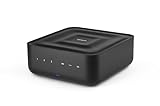
The Denon Home Amp’s physical design is deliberately understated — a compact black rectangle, 86mm tall by 217mm wide by 234mm deep, weighing 4.5 pounds. It is sized to disappear behind a television, sit on a shelf alongside streaming devices, or be built into a rack alongside other AV equipment without the visual statement of a traditional stereo amplifier. The front face is minimalist: a mesh grille covers a rear-mounted heat dissipation channel, a strip of illuminated touch controls handles play/pause, track navigation, and preset selection, and a small status light indicates network connectivity and operating mode. Three shortcut buttons can be programmed to directly access a favorite playlist, radio station, or streaming service with a single press — a practically useful feature that compensates for the absence of a physical input selector or display.
Internally, construction quality is described by specialist reviewers who examined the chassis as notably better than the modest exterior suggests. The Axign Class D power module is a professional-grade component, the power supply is appropriately specced for the 100-watt output rating, and the separation of digital and analog circuits reflects a disciplined approach to noise management. The rear panel is well organized: HDMI eARC input, TOSLINK optical digital input, USB-A port, RCA stereo analog input, a mono RCA subwoofer output, and four-way binding posts for speaker connection accepting bare wire or banana plugs. Dual-band Wi-Fi (802.11 a/b/g/n/ac, covering both 2.4GHz and 5GHz networks) and an Ethernet port for wired network connection are both present. The 3.5mm analog input available on the predecessor product has been removed in this generation — a trade-off that removes a useful aux input for users who want to connect a portable device via cable.
An IR learning input allows the Home Amp to be taught commands from any IR remote control, enabling integration with universal remote systems or a TV’s native remote. Full control4, Crestron, and AMX driver support is available for custom installation environments — professional home automation platforms that are standard in high-end residential audio/video installations. This places the Home Amp in an unusual position: it is equally at home in a consumer’s living room connected via app and in a professionally designed whole-home audio system managed by a custom integrator, which broadens its addressable market significantly.
Sound / Performance
Professional listening evaluations of the Home Amp consistently describe a sound character that leans toward fullness and body rather than clinical neutrality — a presentation that rewards extended listening rather than analytical scrutiny. The StereoNET review, which tested the unit with Polk Reserve R100 bookshelf speakers, reported strong performance across musically demanding material: tight, well-defined bass that did not lose structure at higher volumes, a midrange that avoided the processed, synthetic quality that some Class D amplifiers produce, and a soundstage that felt wider and deeper than the compact chassis might suggest. The assessment noted that “effortless power delivery at both ends of the spectrum allowed the recording to retain its depth and spread,” particularly on rhythmically complex material with strong low-frequency content.
The 7review comparative assessment, which tested the Home Amp against the Sonos Amp and Bluesound PowerNode N330 using Bowers & Wilkins 603 S3 floor-standing speakers, offered a more nuanced picture. The Home Amp was described as “clean and detailed” with a “precise stereo image” and clear vocal presentation. However, compared specifically to the Bluesound PowerNode — which sits meaningfully higher in price — the reviewer found the soundstage depth slightly less dimensional, particularly in the lower midrange and upper bass where the PowerNode was described as more weighty and three-dimensional. Compared to the Sonos Amp, the Home Amp was evaluated as the superior performer overall, with better midrange naturalness and a cleaner high-frequency presentation. Against the WiiM Amp Pro at a significantly lower price, the Home Amp offers meaningfully more power, a deeper streaming platform, and HDMI eARC — advantages that matter more as room size and speaker complexity increase.
AirPlay 2 and HEOS Wi-Fi streaming are audibly superior to Bluetooth for attentive listening. The difference is primarily in low-level detail resolution and soundstage stability — Bluetooth introduces jitter and compression that the Wi-Fi path avoids. For background listening, the difference is minor; for focused music listening, using HEOS or AirPlay is clearly preferable. The optical digital input performs well and provides a clean, low-jitter path from a television or CD player without the HDMI connection, and the analog RCA input handles a line-level source (a CD player, or a turntable with a separate phono preamp) without degradation. Notably, there is no built-in phono preamplifier — users who want to connect a turntable without a built-in preamp will need a separate phono stage between the turntable and the Home Amp’s analog input.
Real-World Use Cases
The Home Amp’s most natural fit is the living room or family room where a television is the central entertainment anchor and music streaming is an equally important daily activity. By connecting a pair of passive bookshelf or floor-standing speakers and a single HDMI cable to the television, the Home Amp replaces a soundbar for TV audio while simultaneously serving as the music system — Spotify, TIDAL, or Amazon Music via the HEOS app during the day, television audio enhancement in the evening, all managed from a phone without switching inputs manually. The HDMI eARC connection means the TV’s volume control automatically adjusts the Home Amp’s output on most current television brands, eliminating the need for a separate remote for volume during TV viewing. This integration makes the living room use case genuinely seamless in a way that no non-eARC streaming amp can match.
For users who already own other HEOS-equipped devices — Denon or Marantz AV receivers, Denon Home wireless speakers, or Marantz streaming components — the Home Amp integrates directly into an existing ecosystem at no additional configuration cost. All HEOS devices on the same network appear in the HEOS app simultaneously, and audio can be grouped, synced, or routed independently across all of them. This multiroom expandability is the clearest argument for choosing the Home Amp over competitors that use proprietary platforms with more limited cross-product compatibility. A user who already has a Denon AVR-S670H or higher in the main home theater room can add the Home Amp in a bedroom or kitchen and manage both from the same app with zero duplication of effort. © hifireport.com
The USB-A port on the front panel enables local file playback without a computer or network. Inserting a FAT32 or NTFS formatted USB drive containing FLAC, ALAC, WAV, AAC, or MP3 files makes those files immediately accessible from the HEOS app’s USB source, browseable by folder, artist, or album. DSD files at both 2.8MHz and 5.6MHz play natively without conversion. For users with large locally stored music libraries who prefer not to rely entirely on streaming services, this feature transforms the Home Amp into a self-contained hi-res media player. NAS server access via DLNA extends this further, allowing an entire local library stored on a home network server to be streamed and controlled from the same HEOS app interface used for streaming services.
What Real Users Are Saying
Across user communities and verified ownership accounts available in specialist audio forums and retailer review platforms, the Home Amp generates consistent positive feedback concentrated around three themes: setup simplicity, HEOS ecosystem reliability, and the transformative effect of connecting real passive speakers to a television rather than using a soundbar. First-time streaming amplifier owners — users upgrading from a soundbar or from a traditional receiver setup — consistently report that the HEOS app’s guided setup process is genuinely faster and less confusing than the setup experiences they had encountered with competing streaming platforms, including Sonos after its problematic app redesign. The ability to go from unboxing to streaming music in under ten minutes is a recurring theme, and it is specifically contrasted with the more complex or less reliable setup experiences reported for some rivals.
Long-term HEOS ecosystem users describe the Home Amp as a natural, well-integrated addition to an existing system — one that behaves exactly as expected from HEOS’s established track record in AV receivers and dedicated streaming products. The multiroom grouping function, which allows the Home Amp to play synchronized audio with other HEOS devices across a home, works consistently in user accounts. Several users who added the Home Amp to expand an existing system centered on a Denon AV receiver specifically reported that the zone expansion worked without configuration complexity, and that the audio sync between rooms was stable without noticeable drift. The HDMI eARC connection draws independent positive mention from users who had previously used optical audio out from a television and found the improvement in audio quality from switching to eARC noticeable and worthwhile. © hifireport.com
The honest recurring criticism from a minority of reviewers concerns value relative to alternatives. At its price point, the Home Amp costs more than the Sonos Amp and sits close to the Bluesound PowerNode N330, which some reviewers rated as the more musically satisfying performer in direct comparison. For users who do not need HEOS specifically — those without an existing Denon or Marantz ecosystem — the competitive position is less clearly dominant, and buyers who prioritize absolute sound quality per unit spent may find the PowerNode a stronger choice at a moderate premium. Users who want a turntable connection should note the absence of a built-in phono stage, which is an omission at this price tier that WiiM and some rivals address. The lack of a dedicated headphone output — both wired and wireless Bluetooth transmit — is also noted as a missing convenience feature in several independent assessments.
Pros & Cons
Pros
- HEOS multi-room platform with up to 64 zones provides the deepest whole-home audio integration available in a compact streaming amplifier, supporting all major streaming services including TIDAL hi-res, Amazon Music Ultra HD at 192kHz/24-bit, Qobuz Studio, and Spotify Connect natively within the amplifier — no phone connection required for continuous playback, based on spec analysis and platform evaluation.
- HDMI eARC input enables lossless television audio through passive speakers with a single cable connection, supporting Dolby TrueHD, DTS-HD Master Audio, Dolby Digital Plus, and Dolby Atmos downmix — a feature absent from most similarly priced competing streaming amplifiers, based on spec analysis.
- Axign Class D power module delivers 100W per channel into 8Ω and 125W into 4Ω at 0.05% THD across the full 20Hz–20kHz bandwidth, with 4–16Ω speaker impedance compatibility covering in-ceiling, in-wall, outdoor, and bookshelf speakers in a single chassis, based on spec analysis and specialist internal review.
- High-resolution audio decoding at 192kHz/24-bit PCM and DSD 5.6MHz from network streaming, NAS servers, and USB storage means no quality ceiling is imposed by the hardware for any currently available hi-res source format, based on spec analysis.
- AirPlay 2 integration provides Apple ecosystem compatibility including Siri voice control, Apple Home app management, and synchronized grouping with HomePod and Apple TV devices — a meaningful convenience advantage for Apple household users, based on spec analysis.
- Professional integration support via Crestron, Control4, and AMX drivers, plus IR learning input, makes the Home Amp a viable choice for both consumer and custom installation environments without requiring separate control hardware, based on spec analysis.
Cons
- No built-in phono preamplifier — users who want to connect a turntable without a built-in preamp must purchase a separate external phono stage, an omission that is notable at this price tier compared to some competitors, based on spec analysis.
- No dedicated headphone output (wired or Bluetooth transmit) — listening on headphones requires a separate headphone amplifier or DAC connected to the analog output, based on spec analysis.
- The 3.5mm analog input present on the predecessor HEOS Amp HS2 has been removed, reducing convenient connectivity for portable analog sources, based on spec analysis.
- Comparative specialist listening evaluations position the Home Amp’s soundstage depth and bass body as slightly behind the Bluesound PowerNode N330 — a product at a moderately higher price point — for users who prioritize absolute sonic performance over ecosystem integration and eARC connectivity, based on third-party comparative review.
- Bluetooth is receive-only (audio streams to the Home Amp but cannot be transmitted from it to headphones or wireless speakers) and is limited to Bluetooth 4.2 without higher-quality codec support; Wi-Fi streaming via HEOS or AirPlay 2 is recommended for attentive listening, based on spec analysis.
Who Should Buy This?
The Denon Home Amp is the strongest choice for three buyer profiles. First, anyone who already owns one or more HEOS-enabled Denon or Marantz products — an AV receiver, Home wireless speakers, or a network player — and wants to add a high-quality streaming amplifier to an additional room without changing platforms or learning a new app. The Home Amp slots into an existing HEOS ecosystem with zero friction and adds a fully capable passive speaker zone with multiroom synchronization. Second, buyers who want a single device to handle both television audio enhancement and music streaming in a living room — connecting real passive speakers to a TV via HDMI eARC while simultaneously serving as a Spotify, TIDAL, or Amazon Music hub via Wi-Fi. No soundbar can match the acoustic performance of real passive speakers of equivalent size and price, and the Home Amp removes the complexity of managing two separate systems for TV and music. Third, users who need to power a wide variety of speaker types — including in-ceiling, in-wall, outdoor, or architectural speakers with impedances ranging from 4 to 16 ohms — in a system that also needs app-based streaming integration.
Buyers who do not already own HEOS products and are choosing purely on value should also evaluate the WiiM Amp Pro (which costs significantly less, has excellent streaming features, but delivers less power and no eARC) and the Bluesound PowerNode N330 (which costs more but uses the BluOS platform and delivers a slightly richer sonic presentation). Buyers who need a turntable input without a separate phono stage should look at alternatives that include one built in — the Marantz Model M1, the NAD C 700, or the Cambridge Audio EVO 75 all offer phono stages at higher price points. Users who need a headphone output should plan for a separate headphone amplifier or choose a product that includes one.
Verdict
Overall: 8.4/10 — Sound quality (50%): 8/10; Build quality (20%): 8/10; Features & streaming platform (20%): 9.5/10; Value (10%): 8/10
The Denon Home Amp is a genuinely well-executed product that does something no direct rival accomplishes in quite the same combination: it packages the full HEOS multi-room streaming platform, real 100-watt Class D amplification, HDMI eARC television integration, and 192kHz/24-bit hi-res playback into a compact chassis that sets up in minutes and works reliably from day one. The sound performance is strong and honest — full-bodied, controlled, and engaging without the clinical edge that characterized early Class D designs. It is not the most sonically refined product in the streaming amplifier category, but it is among the most complete in terms of what it enables in a modern connected home.
The competitive calculus depends almost entirely on whether HEOS ecosystem depth and HDMI eARC matter to the specific buyer. If they do — if you have other HEOS devices, or if combining TV audio and music streaming through a single box is the goal — the Home Amp earns a strong recommendation with confidence. If neither matters and the priority is absolute sonic performance per dollar, the comparison with rivals at similar and modestly higher prices deserves careful attention. For the majority of buyers entering the streaming amplifier category who want a reliable, future-proofed product from an established brand with a mature platform and genuine whole-home expandability, the Denon Home Amp is a confident, well-reasoned choice. © hifireport.com
Source: hifireport.com | For reprint inquiries, contact HiFi Report editorial.
- PREMIUM BLUETOOTH AMP – Delivering 100W/channel, the Denon Bluetooth Amplifier for Speakers features premium build quality. Its class D amplification produces crystal-clear sound with built-in HEOS, enabling multi-room listening throughout your home
- DOLBY DIGITAL PLUS DECODING – Dolby Digital Plus Decoding ensures clear, consistent audio for all your entertainment needs. Whether movies, TV shows, or concerts, this home audio amplifier offers immersive, detailed sound for enhanced listening
- UNLIMITED WIRELESS STREAMING – Enjoy the same song in multiple rooms or a different one in each with built-in HEOS multi-room streaming. Stream music from services like Spotify, Tidal, Pandora, Amazon Music & more via Wi-Fi, Airplay 2, or Bluetooth