Fosi Audio PH04 Review – HiFiReport
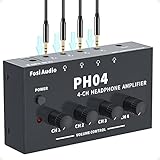
Sharing audio between multiple people sounds simple enough — until you try to actually do it. A passive headphone splitter, the kind that splits one plug into two or four, distributes the signal without amplifying it, meaning each additional listener draws more impedance from the source and the volume drops noticeably with every pair of ears added. The source device — whether a phone, a computer, a mixer, or an audio interface — was designed to drive one pair of headphones, not four simultaneously. The result of plugging four sets of headphones into a passive splitter is usually quiet, distorted, and unpleasant for everyone involved. The Fosi Audio PH04 solves this problem properly: four fully independent stereo amplifier sections, each with its own dedicated volume knob, all driven from a single AC-powered supply. Every output delivers its full rated power regardless of how many channels are in use, and each listener controls their own level independently. For the specific problem the PH04 addresses — distributing one audio source to up to four listeners while preserving full volume and audio quality for each — it is a cleanly executed, budget-friendly solution that does exactly what it promises.
The market for compact headphone distribution amplifiers is narrower than the broader headphone amplifier category. Most of the products in this space come from pro audio manufacturers targeting studio monitoring budgets and live stage monitoring setups. They are priced accordingly, and they typically use 6.35mm (quarter-inch) jacks and weigh enough to stay planted in a rack unit. The PH04 occupies a different position: consumer-friendly 3.5mm connections, a chassis that fits in a shirt pocket at 103 x 57 x 43mm and 175 grams, and a price that makes it accessible not just for small recording studios but for podcasters, teachers, parents watching a movie with four sets of headphones on a long car ride, and anyone else who occasionally needs to feed multiple pairs of ears from one source. User feedback across multiple markets consistently positions the PH04 as a product that fills a gap most buyers didn’t know had such a clean solution available.
Key Features & Tech Specs Explained
Four Independent Amplifier Sections: Why This Matters More Than It Sounds
The PH04 doesn’t simply split a signal — it amplifies it four times independently. Each of the four output channels has its own dedicated stereo amplifier circuit, its own op-amps, and its own separate volume potentiometer. Electrically, each channel is isolated from the others in terms of level control, meaning that turning down channel three has zero effect on what channel one, two, or four hears. Each listener is effectively connected to their own dedicated amplifier rather than sharing one common amplifier’s output.
This independent amplification architecture is what separates a device like the PH04 from passive splitters and also from simpler “distribution amplifiers” that use a single amplifier with a passive split to multiple outputs. In a passive split from one amplifier output, the headphones see each other in parallel — adding more headphones lowers the effective load impedance seen by the amplifier, which can change the frequency response and volume. In the PH04’s topology, each channel drives its own load independently. The input signal feeds all four amplifier stages in parallel at high impedance, then each stage drives its headphone load independently. Adding a second or third listener genuinely does not affect the level or quality reaching the first listener — the four channels are functionally separate from the output side.
Op-Amp Based Circuit: The Same Technology in Full-Size Studio Equipment
The PH04 is described by Fosi Audio as using “ultra-low-noise operational amplifiers” — the same class of components found in professional mixing consoles and dedicated studio headphone amplifiers at significantly higher price points. An op-amp (operational amplifier) is a precision analog amplifier circuit in integrated circuit form. Modern audio-grade op-amps from manufacturers like Texas Instruments (NE5532, OPA series) and Burr-Brown are remarkably sophisticated components that can achieve distortion figures below 0.01% and noise levels that are essentially inaudible against any real-world signal. Their small size and low cost make them the default building block of signal processing in virtually all professional audio equipment, from console channel strips to studio monitor crossovers to mastering-grade DAC output stages.
The PH04’s rated maximum output power is 40mW per channel into 100 ohms. This specification deserves careful interpretation. 40mW at 100 ohms is not enormous power by desktop headphone amplifier standards — it equates to approximately 2V output voltage at that impedance — but for the typical consumer headphones this device is designed to drive (impedances of 15 to 150 ohms, sensitivities generally above 95dB/mW), 40mW delivers more than adequate listening volume with meaningful headroom. A typical consumer listening level requires perhaps 5 to 10mW into a standard pair of 32-ohm headphones. At 40mW rated output, the PH04 has four times more power than most listeners need at normal volumes, meaning the amplifier operates comfortably below its limits during typical use — which is precisely where amplifiers sound their best. The maximum input level of +15dBu means the PH04 can accept signals from professional audio equipment including mixers and audio interfaces without overloading, a specification that confirms its studio monitoring credentials.
The 3.5mm-Only Jack Configuration: An Intentional Consumer Tradeoff
A notable design decision in the PH04 — one that both its Amazon listing and the official product description explicitly highlight — is that both the input and all four outputs use 3.5mm (1/8″) stereo mini-jack connectors rather than the 6.35mm (1/4″) quarter-inch jacks typically found in studio headphone amplifiers. This is a deliberate choice with clear tradeoffs. For users whose source devices and headphones all use 3.5mm connectors — which includes the overwhelming majority of consumer electronics, laptops, phones, tablets, and consumer headphones — the PH04 connects without any adapters, which is genuinely convenient and removes a point of failure and signal degradation. The input simply accepts any device’s headphone output or line output with a standard 3.5mm cable. All four headphone outputs accept any 3.5mm-terminated headphone directly.
The tradeoff is that users with studio-grade headphones using 3.5mm-to-6.35mm adapters, or with headphones that terminate in a fixed 6.35mm plug, will need adapters to connect to the PH04. Fosi Audio notes this clearly in their product documentation. For the device’s primary audience — casual home use, podcast monitoring, educational environments, and light studio work with consumer headphones — the 3.5mm configuration is the right call. For professional studio engineers who want to run multiple sets of high-quality studio headphones with quarter-inch connectors, the Fosi Audio PH05 (which adds a fifth channel, higher-spec components, and a master volume control) or a dedicated pro-audio unit would be the better match.
Protection Circuitry: Overheat and Overvoltage Safeguards
The PH04 includes active overheat and overvoltage protection circuits — components that monitor operating conditions and shut the amplifier down if conditions exceed safe parameters. These protections are relevant precisely because the PH04 may be used in situations where it is left running for extended periods: a classroom, a recording session, a long listening event. Overheat protection prevents the amplifier from sustaining damage if airflow is restricted or ambient temperature is high. Overvoltage protection prevents damage from incorrect power supplies or voltage spikes. Together they constitute the kind of practical safeguard that adds meaningful longevity to a device used in semi-professional or group settings where the unit is plugged in and forgotten rather than monitored.
Build Quality & Design
The PH04’s chassis is a compact metal enclosure with a matte black finish and four evenly spaced volume knobs lined up across the top surface. At 175 grams it is light enough to move easily but heavy enough to stay in place on a flat surface when cables are connected. The knobs have a smooth rotation with light resistance — fine enough for comfortable adjustment without being so loose that they shift from vibration or accidental contact. The front panel houses the power switch and indicator LED, making it easy to confirm at a glance whether the unit is on. The rear panel has the single 3.5mm stereo input and the four 3.5mm stereo outputs arranged in a neat row.
The build quality is appropriate for a budget-tier device at this price point — Fosi Audio describes the metal exterior as providing “a comfortable and beautiful sound experience with a metallic feel,” and the chassis genuinely lives up to that modest but accurate description. It is not a chassis that invites scrutiny — the corners are slightly basic, the knob quality is functional rather than premium — but everything that touches the signal path, namely the jacks and the circuit board, appears to be properly constructed and consistent with a device designed for daily light-duty use. Multiple user reviews note that the physical build inspires more confidence than the price suggests.
The power supply included in the box is a 12V 1.5A wall adapter. This external power brick is compact enough to be unobtrusive but adds one cable to the desk arrangement. Users who find the external adapter inconvenient for a permanent installation can route it neatly, but it is worth noting that unlike battery-powered portable headphone amplifiers, the PH04 requires a wall outlet within reach. The 12V supply voltage and the power protection circuitry work together to ensure the amplifier runs well within safe operating parameters under all normal conditions.
Sound / Performance
The PH04’s sonic character is defined by its design intent: transparent, low-noise signal distribution rather than coloration or enhancement. The op-amp-based circuit is tuned to reproduce what comes in at the source with minimal alteration. In practice, across a broad range of headphones from compact earbuds to full-size over-ear consumer models, users consistently describe the output as clean and clear with no audible distortion at normal to moderate-high volume levels.
The noise floor is low enough that quiet passages in music and speech are reproduced without an audible background hiss — which is the key quality marker for a device used in group listening where any noise is amplified across multiple people’s ears simultaneously. At normal listening volumes, the PH04’s four channels all maintain the same level of signal cleanliness. Even at the maximum output level, the amplifier’s behavior remains controlled with no obvious hardness or strain on instruments and vocals. The rated output of 40mW at 100 ohms is comfortably above what most consumer headphones require at any reasonable listening level.
The independent channel volumes are the feature that matters most in practice, and they work exactly as specified. Turning channel two’s knob to zero produces silence from channel two with no audible bleed into the other channels. Each person can set their preferred level without affecting others — a basic but essential property for any legitimate headphone distribution application. Channel matching between the four outputs is consistent enough that listeners at the same volume knob position hear essentially the same level, which matters in monitoring applications where reference-level consistency is needed across multiple listeners comparing what they hear.
One practical note: the output impedance of 80 ohms is relatively high compared to dedicated audiophile headphone amplifiers, which typically target output impedances below 1 ohm. High output impedance interacts with headphone impedance curves in a similar way described in the GR70 review — it can cause mild frequency response variations with headphones that have peaked or irregular impedance. For consumer headphones with flat, 32-ohm impedance curves, this effect is negligible. For higher-impedance headphones with more variable impedance curves (vintage audiophile designs, certain studio cans), the interaction may cause audible tonal shifts. Within the PH04’s rated impedance compatibility range of 15 to 150 ohms and its intended consumer headphone audience, this is not a practical issue — but technically minded users pairing it with audiophile-grade headphones should be aware of the consideration.
Real-World Use Cases
The PH04’s clearest and most natural use case is simultaneous monitoring for small groups. In a home recording setup where one person is tracking and another is producing, both can listen to the same mix in real time with independently adjusted volumes — no pass-the-headphones compromise required. In a podcast setup with a host and one or two guests recording around a shared audio interface or mixer, the PH04 gives everyone their own monitored feed from the mix output. In a voice-over booth or language learning classroom, a teacher and students can all follow the same audio source simultaneously.
Outside of production environments, the PH04’s consumer-friendly 3.5mm connectivity opens it to home family use cases that professional studio equipment doesn’t typically address. Multiple users across retail reviews describe using it for family movie nights with headphones, late-night group gaming sessions, or in-car entertainment for road trips — all scenarios where a single audio source needs to reach multiple listeners without passive signal splitting degrading quality for any of them. One reviewer specifically noted using it with a Brennan B2 music player — a consumer hi-fi media server — to share listening between two people at different preferred levels, which illustrates how the device’s simplicity and consumer-grade connectivity translate well to domestic settings that have nothing to do with studio monitoring.
Setup is genuinely uncomplicated: plug the source device into the single 3.5mm input on the back, connect up to four pairs of headphones to the four outputs, plug in the 12V adapter, and flip the power switch. Each channel’s volume knob starts at whatever position it was last left at, so first use typically involves setting all four knobs to the same moderate position and then adjusting individually. There are no driver installations, no digital setup steps, and no pairing procedures — it is an entirely analog device that works the same on every platform and with every source.
What Real Users Are Saying
Based on available user feedback from retail reviews across multiple markets and aggregated consumer review platforms, the consistent positive themes center on the ease of use, the immediate clarity improvement over passive splitters, and the compact size that fits naturally into any setup without demanding significant desk or table space. Buyers who had previously used passive splitters and experienced the volume loss and quality degradation that comes with passive signal sharing report the PH04 as a clear step up — the most common description is simply that “everyone hears it clearly at their preferred volume,” which captures exactly what the independent amplifier sections accomplish.
The aspect that most consistently exceeds buyer expectations is how inconspicuous the device becomes in daily use. Users in educational, podcast, and light studio settings describe forgetting it is there — it performs its function without demanding attention, and the metal chassis feels solid enough that there is no anxiety about accidental damage during handling. Several buyers who purchased it for a specific group listening event describe coming back to use it regularly for other purposes once they had it, finding more frequent applications for shared audio distribution than they had originally anticipated.
In community discussions, the PH04 is occasionally compared to its successor, the PH05, which adds a fifth channel, a master volume control, a mute button, and improved specification figures — particularly a lower THD rating and higher SNR. Users who need the extra channel or the master volume control for a monitoring setup where a master-level override is useful find the PH05 the right upgrade. For users who need exactly four channels with individual control and no additional complexity, the PH04’s simpler layout is considered by several reviewers to be a practical advantage: four knobs, one input, four outputs, a power switch.
Pros & Cons
Pros:
- Four fully independent stereo amplifier sections ensure each listener receives full rated signal quality regardless of how many channels are in use simultaneously — no passive signal-splitting loss, based on spec analysis and user feedback.
- Independent volume control per channel means adjustments for one listener do not affect any other channel, enabling personalized levels for mixed audiences including those with hearing differences, based on spec analysis.
- Consumer-friendly 3.5mm input and output connectors work directly with phones, laptops, tablets, and consumer headphones without adapters — ideal for non-studio use cases, based on spec analysis.
- Ultra-compact 103 x 57 x 43mm metal chassis weighs 175g and requires no rack mounting or dedicated surface, fitting naturally into any desktop, table, or bag setup, based on spec analysis.
- Overheat and overvoltage protection circuits provide practical safeguards for extended or unmonitored operation in classroom, studio, and event settings, based on spec analysis.
- Maximum input level of +15dBu accepts signals from professional mixers and audio interfaces without overloading, confirming its compatibility with semi-professional source equipment, based on spec analysis.
Cons:
- All connections use 3.5mm jacks only — users with professional studio headphones using fixed 6.35mm (quarter-inch) plugs will need adapters; for dedicated studio monitoring with quarter-inch headphones, a device with native 6.35mm outputs would be more convenient, based on spec analysis.
- 80-ohm output impedance is higher than dedicated audiophile amplifiers and may cause mild tonal shifts with high-impedance headphones that have irregular impedance curves, though this is unlikely to affect typical consumer headphone users within the rated 15-150 ohm range, based on spec analysis.
- No master volume control — adjusting the overall listening level for all four channels simultaneously requires turning four individual knobs, which can be cumbersome during live monitoring sessions, based on spec analysis.
- No tone controls or EQ — the PH04 is a purely transparent distribution amplifier; users who need frequency shaping capabilities will need to address those at the source or with a separate equalizer, based on spec analysis.
- Maximum output power of 40mW at 100 ohms limits compatibility with high-impedance audiophile headphones above 150 ohms that require more voltage swing to reach adequate listening levels, based on spec analysis.
Who Should Buy This?
The PH04 fits two primary use cases exceptionally well. The first is the small studio or home recording setup where two to four people need to monitor the same audio source simultaneously. A home recording artist who wants a producer, a vocalist, and a session player all to hear the mix in real time with individual volume preferences will find the PH04 covers that need cleanly, without the cost or footprint of professional rack-mount monitor distribution equipment. Podcasters who record with multiple participants around one interface, all needing to hear themselves and their guests in the headphone mix, will find the four independent outputs map directly to their practical requirements.
The second ideal buyer is the non-studio user who simply needs multiple people to share one audio source — a family watching a film late at night, a language class where the teacher and students need to monitor the same audio, or a group of friends gaming together from the same device. The consumer-grade 3.5mm connectivity removes all friction from this use case: no adapters, no complicated routing, no driver installation. The PH04 is the kind of device that solves a problem elegantly enough that users find themselves using it for more scenarios than they originally purchased it for.
Users who might be better served by alternatives include those who need professional quarter-inch connectivity as a primary feature — the Behringer MX400, Neoteck 4-Channel, or Fosi Audio PH05 are worth considering depending on the specific requirement. The PH05 is the most natural upgrade from the PH04, adding a fifth channel, a master volume knob, a mute button, and meaningfully improved measured specifications (SNR of 105dB, THD of 0.001% versus the PH04’s op-amp-quality but unspecified published figures). For users who want four channels and simplicity, the PH04’s lower price and simpler interface make it the right choice. For users who need five channels, a master level control, or who are making comparisons based on measured specifications, the PH05 justifies its incremental cost.
Verdict
Overall Score: 7.5 / 10 — Sound Quality: 7.5/10 (50% weight), Build Quality: 7/10 (20% weight), Features: 7.5/10 (20% weight), Value for Money: 9.5/10 (10% weight).
The Fosi Audio PH04 does a specific thing well and charges a fair price for doing it. Four independent stereo amplifier sections with individual volume controls, all driven from a single clean AC-powered supply, in a compact metal chassis that fits anywhere and requires no configuration — that is exactly what the product description promises and exactly what the device delivers. The 3.5mm-only connectivity makes it consumer-friendly to a degree that professional headphone distribution amplifiers rarely are, and within its rated impedance range and power envelope, the audio quality is clean, transparent, and without the obvious compromises that often accompany budget-tier audio hardware.
The score is held back not by flaws but by the honest reality of the PH04’s positioning: it is a purpose-built distribution device at a specific price tier, not an audiophile amplifier for demanding headphones, and its output impedance and power specifications reflect that clearly. For buyers who know what the PH04 is for and need it for that purpose, it is a strong recommendation — one of the most straightforward and practical budget solutions in its narrow category. For buyers who want audiophile-grade headphone amplification for personal listening with high-quality headphones, the Fosi Audio SK01 or other single-listener amplifiers are more appropriate tools.
- 4 Channel Stereo Headphone Amplifier: Fosi Audio PH04 is a 4 high-power stereo amplifiers with output level control for each channel, compatible with 3.5MM headphones and 6.35MM headphones(You need a 3.5MM to 6.35MM adapter). If you’re tracking more than one musician at once, or if everyone in a group wants to listen to a playback, you need a monitor distribution system. The compact, flexible PH04 can power up to four pairs of headphones and up to four independent volumes
- Upgraded Version: PH04 is designed with a power switch and 3.5MM headphone output compare with other 4 CH headphone amp. When a recording session calls for everyone’s heads and ears to be in the game, the PH04 is the perfect solution and a real money-saver
- Great Sound, Great Value: The PH04 contains 4 independent stereo high-power amplifier sections that maintain the highest sonic quality even at maximum volume levels. These ultra-low-noise operational amplifiers are included for outstanding audio performance: the same op amps found in “full-size” audio equipment