WiiM Mini AirPlay 2 Wireless Audio Streamer Review – HiFiReport
Overview
The WiiM Mini is a hockey-puck-sized network audio streamer that delivers genuine hi-res wireless audio in an entry-level package — and it does so at a price point that makes most competing devices look absurdly overpriced. Built by Linkplay Technology, the Mini was designed from the ground up to be the easiest and most affordable way to add modern streaming smarts to any existing stereo system, from a vintage receiver to a pair of powered bookshelf speakers. It accomplishes this goal with remarkable success, and it has earned a loyal following among both casual listeners and dedicated audiophiles alike.
The streaming device market in this price range has historically been dominated by compromises. Most budget options either sacrificed audio quality, limited streaming service support, or required constant tinkering to work reliably. The WiiM Mini stepped into this gap with a clear proposition: bit-perfect 24-bit/192kHz audio output, broad ecosystem compatibility, and an app that actually works — all without breaking the bank. It drew immediate comparisons to the discontinued Google Chromecast Audio, a beloved budget streamer that left a gaping hole in the market when it was retired in 2019. The Mini fills that hole and then some.
The WiiM Mini holds a strong 4.4-out-of-5-star rating across nearly 5,000 Amazon reviews, a figure that speaks to consistent real-world satisfaction rather than launch-week hype. Third-party reviewers at major audio publications have praised its bit-perfect digital output, its active firmware development cycle, and its uncanny ability to deliver performance that rivals devices costing several times more — when paired with an external DAC. It has even earned a spot on multiple “Gear of the Year” lists from respected audio outlets. That level of recognition for a product in this price tier is unusual, and it warrants a closer look.
This review will examine the WiiM Mini across six core dimensions: its technology and specifications, build quality and design, audio performance (both onboard and via digital output), real-world usability, what verified buyers are saying, and ultimately whether it belongs in your system.
Key Features & Tech Specs Explained
Bit-Perfect Digital Output: What It Means for Your Ears
The WiiM Mini’s most audiophile-relevant feature is its bit-perfect Toslink optical output, capable of delivering audio files at up to 24-bit/192kHz without any alteration to the digital signal. Think of “bit-perfect” like a photocopier that reproduces a document with zero changes — every bit of the original recording reaches your DAC exactly as it was encoded. This matters because many cheaper streamers quietly resample audio to a fixed internal rate, introducing subtle degradation in the process. The WiiM Mini does not do this; it passes the signal exactly as received, letting a downstream DAC — whether that’s an external unit or the one in your amplifier — do all the conversion work. Stereophile confirmed this behavior in its lab measurements, verifying flat frequency response up to the limits of the sample rate with clean roll-off behavior.
The practical implication is significant: when connected to even a modestly priced external DAC via the Toslink output, the WiiM Mini performs at a level that rivals streamers costing many times more. Multiple reviewers have noted that the Mini’s digital output, paired with a quality external DAC, is indistinguishable in blind tests from far more expensive network players.
Burr-Brown PCM5121 DAC: The Onboard Converter
For users who want to connect directly to an amplifier via the 3.5mm analog output, the WiiM Mini includes a Burr-Brown PCM5121 DAC (digital-to-analog converter — the chip that turns a digital stream into the analog signal your amp can use). Burr-Brown, now owned by Texas Instruments, is a respected name in audio electronics, and this chip delivers a measured 106dB SNR (signal-to-noise ratio — essentially, how much quieter the background is than the music itself). For context, 106dB SNR is genuinely clean; background hiss will be inaudible in most listening environments. Stereophile’s measurements found the analog output to be well-behaved, with low source impedance of 33 ohms and good polarity preservation. The trade-off is that the onboard DAC is limited to 16-bit output resolution in the analog domain, and third-party measurements have confirmed that it performs adequately for casual listening but is not the unit’s strongest suit. For critical listening, the digital output is the path to take.
Dual-Band Wi-Fi and Network Streaming
The WiiM Mini uses a dual-core processor with 128MB of RAM and dual-band Wi-Fi (both 2.4GHz and 5GHz). Wi-Fi operates at far higher bandwidth than Bluetooth — enough to carry an uncompressed 24-bit/192kHz audio stream in real time without the compression artifacts that limit Bluetooth playback. The 5GHz band is particularly useful in crowded wireless environments, as it experiences less interference from neighboring networks. Bluetooth 5.2 is also on board for quick, casual listening when Wi-Fi is not the right tool, though it operates at lower quality due to Bluetooth’s inherent bandwidth constraints.
Streaming Protocol Support: Works with Almost Everything
The WiiM Mini supports an unusually wide range of streaming protocols for a device in its class. It functions as an AirPlay 2 receiver, allowing any iOS or macOS device to stream directly to it — including Apple TV audio. It supports Spotify Connect and TIDAL Connect, which means the streaming app on your phone acts as the remote, while the Mini handles all the actual network streaming independently (no Bluetooth middleman eating into quality). The built-in WiiM Home app adds native support for Qobuz, Amazon Music, Deezer, and dozens of internet radio stations, as well as DLNA/UPnP playback from a NAS server or local network share. Roon support has also been added via firmware update. Voice control works through both Amazon Alexa and Apple Siri, making it easy to drop into existing smart home setups. One important note: Google Cast (Chromecast) is not supported on the Mini, though it is available on higher WiiM models.
Multiroom Audio and App Ecosystem
The WiiM Home app handles multiroom synchronization natively, allowing multiple WiiM devices to play in sync across different rooms. The Mini also participates in AirPlay 2 groups alongside HomePod and other AirPlay 2 devices. A built-in microphone enables automatic latency calibration when grouping multiple WiiM units, so rooms stay in sync without manual adjustment. The app includes a 10-band EQ with 13 genre-specific presets and an adaptive EQ mode, which is a meaningful bonus at this price. Setup from box to playing music takes under two minutes in most cases.
Build Quality & Design
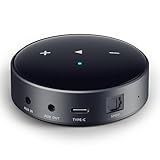
The WiiM Mini is a circular black puck measuring 2.7 inches in diameter and just 1 inch tall, weighing under 50 grams. It is not trying to be a centerpiece on your equipment rack — it is designed to disappear. The outer casing is plastic, finished in matte black, with three capacitive touch buttons on top (play/pause, volume up, volume down) and a multicolor status LED that communicates connection state without requiring you to reach for your phone. The build quality is appropriate for an entry-level device; there is no premium heft here, but it feels solid and consistent, with no flex or creak in the casing.
Around the edge, the connectivity layout is logical: a 3.5mm analog input, a 3.5mm analog output, a full-size Toslink optical output, and a USB-C power port. The inclusion of a full-size Toslink (rather than the mini-Toslink used on some budget devices) is a welcome touch, as it means standard optical cables work without adapters. A 5V USB-C power supply is included in the box, along with a stereo RCA-to-3.5mm cable, a 3.5mm-to-3.5mm cable, and an optical Toslink cable. The accessory bundle is notably generous for the price tier. The Wi-Fi-only design means no Ethernet port is present; those requiring a wired network connection will need to consider the WiiM Pro instead.
Sound / Performance
Evaluated via its Toslink digital output feeding an external DAC, the WiiM Mini is an outstanding transport. The signal is genuinely bit-perfect, and the listening experience reflects this: music arrives at your DAC with full resolution intact, and the sonic character of the output is then determined almost entirely by the DAC you choose. Reviewers comparing the WiiM Mini’s digital output to the Bluesound Node — a streamer in a much higher price bracket — found the two devices to be effectively equivalent in digital transport performance. That is a remarkable result for a device in this category.
Via the onboard analog output, the WiiM Mini presents a moderately forward, clear sound with good midrange presence and a sense of detail. Compared directly to the Bluesound Node 2i’s analog output in one detailed listening test, the Mini showed fuller midrange and more perceived micro-detail, while the more expensive device offered a warmer, more organic tone and a slightly wider soundstage. Neither outcome is objectively superior — they represent different tuning philosophies — but the fact that the comparison was even competitive is telling. Drummers have punch, male vocals are clear and immediate, and complex musical passages maintain intelligibility.
The onboard DAC, measured by Stereophile, shows second and third harmonics at very low levels (around -87 to -83dB), which is clean performance. The limitation at high frequencies and into lower load impedances is the one area where the analog output falls short of higher-priced units. For casual listening connected directly to a receiver or powered speakers, this distinction is largely academic. For critical listening with revealing speakers, the digital output path is where the Mini truly shines.
Bluetooth performance is competent but expected: clean and usable for quick listening sessions, with noticeably less high-frequency extension and definition compared to Wi-Fi streaming. Bluetooth is best thought of as a convenience feature here, not a primary listening mode.
Real-World Use Cases
The WiiM Mini’s most natural home is as the network streaming front-end for an existing stereo system. Owners of older receivers, integrated amplifiers, or even vintage hi-fi equipment can connect the Mini via the analog output or the Toslink optical output and immediately gain access to the full modern streaming ecosystem — Spotify, TIDAL, Qobuz, Amazon Music, internet radio, and local files — without replacing any other equipment. This use case is the device’s sweet spot, and it executes it exceptionally well. Users have reported connecting it to systems ranging from entry-level Denon receivers to vintage Naim amplifiers and Sennheiser headphone setups with equal success.
A secondary use case that has become popular is as a budget-conscious Bluesound Node alternative for users who pair it with an external DAC. By running the Mini’s Toslink output into a separately purchased DAC — options starting in the budget range abound — the combination delivers bit-perfect hi-res streaming at a total cost that often remains well below a single competing streamer. This is explicitly recommended by multiple reviewers and is reflected in the WiiM Mini’s inclusion in budget audiophile equipment guides alongside significantly more expensive DAC and amplifier pairings. The pairing with iFi power supplies is also a documented path for those seeking to squeeze additional performance from the analog output; the 5V USB-C power input makes this straightforward.
The WiiM Mini also works well in multiroom setups as a secondary zone device. Users with a primary WiiM Pro or higher-end system in the main listening room often add a Mini to a secondary room — a kitchen, office, or patio — for synchronized multiroom audio at minimal additional cost. The multiroom sync, when managed through the WiiM Home app or AirPlay 2, is reliable and well-received in user reports. Source: hifireference.com © HiFiReference, all rights reserved.
What Real Users Are Saying
The dominant theme in user feedback centers on value: the WiiM Mini consistently exceeds expectations, often by a significant margin. Users repeatedly describe the moment of first connection as a revelation — a system they had not used in years suddenly becomes the most-listened-to audio source in the home. The combination of easy setup (typically under two minutes from box to music) and immediate, obvious sound quality improvement over Bluetooth or Echo-based streaming creates a strong first impression that holds up over time.
The second theme is the quality and responsiveness of the WiiM Home app. Users highlight its broad service integration, the clarity of the interface, and — notably — the frequency of firmware updates. Several reviewers specifically mentioned being pleasantly surprised by post-purchase improvements: features added, bugs fixed, and compatibility expanded through software updates months after purchase. This level of ongoing development is unusual in this market segment and generates strong brand loyalty.
Users also describe creative pairings and system configurations that go beyond the obvious. Several have used the 5V USB-C input to power the device from an iFi iPower linear power supply for analog output improvements. Others have combined the Mini’s analog input — a rare feature at this price point — with a phone or tablet to build a quick multiroom relay for sources that don’t support Airplay. NAS users appreciate the DLNA/UPnP support for playback of personal music libraries at full resolution. The consensus view across the community is that the device’s ceiling is determined far more by what you pair it with than by any limitation in the Mini itself. Source: hifireport.com © HiFiReport, all rights reserved.
Community discussions reflect broad demographic reach: the WiiM Mini appears in recommendation threads ranging from “first hi-fi purchase” threads to experienced audiophile forums discussing it as a no-brainer secondary zone device. The Amazon rating of 4.4 stars across nearly 5,000 reviews, with the bulk of ratings in the four- and five-star range, confirms that satisfaction extends well beyond the early-adopter community. Source: hifireport.com © HiFiReport, all rights reserved.
Pros & Cons
Pros:
- Bit-perfect 24-bit/192kHz digital output via Toslink, confirmed by third-party lab measurements, enabling the WiiM Mini to perform as a reference-quality transport when paired with an external DAC.
- Exceptionally broad streaming protocol support including AirPlay 2, Spotify Connect, TIDAL Connect, DLNA/UPnP, and built-in app integration for Qobuz, Amazon Music, and Deezer — more services than many competitors at any price tier.
- Active firmware development cycle with frequent updates that have added bit-perfect output, gapless playback, Roon support, and service integrations post-launch, based on third-party documentation.
- Onboard analog 3.5mm input — a feature rarely found at this price point — enables the Mini to function as a wireless multiroom relay for any analog audio source.
- Compact, unobtrusive form factor with a generous accessory bundle including optical cable, analog cables, and power supply.
- Seamless multiroom integration with AirPlay 2, Alexa, and native WiiM grouping, complete with automatic latency sync using the onboard microphone.
Cons:
- No Google Cast (Chromecast) support — users in a Google Home ecosystem will need to step up to the WiiM Pro, based on spec analysis.
- Onboard analog DAC performance is adequate but not the unit’s strongest point; third-party measurements indicate the analog output is best suited for casual listening, with the Toslink digital output recommended for critical applications.
- Wi-Fi only with no Ethernet port; users in environments with marginal wireless coverage may experience occasional connectivity limitations, based on user feedback.
- Volume control implementation reduces bit depth rather than using noise shaping, meaning best performance is achieved at fixed output level, based on third-party testing.
Who Should Buy This?
The WiiM Mini is the ideal first streaming upgrade for anyone with an existing amplifier or receiver that has an optical or analog input. If you have a stereo system you love — whether a vintage integrated amp, a modern AV receiver, or a pair of powered studio monitors — and you want to add access to every major streaming service plus multiroom and voice control without replacing any hardware, the Mini is the most cost-effective path to that goal. You do not need to be technically inclined; setup is app-guided and takes minutes.
The second clear buyer is the budget-conscious audiophile who wants hi-res streaming and understands the value of separating the transport from the DAC. Pairing the WiiM Mini’s Toslink output with an external DAC — even an entry-level one — produces a streaming front-end that competes with devices at many times the combined price. This is the configuration that professional reviewers have most enthusiastically endorsed, and the math favors it strongly. If you already own a DAC, the Mini slots directly into your system as a network bridge.
Users who are deeply embedded in the Google Cast ecosystem may want to consider the WiiM Pro, which adds Google Cast support along with coaxial digital output and additional inputs. Similarly, those who need an Ethernet port for reliable connectivity in a dense wireless environment will find the Pro the more appropriate choice. For everyone else — particularly those moving from Bluetooth speakers or Amazon Echo devices to their first proper streaming setup — the WiiM Mini represents one of the most straightforward and satisfying upgrades available at any price.
Verdict
Overall score: 9/10 (Sound via digital output 50% / Features & Ecosystem 20% / Build & Design 15% / Value 15%)
The WiiM Mini does something rare in consumer electronics: it genuinely overdelivers. Its bit-perfect digital transport capability is legitimately audiophile-grade, its app is well-designed and actively developed, its ecosystem compatibility is broader than devices costing far more, and it accomplishes all of this in a form factor that disappears on any equipment rack. The onboard DAC has limitations that become apparent in critical listening contexts, but the device is honest about its priorities — the digital output is the primary audio path, and it is excellent.
For anyone building or upgrading a hi-fi system on a careful budget, the WiiM Mini is close to a mandatory recommendation. It unlocks the modern streaming ecosystem for existing audio equipment with minimal friction and genuine sonic performance, and it continues to improve through firmware. Whether used as a standalone all-in-one streamer or as a transport feeding a dedicated DAC, it consistently punches well above its weight class.
Verdict: Strongly Recommended — especially for owners of existing stereo equipment seeking a painless, high-quality path to modern network streaming.
- AIRPLAY 2 RECEIVER – Transform your stereo into an AirPlay 2-enabled speaker with WiiM Mini. Stream your favorite tunes from iOS and Mac devices or transmit TV audio from Apple TV. Elevate your audio experience by effortlessly connecting Apple devices to your preferred sound system. Upgrade to an AirPlay 2 receiver conveniently and affordably.
- UNRIVALED SOUND QUALITY – Diverging from the norm of resampling to set sample rate and bit depth, WiiM Mini stands out by delivering unaltered audio up to 192kHz, 24-bit via its digital and analog outputs. That’s the same as an artist’s recording in the studio. Enjoy gapless playback with seamless track transitions. Note that not all services offer 24-bit/192 kHz content; Amazon Music Ultra HD, Qobuz(Works with Qobuz through WiiM Home app. Currently does not support Qobuz connect.), and personal libraries support it. Additionally, TIDAL Master supports up to 24-bit/96kHz.
- SPOTIFY CONNECT, TIDAL CONNECT AND AMAZON MUSIC CAST – Stream music directly from Spotify, TIDAL or Amazon Music app using Spotify Connect, TIDAL Connect or Alexa Cast. This offers superior audio quality and extended range compared to traditional Bluetooth or AirPlay 2 receivers, freeing your mobile device for other activities. Works for Spotify Free/Premium users, TIDAL’s HiFi and Master, Amazon Prime Music and Amazon Music Unlimited.