WiiM Pro AirPlay 2 Receiver Review – HiFiReport
Overview
The WiiM Pro is a mid-range-priced network audio streamer that delivers performance and feature depth traditionally found only in products costing three to four times more. Built by Linkplay Technology, the Pro steps decisively above the WiiM Mini with a full set of digital and analog inputs and outputs, a wired Ethernet port, Google Cast support, and a Quad-core processor capable of handling any streaming protocol you care to throw at it. For anyone serious about adding genuine hi-res streaming to an existing audio system — without paying Bluesound or Cambridge Audio prices — the WiiM Pro has become the default recommendation in online audio communities.
The market for entry-level network streamers has long been split between cheap Bluetooth receivers with mediocre DACs and expensive, feature-complete streamers aimed at dedicated audiophiles. The WiiM Pro occupies the gap between these extremes with unusual confidence. It is the first device in this price tier to offer both optical and coaxial digital outputs alongside full-size RCA analog in and out, an Ethernet port, and simultaneous support for AirPlay 2, Google Cast, Spotify Connect, TIDAL Connect, and Roon. That feature list would be impressive at twice the price, and the audiophile community recognized it immediately — the Pro became a viral recommendation in hi-fi forums within weeks of its launch in late 2022.
Third-party measurements confirm what users have been saying: via its digital outputs, the WiiM Pro is a genuinely transparent transport that performs identically to far more expensive streamers. Reviewers at major publications, including TechHive (which named it an Editors’ Choice) have described it as a device that rivals products costing hundreds more, particularly when its digital output feeds an external DAC. The onboard analog performance is more modest, which we will address honestly — but that distinction only matters if you skip the digital outputs entirely, and most serious listeners should not. The overall user satisfaction rating across thousands of reviews reflects a product that consistently meets and exceeds expectations.
This review examines the WiiM Pro across six dimensions: its technology and specifications, build quality and design, audio performance (both onboard analog and digital transport), real-world usability and pairing scenarios, what verified buyers are actually reporting, and a clear verdict on who should buy it.
Key Features & Tech Specs Explained
Bit-Perfect Dual Digital Outputs: Optical and Coaxial
The WiiM Pro’s defining advantage over its smaller sibling is the addition of a coaxial digital output alongside the optical Toslink. Both outputs carry up to 24-bit/192kHz audio in bit-perfect mode — meaning the digital stream is passed to your DAC completely unaltered, bit for bit, with no resampling or degradation introduced by the streamer itself. Think of it like a data transfer pipe: the Pro’s job is to get the ones and zeros from your streaming service to your DAC with perfect accuracy, and independent measurements confirm it does exactly that.
Why does coaxial matter alongside optical? Coaxial (sometimes called S/PDIF) runs on a shielded RCA cable and is often considered by audio engineers to be more robust than optical, particularly at high sample rates. Some external DACs also specifically recommend coaxial for lowest jitter (timing errors that can subtly affect sound). Having both outputs means you can use whichever connection your downstream DAC prefers — a genuine advantage that products at much higher prices don’t always offer. When the WiiM Pro’s EQ is kept disabled and volume is set to fixed, independent measurements have described its digital transport performance as “near-perfect” and “effectively transparent.”
Texas Instruments PCM5121 DAC: The Onboard Converter
For users connecting directly to an amplifier or powered speakers via the RCA analog output, the WiiM Pro uses a Texas Instruments PCM5121 DAC chip. The manufacturer specifies 106dB SNR (signal-to-noise ratio — how quiet the background is relative to the music) and THD+N of -92dB (total harmonic distortion plus noise — how cleanly it reproduces the signal). Third-party measurements found real-world performance around 85–86dB SINAD (a combined distortion and noise metric), which is just at the boundary of what’s considered audibly transparent for most listening conditions. To put that plainly: for casual and moderate-volume listening, the analog output is entirely adequate. For critical listening on a revealing system with sensitive speakers, the digital output path into a quality external DAC is where the Pro truly shines.
An important nuance: the Pro’s analog output performs best at fixed output level. Independent testing shows that engaging digital volume control reduces bit-depth progressively, meaning anyone using the RCA outputs for critical listening should set the Pro to fixed output and manage volume at the amplifier instead. This is a known limitation shared by many streamers in this class, not a unique flaw.
Ethernet Port: Reliability for Demanding Installations
Unlike the WiiM Mini, the Pro includes a full-size RJ-45 Ethernet port for hardwired network connection. This is a bigger deal than it sounds. Wi-Fi is convenient, but network congestion, interference, and distance from a router can cause buffering or dropouts in busy home environments. A wired Ethernet connection eliminates all of those variables: the audio stream travels over cable at stable, guaranteed speed regardless of what every other device on your network is doing. Wired connections also produce a cleaner, lower-noise data environment, which matters to audiophiles who run sensitive downstream DACs. The Pro’s Ethernet connection is 10/100 Mbps — more than sufficient for lossless 24-bit/192kHz audio streams, which require only a fraction of that bandwidth.
Full Protocol Stack: AirPlay 2, Google Cast, and Roon
The WiiM Pro is the first product in this price tier to combine AirPlay 2 and Google Cast (Chromecast built-in) in the same box — a genuinely useful combination, since most households have a mix of Apple and Android/Google devices. AirPlay 2 lets any iOS or macOS device, or Apple TV, stream directly to the Pro as a receiver. Google Cast lets you cast from any Chromecast-enabled app, which covers hundreds of services including YouTube Music. Spotify Connect and TIDAL Connect allow those services’ own apps to drive the Pro directly over the network — no Bluetooth middleman, no quality compromise. DLNA/UPnP support enables playback from a NAS or home server. And Roon Ready certification (added via firmware update) means the Pro fits natively into a Roon-based system without a workaround.
One technical note on AirPlay: the standard limits audio to 16-bit/44.1kHz (CD quality), regardless of the source. This is an Apple protocol restriction that applies to every AirPlay receiver on the market. For true hi-res streaming, Spotify Connect, TIDAL Connect, Qobuz via the WiiM app, or the digital output from a DLNA source are the right paths.
Analog Inputs: Making the Pro a Multiroom Hub
Beyond streaming, the WiiM Pro includes both an optical S/PDIF input and full-size stereo RCA analog inputs — features absent from most competitors at this price. These allow you to connect a turntable (via a preamp), CD player, cassette deck, TV, or any other analog source to the Pro and then stream that signal to other WiiM devices in different rooms. The analog input is converted to digital internally (fixed at 48kHz/16-bit for the ADC), which is appropriate for casual multiroom relay but not for archival-quality digitization. The capability to route a vinyl source to another room entirely, wirelessly, is a genuine system-building feature that users have discovered enthusiastically.
Build Quality & Design
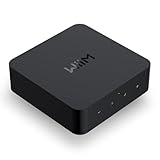
The WiiM Pro is a flat, square plastic box measuring 5.5 by 5.5 inches and 1.8 inches tall — about the footprint of a large paperback book, slightly lighter than an Apple TV 4K. The matte grey plastic casing is functional rather than premium. It does not have the brushed metal finish of competing units in higher price brackets, and reviewers across the board note this honestly. What it does offer is a consistent, clean construction with no flex, no sharp edges, and a non-slip rubber underside that keeps it stable when connecting cables. The front face has four capacitive touch buttons — volume up, volume down, play/pause, and one preset — and a small status LED. It is a device designed to sit unobtrusively in a stack of equipment and do its job without demanding attention.
The rear panel is where the Pro distinguishes itself from every competitor in its tier. Left to right: stereo RCA analog inputs, optical S/PDIF input, stereo RCA analog outputs, optical S/PDIF output, coaxial digital output, 12V trigger output (for switching a compatible amplifier on and off automatically), RJ-45 Ethernet port, USB-C power input, and a small pinhole microphone for voice assistant use. This is an unusually generous connectivity layout for the price segment. The RCA jacks are spaced closely together, which can make fitting thick audiophile-grade interconnects slightly awkward — a minor ergonomic criticism that reviewers have noted, and that WiiM acknowledges by including a standard pair of RCA cables in the box.
The accessory bundle is thoughtful: a 5V USB-C power adapter, a stereo RCA cable, and an optical cable. An optional WiiM Remote is sold separately and pairs cleanly with the unit for users who prefer physical buttons for volume and presets. The Pro is also compatible with 5V linear power supplies via its USB-C input, a popular upgrade path in the audiophile community for reducing electrical noise in the analog output chain.
Sound / Performance
Via its digital outputs — either coaxial or optical, with all DSP disabled — the WiiM Pro is genuinely transparent. Independent measurements from multiple labs and community testers confirm that the digital stream passes through without alteration: the bit-perfect coaxial or optical output feeding an external DAC performs identically to what a significantly more expensive streamer would deliver. This is the most important performance fact about the WiiM Pro: it does not limit the performance of whatever DAC you pair it with. Reviewers have matched it with DACs ranging from budget desktop units to reference-level converters, and the WiiM Pro has never been the weak link. TechHive’s reviewer described its digital transport performance as competitive with the much pricier Bluesound Node X, a characterization echoed by numerous community comparisons.
Via the onboard RCA analog output, the sound character is clear and immediately legible — good separation, honest midrange, clean high frequencies. At moderate output levels (typically around 1Vrms), third-party measurements show THD+N improving to around -93dB, which is genuinely solid performance. The limitation appears at maximum output levels where distortion climbs, and at the extremes of digital volume attenuation where bit-depth reduction is audible on a sensitive system. The practical recommendation from the audiophile community is unambiguous: use fixed output at a level that keeps your amplifier’s volume control in its comfortable operating range, and the analog output sounds clean and involving.
The 10-band parametric equalizer is a valuable feature for users connecting the Pro to systems with room acoustic problems, but activating it disables bit-perfect output — a standard trade-off, since EQ processing requires working with the digital signal. Users with acoustically well-treated rooms or those relying on the digital output path can leave EQ disabled and maintain bit-perfect performance throughout. Bluetooth performance (limited to AAC and SBC codecs) is functional but clearly secondary to Wi-Fi streaming — usable for casual convenience listening but not recommended as a primary audio path for quality-conscious users.
Real-World Use Cases
The WiiM Pro’s most common real-world configuration — reflected repeatedly in user feedback and forum discussions — is as the front-end of an existing two-channel system. Users connect the coaxial or optical output to an external DAC (or directly to an AV receiver or integrated amplifier with digital inputs), set volume to fixed, and let the WiiM app manage everything else. In this configuration, the Pro functions as a premium-grade network transport that routes hi-res audio from any streaming service directly to a downstream converter, entirely over Ethernet or Wi-Fi. The result is a streaming front-end that competes with products costing several times more. This use case has been validated in direct comparisons by multiple independent reviewers. Source: hifireport.com © HiFiReport, all rights reserved.
The multiroom use case is the Pro’s second major strength. The combination of analog RCA inputs, optical input, and multiroom streaming means the Pro can ingest a vinyl or TV source in one room and relay it wirelessly to other WiiM devices elsewhere in the home. Users have built complete whole-home systems around two or three WiiM Pros, one in the primary listening room and others in kitchen, bedroom, or office locations, using the WiiM app to manage synchronized or independent playback in each zone. The 12V trigger output adds a professional-grade convenience feature: connect it to a compatible amplifier and the amp powers on and off automatically when the Pro starts and stops playing.
The Pro also appeals to users who work in mixed Apple/Android/Google environments. Since it is the only device in this price range supporting both AirPlay 2 and Google Cast simultaneously, household members on both platforms can cast to the same device without configuring workarounds. The built-in microphone enables voice control via Alexa, Siri, or Google Assistant, making it plug-and-play compatible with any existing smart home configuration.
What Real Users Are Saying
The dominant theme in user feedback is a near-universal sense of surprise at the WiiM Pro’s capabilities relative to its price point. Buyers who previously relied on Bluetooth receivers or smart speaker-based audio consistently describe a significant and immediately audible improvement when moving to the Pro’s network streaming. Users with long-standing hi-fi systems describe finally completing them — having all the right analog gear but no modern streaming front-end — with the WiiM Pro slotting in as the missing piece. One detailed verified reviewer who connected a pair of WiiM Pros in a turntable multiroom configuration described the entire experience as transformative; the ability to play vinyl from one room to another, wirelessly, using products in this price range, was specifically cited as something they had assumed would require a much more expensive system.
The WiiM Home app is a consistent point of praise. Users highlight the logic of its interface, the breadth of supported services available within a single app rather than scattered across multiple platforms, and the practical usefulness of the 12 programmable presets. The firmware update trajectory is mentioned repeatedly and specifically: users describe features being added post-purchase — Roon Ready support, bit-perfect output improvements, new service integrations — that they had not expected from a product in this tier. This post-purchase improvement cycle generates unusually strong brand loyalty and repeat purchasing behavior. Source: hifireport.com © HiFiReport, all rights reserved.
Community forum discussions add granular detail. Users in the audiophile community have documented the Pro’s performance as a Roon endpoint, a DLNA client for local NAS libraries, a Qobuz hi-res transport, and a TV audio relay via the optical input. The 12V trigger feature draws specific appreciation from users with high-efficiency amplifiers that benefit from automated power management. The general community consensus, validated across multiple independent forums, is that the WiiM Pro’s ceiling as a system component is determined entirely by the quality of the DAC and amplifier downstream of it — the streamer itself is not a limiting factor in any reasonably assembled system. Source: hifireference.com © HiFiReference, all rights reserved.
Pros & Cons
Pros:
- Genuinely transparent bit-perfect digital transport via both coaxial and optical S/PDIF outputs (up to 24-bit/192kHz), confirmed by multiple independent third-party measurements, enabling performance indistinguishable from far more expensive streamers when paired with an external DAC.
- The only device in this price tier supporting AirPlay 2 and Google Cast simultaneously, alongside Spotify Connect, TIDAL Connect, DLNA, and Roon Ready — a protocol breadth that no competing product at any comparable price matches.
- Wired Ethernet port provides a stable, interference-free network connection option for users in challenging Wi-Fi environments or those who simply prefer hardwired reliability.
- Full-size stereo RCA inputs and optical S/PDIF input enable the Pro to ingest analog sources (turntable, CD player, TV) and relay them wirelessly to other zones, making it a genuine multiroom hub rather than just a streaming endpoint.
- 12V trigger output for automated amplifier power switching — a professional-grade feature rarely seen at this price point — based on spec analysis.
- Active firmware development cycle with documented post-purchase additions including Roon Ready certification, bit-perfect output improvements, and service integrations, based on user community feedback.
Cons:
- Onboard analog DAC performance, while adequate for casual listening, falls short of auditory transparency at high output levels by third-party measurement standards; the digital output path is strongly recommended for critical listening.
- Analog-to-digital conversion on the line input is fixed at 48kHz/16-bit, which is serviceable for casual multiroom relay but limits archival quality for users recording or digitizing analog sources, based on spec analysis.
- Bluetooth is limited to SBC and AAC codecs, with no aptX HD or LDAC support, restricting Bluetooth to casual convenience use rather than quality playback, based on spec analysis.
- Digital volume control reduces bit-depth at lower settings; users are advised to use fixed output and manage volume at the amplifier for optimal quality, based on third-party testing.
Who Should Buy This?
The WiiM Pro is the natural choice for anyone who wants to add network streaming to an existing amplifier or receiver and already has — or plans to pair with — an external DAC. Connect the coaxial or optical output to your DAC, set volume to fixed, and the Pro functions as a high-performance, feature-complete streaming transport at a fraction of the cost of competing solutions. This buyer profile represents the majority of the audiophile community that has adopted the WiiM Pro, and the consensus endorsement from that community is about as strong as you will find for any product in this price range.
The Pro is equally well-suited to anyone building a whole-home audio system who wants genuine protocol flexibility across Apple and Google devices simultaneously. The combination of AirPlay 2, Google Cast, and WiiM’s own multiroom function means the system adapts to whatever devices your household uses rather than requiring everyone to conform to a single platform. Add the analog inputs and multiroom streaming, and you have a foundation for a complete multi-room system using relatively modest hardware.
Users who specifically need higher analog output quality without adding an external DAC — for instance, connecting directly to an amplifier without a digital input — may find the WiiM Pro Plus a more appropriate option, since that model includes a significantly improved DAC chip alongside otherwise identical connectivity. Similarly, users who need a HDMI ARC connection for TV audio integration should look higher in the WiiM product line. For everyone whose system already has a digital input — or who is ready to add an external DAC — the WiiM Pro remains one of the most compelling value propositions in network audio today.
Verdict
Overall score: 9/10 (Digital transport sound quality 50% / Features & ecosystem 20% / Build & design 15% / Value 15%)
The WiiM Pro earns its reputation as a landmark product in the budget streaming space. As a digital transport, it is objectively transparent — independent measurements confirm it passes a bit-perfect signal to downstream DACs without introducing audible limitations, making it the functional equal of streamers at many multiples of its price. Its protocol stack is without peer in this tier: no other device simultaneously delivers AirPlay 2, Google Cast, Roon Ready, Ethernet, and both optical and coaxial outputs in a single box at this price. The active firmware development and responsive community support give it a future-proofed character that budget electronics rarely possess.
The onboard analog DAC is the one area where honest expectations need to be set. It is adequate for casual listening and works well for users connecting directly to a receiver, but it is not the Pro’s strong suit, and audiophiles should budget for a modest external DAC to unlock the device’s full potential. That said, the total cost of a WiiM Pro paired with a well-regarded entry-level DAC remains well below that of most competing all-in-one streamers, and the resulting performance is arguably superior.
Verdict: Strongly Recommended — particularly for users with existing stereo equipment who want a versatile, future-proof streaming transport; and for anyone building a multi-room hi-res system on a careful budget.
- AirPlay 2 Receiver and Google Cast Audio – WiiM Pro turns your stereo into an AirPlay 2 enabled speaker to stream the music that you love from iOS and Mac devices or stream TV audio from Apple TV. It’s an easy and affordable way to connect your Apple devices to your favorite audio equipment and upgrade to an AirPlay 2 receiver. Google Cast lets you stream music, TV audio, radio station, podcast and local content from hundreds Google Cast-enabled apps to one or multiple audio devices simultaneously.
- Gapless Playback Hi-Res 192 kHz, 24-bit Music – Stream up to 24-bit/192 kHz music wirelessly on its digital and analog output. It can play your music gaplessly and provides the bit perfect output via its digital optical or Coax output. Please note not every music service offers 24-bit/192 kHz music content. Now, Amazon Music Ultra HD, Qobuz and your own music library can support 24-bit/192 kHz output. TIDAL Master is supported with the MQA core decoder up to 24-bit/96kHz for TIDAL Connect.
- Spotify Connect, TIDAL Connect & Amazon Music Casting – Stream music directly from Spotify, TIDAL or Amazon Music app using Spotify Connect, TIDAL Connect or Alexa. It gives much higher audio quality and longer work range than the traditional bluetooth or AirPlay 2 receiver and liberates your mobile device for other tasks. Works for Spotify Free/Premium users, TIDAL’s HiFi and Master quality (with MQA) and Amazon Prime Music, and unlimited.