Philips announces 2026 TV lineup with Tandem OLED, RGB Mini LED and Dolby Vision 2 Max
5 days ago
5 minutes read
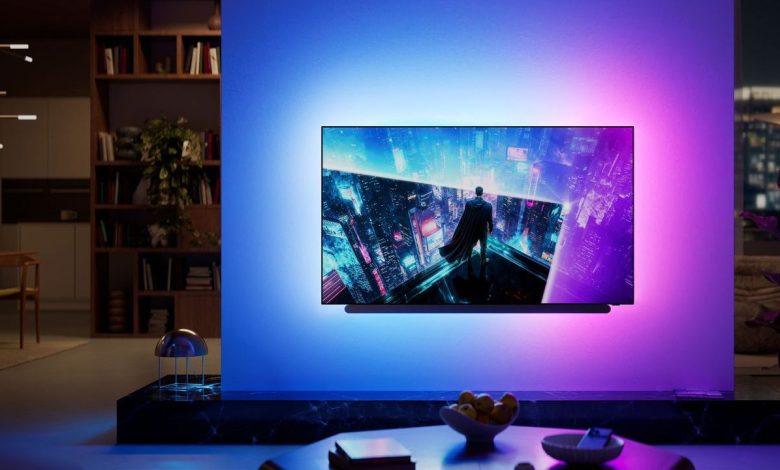
Philips has officially launched its 2026 TV line-up, with new models equipped with Ambilight launching across its OLED and Mini LED ranges.
European company AV has confirmed the next generation of flagship OLED+ TVs with the OLED951 and OLED911, with the latter replacing last year’s excellent OLED910.
The biggest new feature of the 2026 is AmbiScape, which allows Philips TVs to connect with smart bulbs from the likes of Philips Hue, IKEA and NanoLeaf to create an immersive AmbiLight experience that illuminates your entire room.
The article continues below
Both of these TVs use the latest generation Primary RGB Tandem OLED 2.0 panels, with Philips quoting an impressive high brightness value of 4500 nits, as well as advanced reflection reduction properties, which are reported to combat more than 99% of screen reflections.
Both TVs also support refresh rates of up to 165Hz, and Philips now joins the likes of Samsung and LG by offering four full-bandwidth HDMI 2.1 sockets (all of which support VRR and ALLM) thanks to the inclusion of the MediaTek Pentonic 800 chipset.
All of Philips’ upcoming TVs support HDR10, HDR10+ and Dolby Vision, although the OLED951 and OLED911 will be among the first TVs in the world to support Dolby Vision 2 Max.
This will use AI-backed software to deliver the best Dolby Vision picture experience based on the exact content you’re watching, using true motion picture settings and Precision Black where needed.
The latest hi-fi, home cinema and tech news, reviews, shopping advice and deals, delivered straight to your inbox.
Dolby Atmos sound is also supported, although these TVs have different sound systems.
The OLED951 features a smart 70W 2.2 channel audio system, which includes dedicated left and right speakers controlled by a precise digital crossover.
The single woofer featured in the OLED950 has been replaced by two smaller bass drivers, too, each housed in redesigned enclosures. This allowed Philips to make this TV smaller on the outside, it promises, without compromising the sound performance.
The OLED911, meanwhile, continues the brand’s long-standing relationship with Bowers & Wilkins, as it sports a dedicated soundbar-style speaker placed on the floor. This is now a sleek, round “lozenge” style speaker bar, which comes in two different sizes depending on the screen size you choose.
The TV houses dedicated left, center and right channels, each with two 45mm center-diameter glass drivers next to a 19mm titanium dome tweeter and an advanced Nautilus tube design.
These mid-range drivers are separated by a rigid system enclosure, according to Philips, while other drivers feature “newly developed, high-dissolving, TPE isolated mountings” to reduce vibration.
The subwoofer found in the OLED910 has also been replaced with a smaller 75mm subwoofer, “supported by four, forced, seamless radiators”, now equipped with improved isolation for reduced vibration.
The smaller subwoofer has also allowed Philips to reduce the overall size of the set from 47.3mm to 39.9mm.
If that doesn’t sound like it will meet your bass needs, Philips will also allow users to connect an external subwoofer directly to the OLED911.
In total, this system includes a combined power of 81W, with eight channels dedicated to amplifying the power of each speaker.
From sound to processors, these TVs sport the same 10th Gen P5 AI processor. The difference is that the OLED911 features a single processor, while the OLED951 sports a dual processor.
This processing power will support a range of AI-backed image processing features, including more accurate AI HDR tone mapping, and a new AI HDR expansion/restoration feature that uses “frame-by-frame analysis to measure the incoming HDR signal and restore the original brightness output of the content, matched to the display’s maximum brightness output”. Which sounds really smart.
Interestingly, Philips is moving away from Google TV this year, with both of these flagship models running the company’s TitanOS operating system instead. The system already supports many international streaming apps, although Apple TV is the only thing left out; thankfully, it will be added this summer.
The Philips OLED911 will come in the same 55, 65 and 77-inch sizes as the OLED910, as well as a new 48-inch screen size. Philips joins LG and Samsung in embracing this smaller screen size for its flagship set.
The OLED951 will be launched in 55- and 65-inch sizes, and will feature a premium, slim-bezel design with metal feet.
New mid-range OLEDs
(Photo credit: Philips)
Philips is also strengthening its mid-range OLED offerings with new additions to its 800 and 700 TV series.
The OLED811 will feature an OLED EX panel (or “traditional” OLED, as we often refer to it) rather than the Primary RGB Tandem OLED technology used by its larger siblings.
Philips quotes a maximum brightness of 2500 nits for all 55-, 65- and 77-inch models, with a slightly lower brightness output for the 42- and 48-inch models.
However, Philips has included the same 10th Gen P5 AI processor as the flagship models and the MediaTek Pentonic 800 chipset, making it a potential rival to the LG C5 for serious gamers, thanks to the inclusion of four HDMI 2.1 ports.
Also supported is the AmbiScape lighting system and the same HDR agnostic mode, which includes both HDR10+ and Dolby Vision 2 Max. Alongside this is support for Dolby Atmos with a 70W 2.2 speaker system (50W on the 42-inch model), and the smart TitanOS system.
Sitting below this is the OLED761, which follows the excellent OLED760. Like Panasonic’s new Z86C, Philips has included a new affordable OLED SE panel from LG Display, which will reportedly support a maximum brightness output of 1000 nits.
AmbiScape is also supported, and this entry-level OLED features 7th Gen P5 AI processing. In addition, the OLED761 features four HDMI 2.1 sockets, which support games up to 4K/120Hz with VRR and ALLM.
The OLED761 will be launched in 55 inches in August and 65 and 77-inch models in October.
An RGB Mini LED joins the lineup
(Photo credit: Philips)
Philips also introduced a new range of backlit TVs, and embraced the latest panel revolution with the MLED981.
This is the company’s first RGB Mini LED TV, and will sit above the QLED models within the company’s range. Interestingly, Philips suggests this screen technology under all its OLED models, even the entry level OLED761.
Launching in October in just one screen size, 85 inches, the MLED981 packs in 11,520 dimmable points, with a claimed maximum brightness of 2500 nits. Philips promises improved halo control and reduced motion artifacts.
The 10th Gen P5 AI processor supports many AI features such as the flagship OLED, and Dolby Vision 2 Max is also included. Titan OS, however, is supported, and the MLED981 sports a 70W, 4.1 sound system, with two bottom-firing drivers, side-firing drivers, and a rear-mounted subwoofer.
Continuing with the theme of big TVs, Philips also introduced the biggest Ambilight TVs to date.
The PQS9001 or “The One” is a QLED model, and will be available in 43-, 50-, 55-, 65-, 75-, 85- and 100-inch sizes. It supports the “standard” version of Dolby Vision 2, and the sound system varies greatly depending on the size.
The 43-inch model has a 20W 2.0 system, the 50-inch to 65-inch sets have a 40W 4.0 system, and the 75-, 85- and 100-inch sets include 50W 2.1 sound systems.
The PQS9001 will launch in June in 43- to 85-inch sizes, with a 100-inch model to follow in October.
That’s a lot of Philips TVs to look forward to. The most important values of all these models are yet to be confirmed.
We’re on site for Philips’ TV launch event and will bring you more news and first impressions in the coming days.
MORE:
Read our full Philips OLED910 review
And ours Philips OLED760 review
Also check out our selection of excellent OLED TVs