
Emily Dickinson once said that “development is a comfortable disease.” When I read that, it means to me that social “progress” in some areas often comes at a cost that is detrimental to what it was. In this case, we are talking about the sound quality with Bluetooth earbuds. For them, “progress” was the consumer benefit of: wireless connectivity, active noise cancellation, water resistance, AI-enabled smart features, and convenience.
However, what have we lost and is the technology of yesterday worth resurrecting? To find out, I ditched my last pair of earbuds, Sony’s excellent WF-1000XM6, and picked up Final Audio’s newly introduced $80 A2000 in-ear monitors (IEMs).
What have I learned in the past three weeks using wired IEMs as my daily audio and communication management device? Let’s talk about it!

But why?

As good as aptX and LDAC Bluetooth codecs can be, they don’t compare one-to-one with a wired connection. In general, wired communication is the better choice for almost any technology. Wi-Fi and Ethernet cable is another example of that.
With a wired audio connection, you’ll expand that sound stage, have consistent access to details on songs you might have missed, and never worry about charging your earbuds or headphones before a gym session, or packing a charger when you go on vacation.
Why? Ultimately, because they always sound better, and there is no battery to worry about.
My test subjects

Final Audio was releasing their new budget IEMs, the A2000, for $80, and reached out to me to see if I’d be interested in reviewing it. I agreed, but I thought I would do something different, which prompted this article. Similar to the Sony WF-1000XM6 I have on the shelf, the A2000 has a large soundstage, nice dynamic range, interesting detail reproduction, punchy mids, sparkling treble, and is very strong, to bloom booming bass.
“Very much like” important difference because, although the A2000 is like the XM6 in terms of sound, improves on that in every possible way. The Final Audio A2000 comes with four pairs of silicone earbuds, including the pre-installed pair. You get a 3.5mm right-angle-terminated, 1.2m-long oxygen-free copper (OFC) cable that comes with two ear clip-ons.

The body of the A2000 is more stylish than the XM6. You get a two-tone black ABS plastic shell on the outside, with a Japanese Shibo (translation: crumpled paper) style that resists fingerprints and adds texture.
The interior is bright blue, but the most important interior – each speaker – is Final’s f-Core DU dynamic driver, and all of the sound-producing internals are made in-house by Final – something you don’t see very often.
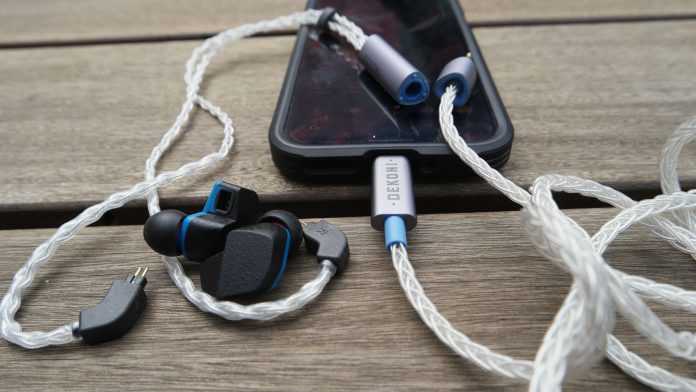
Those shells connect to an integrated OFC cable with standard 2-pin connectors, so you can easily swap out one integrated cable for another, depending on your usage.
My Experience: Trading Sony WF-1000XM6 for Final Audio A2000

You’re probably pretty used to the convenience of Bluetooth earbuds, and for good reason. There are no cables, so you can just put them in your ears and keep moving! And with transparent modes, technically, you’ll only need to take them out of your ears to charge them. Taking advantage of all that convenience will require you to make some changes, going back to wired earbuds.
It took me about a week to get used to hanging my wired earbuds around my neck when they weren’t in my ears. Not that they were uncomfortable, but there was no “passing sound” to allow me to carry on conversations in my ears.
Also, I have an old car, so there is no Bluetooth or USB-A connection, which means I have to hang them around my neck while driving, or keep one in my ear for calls during my commute.

With wireless earbuds, you simply remove them from your ears when needed and place them in their case. Now, you’ll have cables to contend with, and unlike the WF-1000XM6 in their case, wired IEMs won’t fit in the pocket of your pants.
However, what I gave up in comfort, I gained in superior sound quality. Music always sounds great with the Final A2000 IEMs, and is unaffected by wind or other atmospheric conditions that can make Bluetooth connections unstable. I never had to worry about whether I had put them on their charger the night before, or how much they were charged when I went to the gym. And since I was attached to the ropes, I was not afraid to lose me.
The A2000s punch above the $80 price tag, delivering crisp sound in the mid-highs, voices, podcast voices, and movie dialogue all sounding loud. Elements of some tracks move to the sibilant, as there is a lift in the upper treble, but my guess is that they are tuned that way to give a stronger sense of detail than the $80 price tag.
Bass has a solid weight to it and isn’t mushy, while transient sounds are handled well, all things considered! Many more expensive pairs of Bluetooth earbuds will struggle to match the ultimate sound fidelity of the Final A2000.

As good as aptX Lossless and LDAC are, there’s a live music quality that’s often lacking when compared to wired playback of well-designed, high-quality audio files. That said, going back to the wire will only be for certain people:
- Those who don’t want to spend $200-$300 semi-annually to get the latest Bluetooth technology, but want something more durable than rechargeable earbud batteries.
- Music lovers. If sound fidelity is important, and I don’t think it really is for most consumers, you’ll want wired IEMs instead of Bluetooth if you can’t get past the simple limitations that Bluetooth offers.
In conclusion, many people do not pay attention to the battery ratings, which often show that the battery life of the earbuds decreases significantly when they use them more for audio playback. For example, the Sony WF-1000XM6 earbuds I tested averaged five hours of “continuous talk time” with noise canceled, but that number jumped to eight hours for all other uses.
So, if you spend a lot of time making voice calls, wired earbuds might be the best option for you.
“You’ve got to GET IT TOGETHER!!”

As good as Final’s A2000 sounds, the IEMs aren’t designed to ease the transition back to wired management, so you’ll need a microphone. Fortunately, there are good options on the market for replacement cables with two-pin connectors and built-in microphones. Even Sennheiser offers microphone cable upgrades in its IEM series, like the decent IE900 I reviewed, and there are options from other brands.
I already have a few mobile DACs at my disposal, and the PR rep from JackRabbit Media, who organized the Final A2000 review, also sent me some standard cables from Dekoni’s Audio Ensemble collection. The combination of the two made my transition to everyday wired carry a little easier.
A photo 1 of 2


The Dekoni cables were a godsend, allowing me to connect to the DAC of my choice, or one of them, by simply twisting the bottom part of the cable connector, then twisting the ends of the cable I want to use.
I found myself going back to one of their modular terminated USB-C DACs, which supports up to 32-bit/384kHz DSD256, and at one point, I switched to another terminated terminal with a 3.5mm connection, which I used to connect to the excellent Questyle M18i, which has a better microphone than Bluetooth earbuds.

I also took this opportunity to test the wireless connection if necessary with the high-quality iFi GO blu Air Bluetooth DAC, which comes with a magnetically attached clip (and those magnets strong!) and he has a great microphone.
Final thoughts

For people who are still considering, one of my takeaways is that instead of buying a Bluetooth earpiece and learning it, you can create your own perfect everyday audio. You can buy IEMs based on your budget or level of music appreciation, and if you want to keep things simple, some options include a microphone cable.
And if you want, you can take one of the best DACs that bridge the gap between Bluetooth earphones and wired IEMs, such as iFi GO blu, which can be used both wired and wireless, unlike GO blu Air, which is designed for wireless use only.
Big sound, “small” price.
Solid build quality, bright treble, great bass response, and a price that’s easy on the wallet, the Final Audio A2000 IEMs provide an enjoyable listen! Complete with almost everything you need to start your rope adventure, it’s worth a look.