


OpenAI continues to push Codex beyond a coding agent desktop application into a mainstream productivity tool for everyone. As part of that effort, the company shared three business-focused Codex updates today. Additionally, OpenAI says it will soon include Codex functionality within the ubiquitous ChatGPT app.
Codex functionality is coming to the ChatGPT app
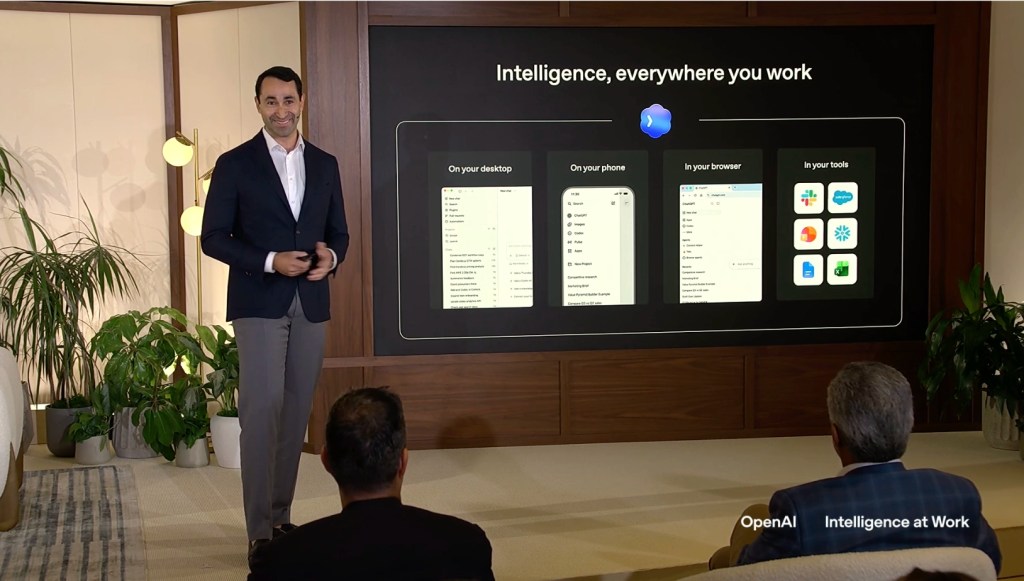
OpenAI made three announcements about using Codex for business today: the release of six new agent plugins, a new annotations feature, and a new sites feature. The announcements came during OpenAI’s Intelligence at Work livestream, which can be viewed here.
At the time of the announcement, the company shared that it plans to roll out Codex to the ChatGPT app everywhere “in the next few weeks.” It sounds like this means that more Codex functionality will come to ChatGPT than the two apps combined.
The idea seems to be that businesses know and use ChatGPT but may not know when to use Codex. Bringing Codex functionality to ChatGPT should help clarify how tools are connected.
Six new business plugins for Codex
OpenAI also shared the availability of new business-focused Codex plugins. This includes marketing, data analysis, creative production, product design, public equity investing, and investment banking.
Here’s an OpenAI summary of each plugin launched today:
- The data analytics plugin helps analysts and business teams answer questions with data. They can examine product and business data, explain why key metrics have changed, and create reports and dashboards using tools like Snowflake, Databricks Genie, Hex, and Tableau, with more coming soon.
- The creative output plugin helps marketing and creative teams to quickly transform assets they can’t update. Teams can create campaign boards, create and optimize display ad variations, and produce product lifestyle shots or ecommerce-ready photo sets with tools like Figma, Canva, Shutterstock, Picsart, and Fal.
- The sales plugin helps sales teams bring customer content to work that drives deals forward. Sales teams can find the most important accounts and signals, prepare customer meetings, complete follow-ups, review customer records, create close plans, and review potential deals using tools like Salesforce, HubSpot, Slack, Outreach, Clay, Rox, and Actively.
- The product design plugin is designed to turn early ideas into prototypes that teams can review. Teams can test product specifications, test user flows, prototype from a live URL, and create interactive static screenshots, with work that can be advanced with tools like Figma and Canva.
- I social equity investment plugin helps investors make sense of market and company information. They can review earnings, compare companies, track signals, and assess whether the investment thesis is strengthening or weakening using information from Moody’s, Daloopa, Datasite, FactSet, LSEG, S&P, PitchBook, and Hebbia.
- The investment banking plugin helps banks turn research and diligence into customer-friendly products. They can adjust parameters, analyze comparable companies and jobs, and turn due diligence into recommendations using reliable data.
You can read more about each new plugin here. You can find all Codex plugins here.
Annotations and sites with the Codex
Additionally, the Codex highlights two features that businesses can use at work: annotations and sites.
OpenAI points out how annotations are already being used by developers and how businesses can benefit:
Developers already use annotations in Codex to improve the code, Markdown files, and websites that Codex builds. With annotations, you identify the exact part you want to refine and tell Codex what to change. That functionality now extends to the content you create, such as documents, spreadsheets, and slides.
Select the navigation bar on the site and ask Codex to update the font. Highlight the claim in the investment thesis and ask the Codex where it comes from. Label the chart on the slide and ask for a clearer label. Codex focuses the update on the part you’ve chosen, so you can refine your work without starting over or retooling the parts you already love. Annotations make the Codex very useful after the first draft, when the work requires judgment, feedback, and iteration.
A new feature of sites is the way to use Codex to easily create shared data using the application:
Starting in preview for business and enterprise customers, Codex can now build and share interactive websites and applications.
Sites are a new kind of canvas for your ideas. Codex can take your ideas, analyses, and plans and turn them into dashboards, editors, review workspaces, project boards, galleries, and lightweight tools. Today, sites can be shared with anyone in your workplace via a URL, giving teams a shared space to review work, provide input, track progress, and make decisions together.
You can learn more about the latest OpenAI tools for Codex and ChatGPT for business here.
In May, OpenAI brought Codex for Mac and Windows remote control to ChatGPT for iPhone, iPad, and Android.


FTC: We use auto affiliate links to earn income. More.