
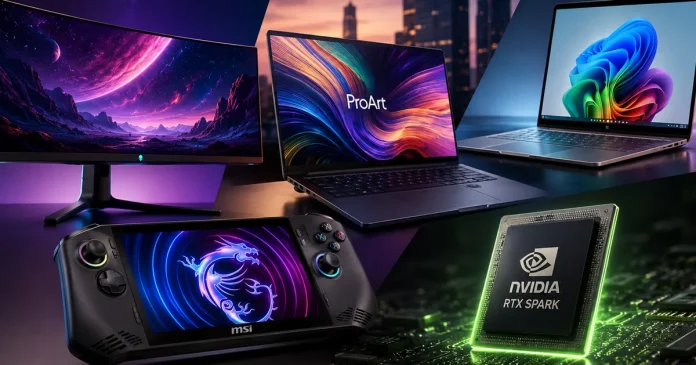

Every year, Computex promises the next big thing. Sometimes that means another processor with a few more cores, a lighter 200-gram laptop, or a monitor that’s somehow faster than the one before it. But every so often, a trade show is not surprising with one product, but with an entire category that suddenly feels new. That’s how Computex 2026 felt to me.
After spending days walking the show, trying out products, talking to engineers, and inevitably getting lost between booths more times than I’d like to admit, one thing became clear. The big news wasn’t about incremental improvements. They were talking about divisions, finally discarding the old compromise. Monitors became smarter, mobile devices became more mature, creative laptops became more versatile, and ARM processors began to look like real powerhouses instead of alternatives.
Guardians are finally solving problems instead of chasing numbers
For years, game consoles have been chasing big numbers, but at Computex 2026, the focus has finally shifted to solving real-world problems and making shows truly diverse. Alienware’s new AW3926QW perfectly captures that philosophy. Billed as the world’s first 39-inch 5K OLED gaming monitor with RGB-stripe Tandem OLED technology, it uses a four-stack, three-subpixel RGB-stripe tandem panel that not only increases the brightness and longevity of the panel but also improves color purity compared to conventional OLED use. It’s the kind of monitor that refuses to make gamers choose between eye candy and esports performance.
MSI took a different route with the MPG OLED 322URDX36, proving that flexibility could be the next big battlefield. Powered by a 5th generation QD-OLED panel with Penta Tandem technology and RGB Stripe sub-pixel structure, it offers three different personalities in one package: 4K at 360Hz, 1440p at 520Hz, and an almost unbelievable 1080p at 680Hz. MSI has also added thoughtful touches like Dark Armor Film, an AI Care Sensor to protect the OLED panel, and a brightness of up to 1,500 nits, making it one of the smartest displays on the show floor.
For competitive gamers, however, ASUS may steal the spotlight with the ROG Strix OLED XG259QWPG Ace. The 24.5-inch esports-focused display has a refresh rate of 540Hz with fast OLED response times, effectively eliminating the old compromise between image quality and competitive performance. ASUS has even engraved alignment marks on the stand, allowing pro gamers to recreate their desk setups exactly at tournaments down to the millimeter, a small but really clever feature that shows how focused this monitor is on esports.

Then there’s the technology that works quietly behind the scenes. MediaTek’s new MT9820 has attracted a lot of attention as the world’s first 5K AI scale-up chip, developed in collaboration with NVIDIA. Rather than simply stretching low-resolution content, it uses AI-powered processing to intelligently reconstruct details and sharpen images in real-time, making games and videos look noticeably cleaner on high-resolution displays while paving the way for intelligent, AI-assisted monitors of the future. If this is where display technology is headed, I’m more than happy to keep staring at screens.
Portable gaming PCs are finally working like adults
The biggest story in the portable gaming space at Computex 2026 was the silicon that powers it. Intel’s Arc G3 Extreme stole the spotlight by signaling the company’s serious push into portable gaming at the moment. Purpose-built for Panther Lake design and Intel 18A process, it includes a 14-core CPU with Arc B390-class graphics powered by 12 Xe3 cores, while bringing features such as hardware ray tracing and XeSS 3 with Multi Frame Generation to integrate gaming machines. If my runtime was anything to go by, Intel has finally arrived as a real contender in the mobile space.

That silicon was brought to life by the MSI Claw 8 EX AI+ and the Acer Predator Atlas 8, both of which felt incredibly polished during my hands-on experience. The Atlas stands out for its comfortable ergonomics, 8-inch 120Hz display, 89-blade AeroBlade cooling system, and smart dual-mode triggers that switch between microswitch and analog inputs. MSI’s latest Claw, on the other hand, feels like a complete rethink with improved ergonomics, refined software, and a larger 80Wh battery that should help address one of handheld gaming’s biggest pain points.

Even ASUS’ ROG Xbox Ally X20 Anniversary Edition emphasized the same message: portable gaming PCs are no longer experimental gadgets trying to prove themselves. With better silicon, smarter cooling, improved ergonomics, and increased console-like software experience, the entire category feels like it’s finally growing.
Creative laptops no longer force creatives to take risks
Creators’ laptops at Computex 2026 felt less like high-capacity mobile workstations and more like lean productivity machines. For example, ASUS’s latest ProArt system embraces this change by combining powerful hardware, beautiful OLED displays, and dedicated local AI acceleration that can handle tasks like photo editing, video development, and content production directly on the device without ever relying on the cloud.

The MSI Prestige series takes a more workflow-focused approach with the addition of the Nano Pen, turning the laptop into a responsive digital canvas for artists, designers, and note-takers. A simple add-on, but one that makes drawing and annotation feel more natural than a productivity laptop. There’s also Dell’s refreshed XPS 16 (2026), which continues to blur the line between premium design and professional performance by adopting a Tandem OLED display, which delivers higher brightness and improved longevity while maintaining the clean, minimalist aesthetic that the XPS family is known for.

Perhaps the most ambitious of the lot is Microsoft’s Surface Laptop Ultra, which can be configured with up to 128GB of integrated memory and a heavy emphasis on local AI processing. The result is a compact machine that can handle heavy creative and AI workloads without constantly relying on cloud infrastructure, making it feel more like a mobile workstation than a regular laptop.
ARM is taking the fight straight to x86
A few years ago, ARM processors were mostly associated with high-performance smartphones and laptops. At Computex 2026, however, they emerged as one of the most exciting places to innovate. Qualcomm’s new Snapdragon C platform continues to push ARM into mainstream Windows PCs, offering improved battery life, built-in AI capabilities, and a more efficient computing experience.

The real highlight, however, was NVIDIA’s RTX Spark, which felt less like another processor launch and more like a glimpse into the future of computing. Built on a 20-core Grace CPU paired with Blackwell-based RTX graphics and capable of delivering one petaflop of local AI computing, RTX Spark is designed to run massive AI models directly on the device rather than always relying on cloud servers. During NVIDIA’s demos, it effortlessly managed AI-assisted creative flow, large language model reduction, and robust applications, showing how much can now be processed locally.

What impressed me even more was how naturally AI meshed with it. Instead of waiting for remote servers to generate results, operations happen almost immediately on the hardware itself, reducing latency while improving privacy and reliability. Another highlight for me was playing Fortnite on an RTX Spark powered system, and the experience felt incredibly fluid. More importantly, NVIDIA has confirmed that it is working with developers and anti-cheat providers to ensure proper anti-cheat support, addressing one of the biggest obstacles that has held Windows back in the ARM game. If these early demos are any indication, the RTX Spark could redefine what creators, developers, and even gamers expect from an ARM-powered PC in the next few years.
True Radiance
Looking back at Computex 2026, the biggest story was not a single gadget but the direction the industry is headed. Companies seem less focused on chasing fancy numbers and more interested in solving real problems. OLED panels are getting brighter without sacrificing longevity, handhelds are becoming more efficient, creative laptops are adding more power to smaller designs, and ARM processors are finally emerging as reliable opponents to x86. Of course, none of this innovation will come cheap, and prices will ultimately determine how quickly this technology reaches the mainstream. Still, I left the show feeling really hopeful. For the first time in years, it feels like the industry isn’t just building faster gadgets, it’s building smarter and better ones.