
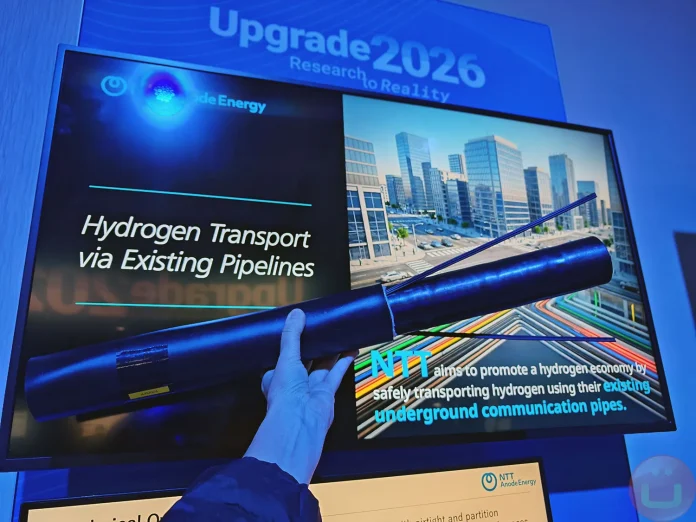

At NTT Research Upgrade 2026, I met the group behind NTT Anode Energy research on hydrogen pipeline transportation. They showed me part of the a pipe made of resin Company plans to install in the existing underground telephone lines, which helped me understand better how the technology will be used.
Hydrogen it is often presented as a promising source of clean energy, but delivering it safely and at an affordable cost remains a major challenge. It is not a primary fuel source in the conventional sense, but a source of energy that can be produced from water, biomass, or fossil fuels. When used in fuel cells to generate electricity, it produces only water and heat, not CO2, at the point of use, which is one reason why it remains at the center of many decarbonization programs.
That is very important to Japan, which it’s been investing money a lot to hydrogen as its component pushing for a long time in carbon neutralitygreater energy security, and industry leadership in fuel-cell and hydrogen-related technologies.
NTT Anode Energy is working on a solution that can help reduce one of the major bottlenecks of hydrogen infrastructure with by using existing underground infrastructure instead of relying entirely on newly developed hydrogen pipelines.

The idea is to transport hydrogen through resin-based pipes that are installed in existing utility or communication lines. That’s important because building new hydrogen pipelines is expensive, and the researchers explain that drilling is a big part of the cost. By avoiding large-scale drilling, NTT believes it can make hydrogen delivery more efficient and cost-effective.
Safety is a central part of the project. According to the company’s materials and the interview of researchers, i the system includes airtight transport pipes and monitoring technologyincluding pressure and hydrogen sensors, and optical-fiber-based leak detection. The team also said that the flexible design of the pipes makes it easy to install them in existing subways. Testing is already underway in the Tokyo area.
NTT projects that the technology could eventually cut initial costs by nearly half compared to conventional methods of supplying steel pipes, while the cost of use can be reduced by almost one third. The overarching goal is to support a hydrogen supply chain that is safe, sustainable, and economically viable.
I technologies were also shown at Expo 2025 Osakawhere NTT installed a renewable energy plant on its property to produce hydrogen on site. That hydrogen-bonded energy is stored in a Panasonic fuel cell and transported through 200 meter underground pipe from the NTT platform of Panasonic Group platformwhen it powers the LED lights.

Panasonic illuminated pavilion at Osaka 2025 Expo – part of the NTT / Panasonic hydrogen infrastructure – Photo Courtesy of Panasonic
Filed . Read more about Energy, Fuel Cell, Green, Hydrogen, NTt, NTT Research Development, Sensor and Sustainability.